, to see if you have full access to this publication.
Book Titles No access
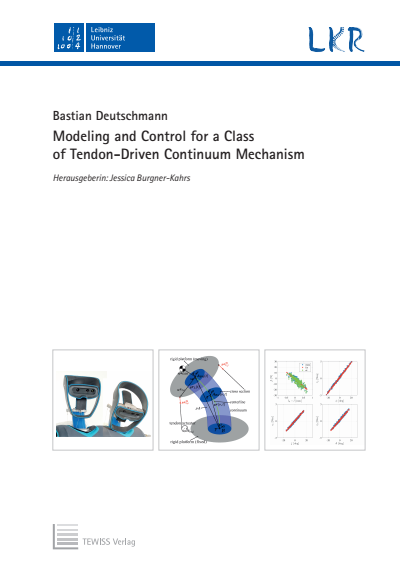
Modeling and Control for a Class of Tendon-Driven Continuum Mechanism
- Authors:
- Publisher:
- 2020
Keywords
Search publication
Bibliographic data
- Edition
- 1/2020
- Copyright year
- 2020
- ISBN-Online
- 978-3-95900-476-3
- Publisher
- TEWISS, Garbsen
- Language
- German
- Pages
- 223
- Product type
- Book Titles
Table of contents
ChapterPages
- Preface No access
- Abstract No access
- Kurzfassung No access
- Contents No access
- List of symbols No access
- 1.1.1 Modeling of continuum mechanisms No access
- 1.1.2 State estimation of continuum mechanisms No access
- 1.1.3 Control of continuum mechanisms No access
- 1.2.1 Modeling No access
- 1.2.2 State estimation No access
- 1.2.3 Control No access
- 1.3 Organization of the work No access
- 2.1.1 Elastic Continuum Mechanism No access
- 2.1.2 Tendon actuation system No access
- 2.2.1 Planar testbed No access
- 2.2.2 Spatial testbed No access
- 2.3 Summary No access
- 3.1.1 Beam Kinematics No access
- 3.1.2 Head Kinematics No access
- 3.1.3 Constitutive equations No access
- 3.2.1 Internal forces No access
- 3.2.2 External forces No access
- 3.2.3 Dynamic forces No access
- 3.2.4 Summary No access
- 3.3 Discretization No access
- 3.4.1 Identification process No access
- 3.4.2 Neo-Hookean compression stiffness No access
- 3.4.3 Planar System No access
- 3.4.4 Spatial system No access
- 3.5.1 Workspace analysis of the planar system No access
- 3.5.2 Dynamic characteristic of the planar system No access
- 3.5.3 Torsional workspace of the spatial system No access
- 3.5.4 Kinematic approximation of the spatial workspace No access
- 3.5.5 Computation time No access
- 3.6 Summary No access
- 4.1 Assumptions & model reduction No access
- 4.2.1 Admissible wrench set No access
- 4.2.2 Simulation No access
- 4.2.3 Experimental design No access
- 4.2.4 Experimental results No access
- 4.3.1 Motor dynamics No access
- 4.3.2 Tendon coupling No access
- 4.4 Summary No access
- 5.1.1 Length sensors No access
- 5.1.2 Force torque sensor No access
- 5.1.3 Inertial measurement unit No access
- 5.2.1 Optimization algorithms No access
- 5.2.2 Reduced kinematic models No access
- 5.2.3 Six DoF kinematic model No access
- 5.3 State estimation based on static models No access
- 5.4.1 State space equations No access
- 5.4.2 Extended Kalman Filter No access
- 5.4.3 Summary No access
- 5.5.1 Sensor accuracy and initialization No access
- 5.5.2 Reaching static poses No access
- 5.5.3 Actuated dynamic motion No access
- 5.5.4 Manual interaction No access
- 5.6 Discussion and summary No access
- 6.1.1 Control structure No access
- 6.1.2 Set point generation No access
- 6.1.3 Desired performance No access
- 6.2 Tendon tension control No access
- 6.3 H-synthesis using a structured description of nonlinearities No access
- 6.4.1 Input Output Normal Form No access
- 6.4.2 Partial feedback linearization No access
- 6.4.3 Passivity based approach No access
- 6.5 Feedforward compensation of the continuum No access
- 6.6.1 Experimental setup No access
- 6.6.2 Steady state accuracy No access
- 6.6.3 Transient behavior No access
- 6.6.4 External disturbances No access
- 6.7.1 Preliminary study: SISO systems No access
- 6.7.2 Application onto MIMO systems No access
- 6.8.1 Projection of pretensions No access
- 6.8.2 Generation of suitable set points No access
- 6.9 Summary No access
- 7 Summary & outlook No access Pages 175 - 182
- A.1 Example 1: Planar system No access
- A.2 Example 2: Spatial system No access
- B.1 Experimental setup No access
- B.2.1 Pose measurement and calibration No access
- B.2.2 Wrench measurement and calibration No access
- B.3.1 Comparison of Planning Strategies No access
- B.3.2 Comparison of Control Strategies No access
- Bibliography No access Pages 207 - 223