, to see if you have full access to this publication.
Monograph No access
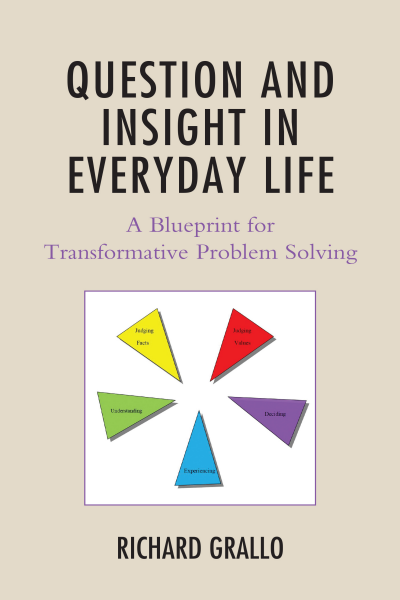
Question and Insight in Everyday Life
A Blueprint for Transformative Problem Solving
Authors:
Publisher:
2021
Summary
In Question and Insight in Everyday Life: A Blueprint for Transformative Problem Solving, Richard Grallo examines the nature and patterns of human problem solving. Grallo identifies four patterns of problem solving that together result in complex human learning and growth. The four patterns constitute a cycle that is transformative not only of problematic situations but of the problem solvers themselves. This book also explores the roles of questions, insights, the desire to know, and social trust in problem solving. Its conclusions apply equally to the problems of everyday life as well as to challenges that arise in educational, counseling, political, engineering, and science fields.
Keywords
Search publication
Bibliographic data
Edition
1/2021
Copyright Year
2021
ISBN-Print
978-1-7936-4390-2
ISBN-Online
978-1-7936-4391-9
Publisher
Lexington, Lanham
Language
English
Pages
182
Product Type
Monograph
Table of contents
ChapterPages
Dedication No access
Contents No access
Figures No access
Tables No access
Acknowledgments No access
Introduction No access Pages 1 - 4
Initial Considerations No access
Problem Solving Is a Learning Process No access
Mental Events in Problem Solving No access
Patterns of Problem Solving and a Mode of Pause No access
The Four Patterns of Problem Solving in Functional Relation to One Another No access
Patterns of Problem Solving in Larger Contexts No access
Ensuring Problem Solving Quality No access
Additional Considerations: Predictions No access
Notes No access
Introduction No access
Goals and Objectives No access
Limitations No access
Setting a Context for Understanding No access
Pattern 1: Seeking Understanding by Considering Possibilities No access
Additional Considerations: Key Points and Implications No access
Summary No access
Notes No access
Introduction No access
Some Background for Critical Thinking No access
Elements of Critical Thinking No access
Pattern 2: Factual Critical Thinking: When Possibilities Are Not Enough No access
Pattern 3: Values-Oriented Critical Thinking: When Truth Is Not Enough No access
Pattern 4: Deliberative Critical Thinking: When Good Intention Is Not Enough No access
Additional Considerations No access
Summary No access
Notes No access
Functions of Experience in Overview No access
Experience as Source and Resource for Learning No access
Experience as Testing Ground for Learning No access
Experience as Pause from Learning No access
Organization of Experience as Modes of Pause No access
Additional Considerations: Implications No access
Summary No access
Notes No access
Overview of Larger Contexts No access
Personality as Context No access
Social Trust as Context No access
Culture as Context No access
History as Context No access
Additional Considerations: Key Points and Some Implications No access
Summary No access
Notes No access
Two Illustrative Examples: Overview No access
Epictetus No access
Locke and Latham’s High Performance Cycle No access
Additional Considerations: Key Points and Implications No access
Summary No access
Notes No access
Summary Remarks on Transformative Problem Solving: Introduction No access
Recapitulation of Major Themes of Chapters 1–6 No access