, to see if you have full access to this publication.
Edited Book No access
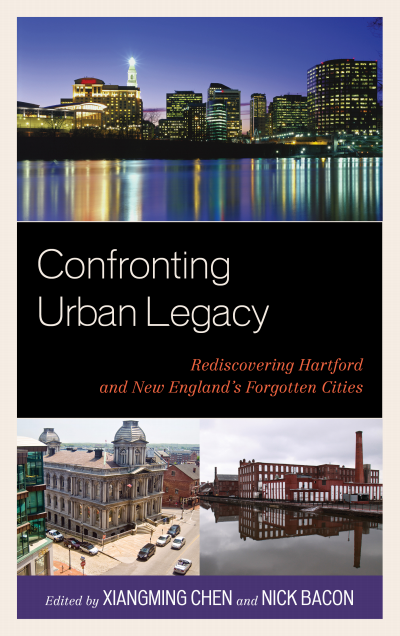
Confronting Urban Legacy
Rediscovering Hartford and New England's Forgotten Cities
Editors:
|
Publisher:
2013
Summary
Confronting Urban Legacy fills a critical lacuna in urban scholarship. As almost all of the literature focuses on global cities and megacities, smaller, secondary cities, which actually hold the majority of the world’s population, are either critically misunderstood or unexamined in their entirety. This neglect not only biases scholars’ understanding of social and spatial dynamics toward very large global cities but also maintains a void in students’ learning. This book specifically explores the transformative relationship between globalization and urban transition in Hartford, Connecticut, while including crucial comparative chapters on other forgotten New England cities: Portland, Maine, along with Lawrence and Springfield, Massachusetts. Hartford’s transformation carries a striking imprint of globalization that has been largely missed: from its 17th century roots as New England first inland colonial settlement, to its emergence as one of the world’s most prosperous manufacturing and insurance metropolises, to its present configuration as one of America’s poorest post-industrial cities, which by still retaining a globally lucrative FIRE Sector is nevertheless surrounded by one of the nation’s most prosperous metropolitan regions.
The myriad of dilemmas confronting Hartford calls for this book to take an interdisciplinary approach. The editors’ introduction places Hartford in a global comparative perspective; Part I provides rich historical delineations of the many rises and (not quite) falls of Hartford; Part II offers a broad contemporary treatment of Hartford by dissecting recent immigration and examining the demographic and educational dimensions of the city-suburban divide; and Part III unpacks Hartford’s current social, economic, and political situation and discusses what the city could become. Using the lessons from this book on Hartford and other underappreciated secondary cities in New England, urban scholars, leaders, and residents alike can gain a number of essential insights—both theoretical and practical.
Keywords
Search publication
Bibliographic data
Edition
1/2013
Copyright Year
2013
ISBN-Print
978-0-7391-4942-3
ISBN-Online
978-0-7391-4944-7
Publisher
Lexington, Lanham
Language
English
Pages
308
Product Type
Edited Book
Table of contents
ChapterPages
Contents No access
Illustrations No access
Acknowledgments No access
Prologue No access
Chapter 1. Introduction: Once Prosperousand Now Challenged: Hartford’s Transformation in Comparative and Global Perspectives No access Pages 1 - 20
Chapter 2. Hartford: A Global History No access Pages 21 - 45
Chapter 3. Podunk after Pratt: Place and Placelessness in East Hartford, Connecticut No access Pages 46 - 64
Chapter 4. “If We Would . . . Leave the City, This Would Be a Ghost Town”: Urban Crisis and Latino Migration in Lawrence, Massachusetts, 1945–2000 No access Pages 65 - 84
Chapter 5. Poverty, Inequality, Politics, and Social Activism in Hartford No access Pages 85 - 109
Chapter 6. Investigating Spatial Inequality with the Cities, Suburbs, and Schools Project No access Pages 110 - 126
Chapter 7. The Puerto Rican Effect on Hispanic Residential Segregation: A Study of the Hartford and Springfield Metro Areas in National Perspective No access Pages 127 - 144
Chapter 8. A Metro Immigrant Gateway: Refugees in the Hartford Borderlands No access Pages 145 - 168
Chapter 9. Re-imagining Portland, Maine: Urban Renaissance and a Refugee Community No access Pages 169 - 192
Chapter 10. Shifting Fortunes: Hartford’s Global and Regional Economic Dimensions No access Pages 193 - 218
Chapter 11. A Tragic Dialectic: Politics and the Transformation of Hartford No access Pages 219 - 235
Chapter 12. Metropolitan Hartford: Regional Challenges and Responses No access Pages 236 - 258
Chapter 13. A Sobering Era with New Possibilities No access Pages 259 - 275
Chapter 14. Conclusion: Inheritance, Inertia, and Inspirations: The Potential Remaking of Hartford No access Pages 276 - 286
Index No access Pages 287 - 302
About the Editors and Contributors No access Pages 303 - 308