, to see if you have full access to this publication.
Monograph No access
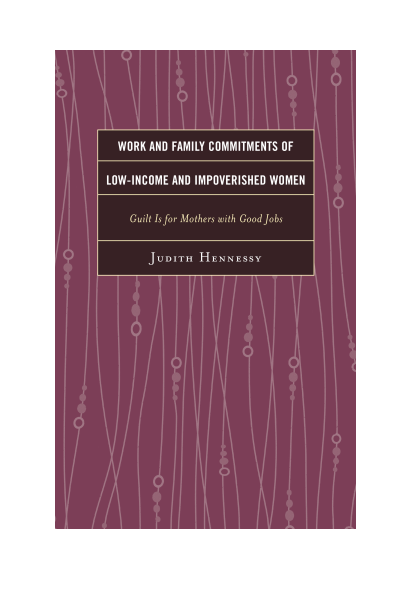
Work and Family Commitments of Low-Income and Impoverished Women
Guilt Is for Mothers with Good Jobs
Authors:
Publisher:
2015
Summary
Conflict between work and family life is an all too familiar experience for many Americans. The difficult choices facing women who combine paid work with childcare are the subject of a deluge of books and articles in addition to an ongoing public debate about how women and men should balance their work and family commitments. Although we know a great deal about the social and cultural environment fueling these contradictions among middle-class and upper middle class women, we know little about the forces that influence poor and low-income women. Work and Family Commitments of Low-Income and Impoverished Women addresses this omission and gives voice to women in poverty as it traces the moral and cultural structures that help shape the meaning and value of paid work and motherhood among a group of mothers who rely on welfare or a combination of low-wage work and welfare to provide and care for their families. This portrayal of poor women’s lives rarely enters the work-life debate over women’s choices, generally characterized as between mothers who have to work versus those who choose to. Judith Hennessy puts low-income women front and center to shed light on less explored aspects of the moral and cultural foundations of contemporary work and family conflict from interviews and survey data of a group of low-income and poor mothers on and off welfare.
Hennessey explores the paradox in American society where combining paid work with caring for children continues to generate considerable ambivalence (and often guilt) on the part of married middle-class mothers for devoting too much time to paid work and supposedly neglecting their children. While poor and working class mothers who might otherwise rely on welfare are relegated to working at low-wage jobs outside the home in fulfillment of their family responsibilities.
Search publication
Bibliographic data
Edition
1/2015
Copyright Year
2015
ISBN-Print
978-0-7391-8679-4
ISBN-Online
978-0-7391-8680-0
Publisher
Lexington, Lanham
Language
English
Pages
184
Product Type
Monograph
Table of contents
ChapterPages
Contents No access
1 The Paradox No access Pages 1 - 18
2 Historical Context No access Pages 19 - 36
3 Work Commitment No access Pages 37 - 66
4 Family Commitment No access Pages 67 - 96
5 Work and Family at the Welfare Office No access Pages 97 - 126
6 Survey Findings No access Pages 127 - 140
7 Conclusion No access Pages 141 - 156
Acknowledgments No access Pages 157 - 158
Methodological Appendix No access Pages 159 - 170
References No access Pages 171 - 178
Index No access Pages 179 - 184
Similar publications
from the topics "Soziologie allgemein"
Edited Book Full access
Karen Kastenhofer, Marius Albiez, Pauline Riousset, Constanze Scherz, Michael Decker