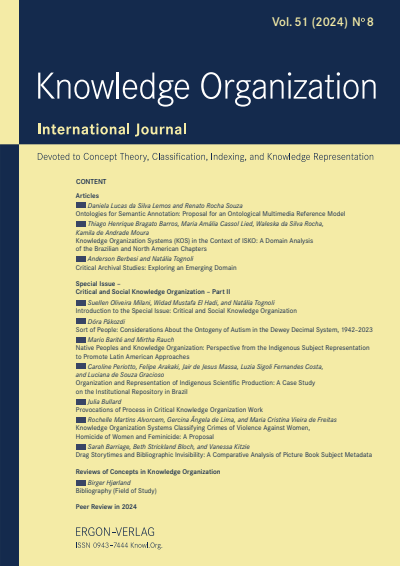
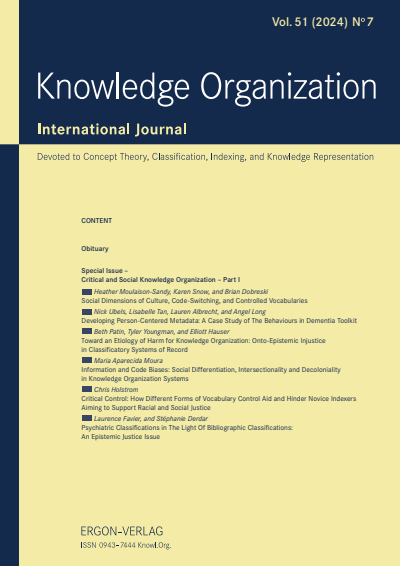
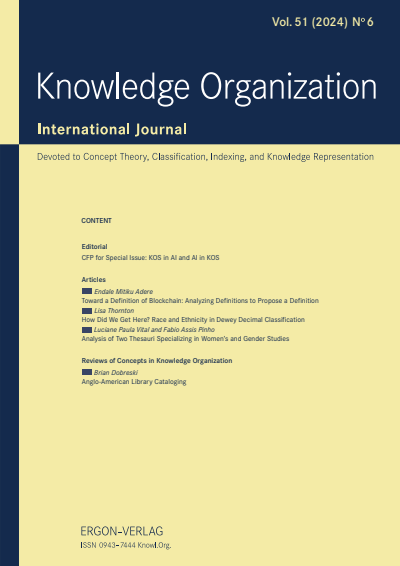
KNOWLEDGE ORGANIZATION is a forum for all those interested in the organization of knowledge on a universal or a domain-specific scale, using concept-analytical or concept-synthetical approaches, as well as quantitative and qualitative methodologies. KNOWLEDGE ORGANIZATION also addresses the intellectual and automatic compilation and use of classification systems and thesauri in all fields of knowledge, with special attention being given to the problems of terminology.KNOWLEDGE ORGANIZATION publishes original articles, reports on conferences and similar communications, as well as book reviews, letters to the editor, and an extensive annotated bibliography of recent classification and indexing literature.KNOWLEDGE ORGANIZATION should therefore be available at every university and research library of every country, at every information center, at colleges and schools of library and information science, in the hands of everybody interested in the fields mentioned above and thus also at every office for updating information on any topic related to the problems of order in our information-flooded times.
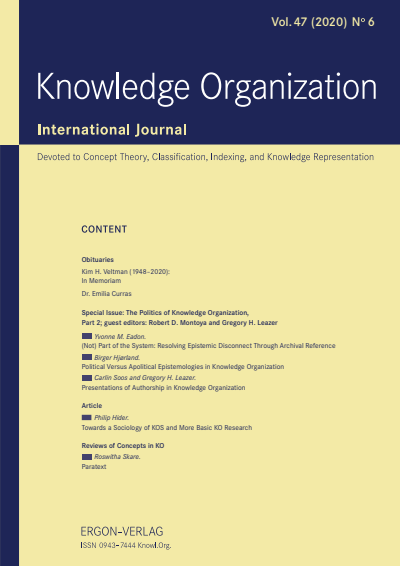
Information seeking practices of conspiracists are examined by introducing the new archival user group of “conspiracist researchers.” The epistemic commitments of archival knowledge organization (AKO), rooted in provenance and access/secrecy,...
Section 1 raises the issue of this article: whether knowledge organization systems (KOS) and knowledge organization processes (KOP) are neutral or political by nature and whether it is a fruitful ideal that they should be neutral. These questions...
The “author” is a concept central to many publication and documentation practices, often carrying legal, professional, social, and personal importance. Typically viewed as the solitary owner of their creations, a person is held responsible for...
It is suggested that the knowledge organization (KO) field places greater emphasis on basic research that examines the sociology of KO systems (KOS) and the broader, environmental reasons for the development of both formal and informal KOS. This...
This article presents Gérard Genette’s concept of the paratext by defining the term and by describing its characteristics. The use of the concept in disciplines other than literary studies and for media other than printed books is discussed. The...