, to see if you have full access to this publication.
Monograph No access
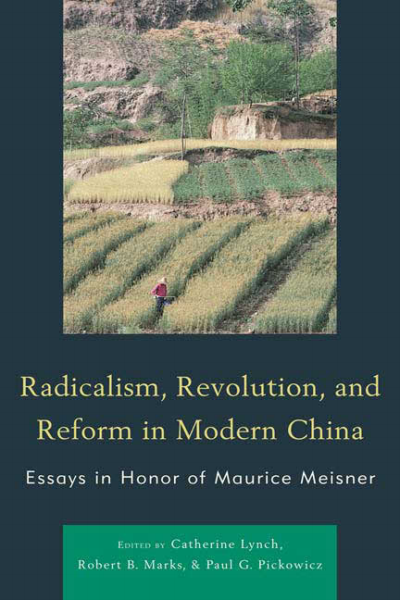
Radicalism, Revolution, and Reform in Modern China
Essays in Honor of Maurice Meisner
Authors:
| |
Publisher:
2011
Summary
This volume illuminates the relationship of China's radical past to its reformist present as China makes a way forward through very differently conceived and contested visions of the future. In the context of early twenty-first century problems and the failures of global capitalism, is China's history of revolutionary socialism an aberration that is soon to be forgotten, or can it serve as a resource for creating a more fully human and radically democratic China with implications for all of us? Ranging from the early years of China's revolutionary twentieth-century to the present, the essays collected here look at the past and present of China with a view toward better understanding the ideas, ideals, and people who have dared to imagine radical transformation of their worlds and to assess the conceptual, political, and social limitations of these visions and their implementations. The volume's chapters focus on these issues from a range of vantage points, representing a spectrum of current scholarship. The first half of the book brings new insights to understanding how early-twentieth century intellectuals interpreted ideas that allowed them to break with China's past and to envision new paths to a modern future. It treats of Chen Duxiu, a founder of the Communist party, Mao Zedong, and Mao in relation to the non-Communist Liang Shuming and with the Dalai Lama. With continuing threads of nation and nationalities, of peasants, utopias and dystopias linking the chapters, the book's second half looks broadly at the consequences of the implementations of radical ideas, at the same time critiquing our accepted frameworks of analysis. Moving up to the present, the book investigates the effects of the reforms since the 1980s on long-term environmental degradation and on the emergence of a capitalist rural economy. It gives an unsparing view into contemporary rural China through independent films. The book concludes with an analysis of the unshakable persistence of the shibboleth, 'the rise of China,' in popular and academic imagination and argues for the importance instead of taking seriously the twentieth-century history of radicalism in China and its significance for understanding China's present and its future potentials.
Search publication
Bibliographic data
Edition
1/2011
Copyright Year
2011
ISBN-Print
978-0-7391-6572-0
ISBN-Online
978-0-7391-6574-4
Publisher
Lexington, Lanham
Language
English
Pages
224
Product Type
Monograph
Table of contents
ChapterPages
Contents No access
Acknowledgements No access
Introduction: Chinese Radicalism in Historical Context No access Pages 1 - 10
1 Individualism and Nationalism in the Thought of Chen Duxiu, 1904–1918 No access Pages 11 - 28
2 Radical Visions of Time in Modern China: The Utopianism of Mao Zedong and Liang Shuming No access Pages 29 - 54
3 Peasant and Woman in Maoist Revolutionary Theory, 1920s–1950s No access Pages 55 - 78
4 Mao and Tibet No access Pages 79 - 104
5 Chinese Communists and the Environment No access Pages 105 - 132
6 Post-Socialist Capitalism in Rural China No access Pages 133 - 160
7 Independent Chinese Film: Seeing the Not-Usually-Visible in Rural China No access Pages 161 - 184