, to see if you have full access to this publication.
Monograph No access
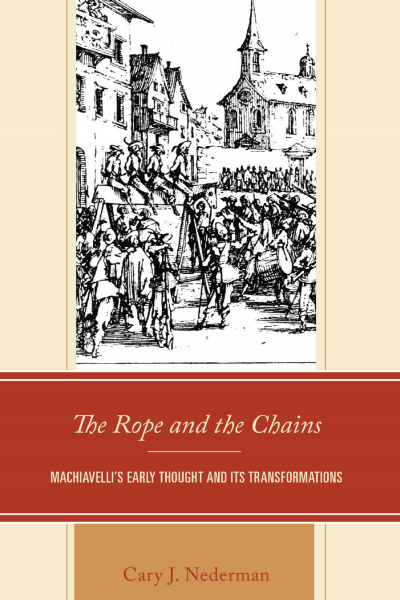
The Rope and the Chains
Machiavelli’s Early Thought and Its Transformations
Authors:
Publisher:
2023
Summary
Niccolò Machiavelli counts among the most famous (and infamous) political authors in the history of Western political thought, primarily on account of his book the Prince. Before he wrote that notorious treatise, however, he served for fourteen years as a prominent and active civil administrator in the government of the Republic of Florence. Removed from office in 1512, following a take-over by the Medici dynasty that had ruled the city during much of the fifteenth century, Machiavelli was incarcerated and tortured as a result of unsubstantiated accusations of his involvement in a coup plot. Soon after his release from prison, he composed the Prince, which is generally seen to constitute the beginning of his career as a political theorist as well as a comic playwright, poet and military analyst of note. Yet little attention has been devoted to the large body of writings—in the form of prose and poetry, as well as the hundreds of pages of diplomatic and personal correspondence—that he produced in the course of his public service. In an unprecedented interpretation, The Rope and the Chains carefully examines the neglected pre-Prince texts in order to frame his later theories. The book reveals that Machiavelli’s thought prior to the Prince was largely conventional when judged by the standards of his day. At the same time, it also demonstrates his dissatisfaction with the intellectual worldview in which he was enmeshed. Machiavelli “became” Machiavelli once liberated from the rope and the chains by which centuries of tradition had constrained him.
Keywords
Search publication
Bibliographic data
Edition
1/2023
Copyright Year
2023
ISBN-Print
978-1-7936-1724-8
ISBN-Online
978-1-7936-1725-5
Publisher
Lexington, Lanham
Language
English
Pages
154
Product Type
Monograph
Table of contents
ChapterPages
Contents No access
Preface No access
Texts and Abbreviations No access
Introduction No access Pages 1 - 14
Before Virtù No access Pages 15 - 36
The Road to Vivere Libero No access Pages 37 - 62
Say Your Prayers No access Pages 63 - 86
The Medicine Man No access Pages 87 - 108
Facing the “Twin Furies” No access Pages 109 - 132