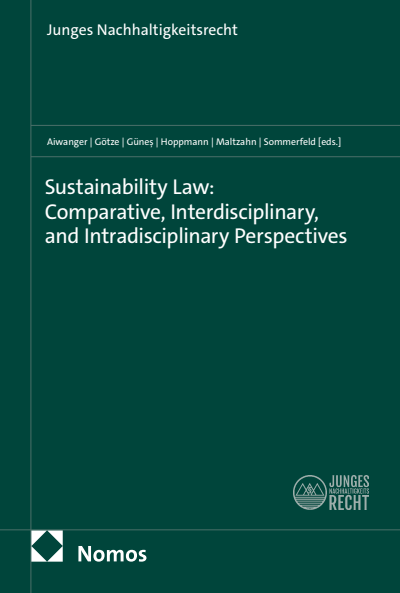
Sustainability Law: Comparative, Interdisciplinary, and Intradisciplinary Perspectives
- Editors:
- | | | | |
- Series:
- Junges Nachhaltigkeitsrecht, Volume 4
- Publisher:
- 2026
Summary
Promoting sustainable development is one of the most complex challenges we face. Feasible and effective solutions require an international and interdisciplinary understanding. The fourth volume of the Young Sustainability Law Conference aims to contribute to legal research in this field. It brings together contributions from early career researchers from around the world who take an in-depth look at comparative, interdisciplinary and intradisciplinary aspects of sustainability law. The overarching goal of the contributions is to open up new perspectives for sustainability law and its further development. Simultaneously, the volume highlights the major transformative potential of sustainability law and need for further research in this area.
With contributions by Maha Balbaa | Vincent-Carlos Barduhn | Nora Bouzoraa | Isadora Camplà | Vítor de Souza Ishikawa | Marlon Dreisewerd | Bahar Ferahköse | Jebby Gonza | Anita Grigoryan | Jamal Hajiyev | Yassine Hasnaoui | Sameh Mansour | Isadora Camplà Morale | Sanjeet Ruhal | María Elisa Morales | Sara Moreno | André Noellkaemper | Kate O'Reilly | Aneta Paleczna-Zgonina | Riccardo Rao | Melina Schleef | Shuma Talukdar | Oskar Zgonina
Search publication
Bibliographic data
- Edition
- 1/2026
- Copyright Year
- 2026
- ISBN-Print
- 978-3-7560-3566-3
- ISBN-Online
- 978-3-7489-6626-5
- Publisher
- Nomos, Baden-Baden
- Series
- Junges Nachhaltigkeitsrecht
- Volume
- 4
- Language
- English
- Pages
- 292
- Product Type
- Edited Book
Table of contents
- The Conference Programme
- Acknowledgements
- Authors:Download chapter (PDF)
- A. Death by a thousand cuts: understanding cumulative environmental harm
- B. A problem of many hands: diffusion of responsibility for cumulative environmental harm
- C. System failure by design: when international law produces what it fails to prevent
- D. Tilting the system: incremental responses to cumulative harm in international law
- E. Conclusion
- Authors:Download chapter (PDF)
- A. Introduction
- I. Environmental issues
- II. Social issues
- C. Extraterritorial impact of CSRD and CSDDD
- D. Lessons from France´s Duty of Vigilance Act and India’s Utthan Pact
- E. Legal reforms for worker protection and compliance
- F. Conclusion
- Authors:Download chapter (PDF)
- A. Introduction
- I. Impact of Indigenous Knowledge on the biodiversity legal regime
- II. Legal expressions of sustainability’s intergenerational dimension
- III. Ontological paradigms shaping legal relationships with the environment
- I. Limited recognition of Indigenous Peoples in the economic apparatus
- II. Challenges of transculturation under economic frameworks
- III. Procedural obstacles to the recognition of Indigenous legal systems
- IV. Functional dissonance between International Economic and Environmental Law
- D. Conclusion
- Authors: |Download chapter (PDF)
- A. Why traditional consumer law falls short in the face of the climate crisis: A comparative perspective to inspire a Chilean proposal
- B. Methodological approach and article structure
- I. Two preliminary clarifications on the concept of sustainable consumer law
- II. Formulating the functional research question
- III. Construction of the comparative framework: Chile and France
- a) The French approach to sustainable consumer law
- b) Enforcement mechanisms and projections of effectiveness
- 2. Chile
- 1. Misleading environmental claims and greenwashing
- 2. Consumer information and environmental labelling
- 3. Product durability and repairability
- 4. Waste prevention and fast fashion controls
- VI. Reflections and lessons for Chile
- Authors:Download chapter (PDF)
- A. Introduction
- I. Main features and limitations
- II. How widespread are collective hybrids at present?
- I. The permissive pattern: Denmark
- II. The halfway pattern: Germany
- III. The hostile pattern: Italy, France and the US
- IV. Comparative outlook: advancements in the regulatory framework (albeit slowly)
- I. Comparatively high ESG (and no worse financial) performance
- II. Policy proposals: with a focus on charity enterprise foundations
- Authors:Download chapter (PDF)
- A. Introduction
- I. Recognition of the right to water
- II. Sustainable development and water
- I. Corporations as stewards of water sustainability
- II. Integrating Sustainability Practices in Corporate Water Governance
- I. European Union (EU)
- II. Association of Southeast Asian Nations (ASEAN)
- III. East African Community (EAC)
- E. Conclusion: Evaluation and synergy
- Authors:Download chapter (PDF)
- A. Introduction: the ocean’s dilemma
- I. Historical development: From mare liberum to a common heritage
- II. Part XI of UNCLOS: codifying the common heritage
- III. The role and regulations of the International Seabed Authority
- IV. Current legal challenges and the regulatory gap
- C. DSM: necessities v. uncertainties
- D. Geopolitics as the new battleground
- E. Conclusion: Charting a sustainable course
- Authors: |Download chapter (PDF)
- A. The European ‘right to repair’
- B. The warranty rights of the Sale of Goods Directive
- C. The incentive mechanism of the Repair Directive
- D. Interdisciplinary research on the effectiveness of the incentive mechanism
- E. The hidden deficiencies of the incentive mechanism
- F. Conclusion
- Authors: |Download chapter (PDF)
- A. Introduction
- I. Behavioural economics and environmental law
- II. Neuroscience of environmental decision-making
- III. Legal compliance and behavioural insights
- I. Theoretical foundation
- II. Framework Components
- I. Tier one: cognitive bias mitigation
- II. Tier two: social norm integration
- III. Tier three: default optimisation
- E. Policy implications
- F. Economic efficiency considerations
- G. Conclusion
- Authors:Download chapter (PDF)
- A. Introduction
- I. Traditional IIAs and their sustainability gaps
- II. Modernisation of investment treaties in pursuit of sustainable development
- I. Classic treaty-based mechanisms
- II. Complementary and emerging mechanisms
- D. Challenges and prospects
- E. Conclusion
- Authors:Download chapter (PDF)
- A. Introduction
- B. Climate stress tests
- a) System wide analysis and closing information gaps
- b) Forward-looking analysis
- c) Scenario development and international cooperation
- a) Radical uncertainty
- b) Other methodological challenges
- a) Evidence based regulatory intervention and legal legitimacy
- b) Incentives for banks and investors
- a) Environmental impacts vs. financial risk and return
- b) Lack of regulatory action
- c) Gaming the methodologies
- D. Conclusion
- Authors: |Download chapter (PDF)
- A. Introduction
- I. A growing insurance gap
- II. Consequences of the insurance gap
- I. The public model
- II. The private model
- III. The mixed model
- IV. The international model
- I. Germany and Poland
- II. Switzerland
- III. Spain
- IV. France
- I. The voluntary model
- II. The compulsory model
- III. Arguments for and against introducing a requirement to take out insurance
- I. The constitutional aspects
- II. The EU law perspective
- III. The hybrid model conception
- IV. The role of prevention and education
- V. The significance of insurance in mitigating the consequences of natural disasters
- G. Conclusions and recommendations
- Authors:Download chapter (PDF)
- A. Introduction
- B. The legal good theory (Rechtsgutslehre) as a limit to the state’s power to criminalise conduct
- C. Future generations in the legal good theory discourse
- D. Two definitions of ‘future generations’
- E. Protecting future generations through protecting present generations
- F. Serious environmental crimes as crimes against future generations: human-made natural disasters, ecocide, and climate crimes
- G. Conclusive remarks
- Authors:Download chapter (PDF)
- A. Introduction
- I. Under the Rome Statute
- II. Fragmented domestic approaches
- I. Domestic jurisdiction and legal reform
- II. Regional Environmental Tribunals (RETs)
- III. International Tribunal for Ecocide (ITE)
- I. Treaty-based institutionalization
- II. Evidence and Adjudication for Ecocide
- III. Integration of the proposed model into existing legal and political systems
- IV. Roadmap for implementation and next steps
- E. Conclusion
- Authors: |Download chapter (PDF)
- A. Introduction
- I. General obligations
- II. Situation specific obligations
- III. Protection of property rights
- I. Sustainable retrofitting in Dutch rental law
- II. Condominium law and indirect sustainability obligations
- III. Is private law regulation the way forward?
- D. Conclusion
- Authors:Download chapter (PDF)
- A. Introduction
- I. Factual terms
- II. Legal terms
- 1. Mobility
- 2. Mobility Planning
- 3. Urban Mobility Planning
- 4. Sustainable Urban Mobility Planning
- II. Germany
- III. Spain
- IV. Comparison
- D. Outlook
- Authors:Download chapter (PDF)
- A. Introduction
- I. Law as a social institution
- II. Connecting law with processes of global warming
- III. Sustainability law and the great derangement
- I. From criticism to critique as method
- II. Ideology
- III. Reflexivity and dialectics
- D. Conclusion