, to see if you have full access to this publication.
Monograph No access
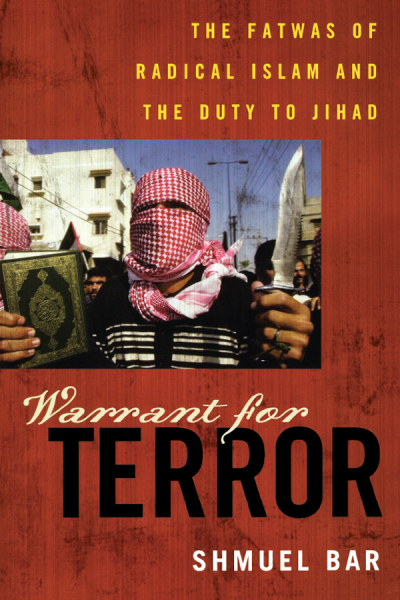
Warrant for Terror
The Fatwas of Radical Islam and the Duty to Jihad
Authors:
Publisher:
2008
Summary
Since September 11, 2001 much has been written about 'Islamist terrorism,' arguing that it is a perversion that has 'hijacked Islam' in the service of social, political and economic grievances. However, such accounts cannot explain why other people that can lay claim to similar or more serious grievances have not developed such devastating religious terrorist ideologies. Moreover, many of the terrorists themselves have attested to their own religious motivation and their belief that they acted in accordance with the precepts of Islam. In Warrant for Terror Shmuel Bar examines fatwas—legal opinions declaring whether a given act under Islam is obligatory, permitted, or forbidden. Fatwas serve as a major instrument by which religious leaders impel believers to engage in acts of jihad. Bar argues that fatwas, particularly those that come from the Arab world, should not be dismissed as a cynical use of religious terminology in political propaganda. Many terrorists testify that they were motivated to act by them. Indeed, this book shows that Islamic law plays a central role in determining for believers the practical meaning of the duty to jihad. Bar examines the underlying religious, legal, and moral logic of fatwas and the depth of their influence, particularly in contrast to alternative moderate Islamic interpretations. He explores the wide scope of issues that fatwas deal with, covering almost all facets of Islamic 'law of war': the justification for declaring jihad; the territory in which the jihad should be fought; whether women and children may participate in jihad; the legality of killing women, children and other non-combatants; the justification for killing hostages and mutilating their bodies; and the permissibility of diverse tactics and weapons, including suicide attacks and even nuclear weapons and other weapons of mass destruction. Warrant for Terror also delves into the contradictions between the radical and the mainstream narratives and the sources of the weakness of the latter in the face of the former. In the conclusion, the author raises a number of provocative questions relating to the 'religious policy' of the West in the face of the threat of Islamic extremism. This book is published in cooperation with the Hoover Institution
Search publication
Bibliographic data
Edition
1/2008
Copyright Year
2008
ISBN-Print
978-0-7425-5121-3
ISBN-Online
978-1-4616-4685-3
Publisher
Rowman & Littlefield, Lanham
Language
English
Pages
138
Product Type
Monograph
Table of contents
ChapterPages
Table of Contents No access
Preface No access
Introduction No access
Chapter 1: 'Ulamā and Fatwās in Islam No access Pages 1 - 10
Chapter 2: The Mechanism of the Jihād Fatwā No access Pages 11 - 17
Chapter 3: The House of Islam versus the House of War No access Pages 18 - 24
Chapter 4: The Doctrine of Jihād No access Pages 25 - 35
Chapter 5: The Defensive Jihād, an Individual Duty No access Pages 36 - 45
Chapter 6: Rules of Engagement No access Pages 46 - 79
Chapter 7: Apostates and Apostate Rulers No access Pages 80 - 84
Chapter 8: Palestine, Afghanistan, and Iraq No access Pages 85 - 96
Chapter 9: The War of the Fatwās No access Pages 97 - 112
Conclusion No access Pages 113 - 118
Afterword No access Pages 119 - 122
Glossary of Selected Terms No access Pages 123 - 128