, to see if you have full access to this publication.
Monograph No access
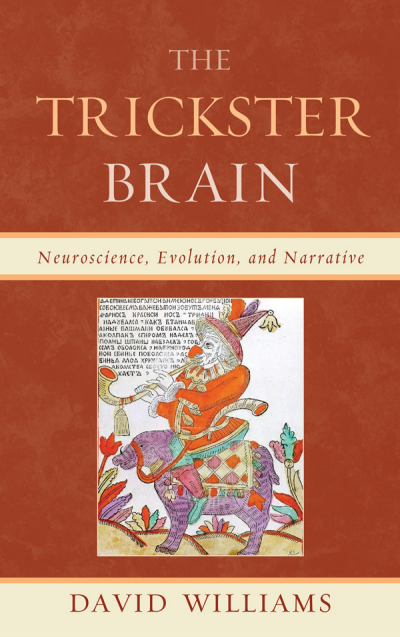
The Trickster Brain
Neuroscience, Evolution, and Narrative
Authors:
Publisher:
2012
Summary
Until recently, scientific and literary cultures have existed side-by-side but most often in parallel universes, without connection. The Trickster Brain: Neuroscience, Evolution, and Nature by David Williams addresses the premise that humans are a biological species stemming from the long process of evolution, and that we do exhibit a universal human nature, given to us through our genes. From this perspective, literature is shown to be a product of our biological selves. By exploring central ideas in neuroscience, evolutionary biology, linguistics, music, philosophy, ethics, religion, and history, Williams shows that it is the circuitry of the brain’s hard-wired dispositions that continually create similar tales around the world: “archetypal” stories reflecting ancient tensions that arose from our evolutionary past and the very construction of our brains. The book asserts that to truly understand literature, one must look at the biological creature creating it. By using the lens of science to examine literature, we can see how stories reveal universal aspects of the biological mind. The Trickster character is particularly instructive as an archetypal character who embodies a raft of human traits and concerns, for Trickster is often god, devil, musical, sexual, silver tongued, animal, and human at once, treading upon the moral dictates of culture.
Williams brings together science and the humanities, demonstrating a critical way of approaching literature that incorporates scientific thought.
Keywords
Search publication
Bibliographic data
Edition
1/2012
Copyright Year
2012
ISBN-Print
978-0-7391-4397-1
ISBN-Online
978-0-7391-4399-5
Publisher
Lexington, Lanham
Language
English
Pages
296
Product Type
Monograph
Table of contents
ChapterPages
CONTENTS No access
CREDITS No access
INTRODUCTION No access
Chapter 1. SEARCHING FOR TRICKSTER No access Pages 1 - 6
Chapter 2. THE SILVER-TONGUED DEVIL No access Pages 7 - 26
Chapter 3. THE TRICKSTERISH BRAIN No access Pages 27 - 34
Chapter 4. EVOLUTION No access Pages 35 - 40
Chapter 5. THE BRAIN OF SEX No access Pages 41 - 54
Chapter 6. THE BRAIN OF LOVE AND WAR No access Pages 55 - 72
Chapter 7. THE BRAIN OF SONG No access Pages 73 - 86
Chapter 8. ETHICS No access Pages 87 - 98
Chapter 9. STORYTELLING AND THETHEORY OF MIND No access Pages 99 - 110
Chapter 10. THE BRAIN OF GOD No access Pages 111 - 124
Chapter 11. THE TRICKSTER OF MYTHOLOGY No access Pages 125 - 136
Chapter 12. A SWATH OF TRICKSTER STORIES FROM ORAL LITERATURE No access Pages 137 - 160
Chapter 13. FEMALE TRICKSTERS No access Pages 161 - 176
Chapter 14. LITERARY FILTERS No access Pages 177 - 182
Chapter 15. MUSIC AND THE TRICKSTER No access Pages 183 - 202
Chapter 16. A SWATH OF OTHER TRICKSTER STORIES FROM AROUND THE WORLD No access Pages 203 - 220
Chapter 17. THE TRICKSTER PERSONIFIED No access Pages 221 - 242
Chapter 18. BLUES AND COURTING TRICKSTERS No access Pages 243 - 256
Chapter 19. TRICKSTER INWRITTEN LITERATURE No access Pages 257 - 262
Chapter 20. TRICKSTER WAS WANDERING No access Pages 263 - 268
NOTES No access Pages 269 - 284
INDEX No access Pages 285 - 294
ABOUT THE AUTHOR No access Pages 295 - 296
Similar publications
from the topics "Gesundheit und Medizin allgemein"