, to see if you have full access to this publication.
Monograph No access
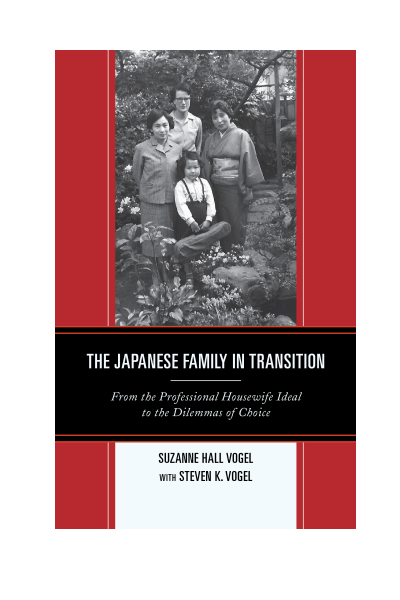
The Japanese Family in Transition
From the Professional Housewife Ideal to the Dilemmas of Choice
Authors:
Publisher:
2013
Summary
In 1958, Suzanne and Ezra Vogel embedded themselves in a Tokyo suburban community, interviewing six middle-class families regularly for a year. Their research led to Japan’s New Middle Class, a classic work on the sociology of Japan. Now, Suzanne Hall Vogel’s compelling sequel traces the evolution of Japanese society over the ensuing decades through the lives of three of these ordinary yet remarkable women and their daughters and granddaughters.
Vogel contends that the role of the professional housewife constrained Japanese middle-class women in the postwar era—and yet it empowered them as well. Precisely because of fixed gender roles, with women focusing on the home and children while men focused on work, Japanese housewives had remarkable authority and autonomy within their designated realm. Wives and mothers now have more options than their mothers and grandmothers did, but they find themselves unprepared to cope with this new era of choice. These gripping biographies poignantly illustrate the strengths and the vulnerabilities of professional housewives and of families facing social change and economic uncertainty in contemporary Japan.