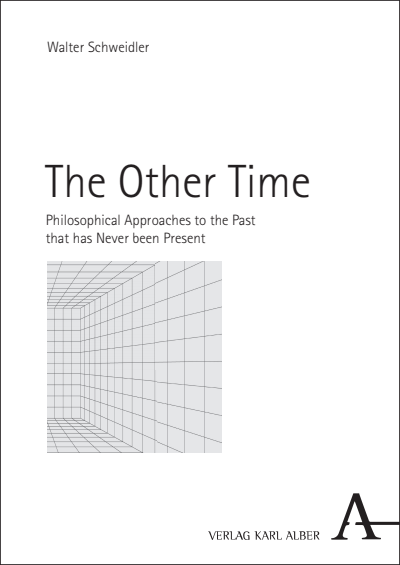
The Other Time
Philosophical Approaches to the Past that has Never been Present- Authors:
- Publisher:
- 2023
Summary
Man is the only living being who is able to relate to the whole and the limits of his existence. In philoso-phising, he faces the question of the reasons why this is possible. This leads us to a topos that links not only the question of truth and existence, but also the most diverse forms of symbolic access to the world: myth and poetic narratives, scientific and artistic world views, and religious and political claims to power. This topos is the time beyond time, the other, the lost, the turned time: the past that has never been present. Phenomenological, hermeneutic, analytical and semiotic approaches have interpreted this topos in different ways. Their inner bond is explored in the essays presented in this book.
Keywords
Search publication
Bibliographic data
- Copyright Year
- 2023
- ISBN-Print
- 978-3-495-99410-8
- ISBN-Online
- 978-3-495-99411-5
- Publisher
- Karl Alber, Baden-Baden
- Language
- English
- Pages
- 262
- Product Type
- Monograph
Table of contents
- Titelei/Inhaltsverzeichnis No access Pages 1 - 8
- 1. Aspects of time’s turning in traditional conceptions of temporality No access
- Emmanuel Lévinas: The »illeity« of human desire No access
- Jacques Derrida: »Illeity« deconstructed No access
- Maurice Merleau-Ponty: Time personified No access
- Friedrich Wilhelm Joseph Schelling: The Second Time No access
- Metaphysics, phenomenology, and the other time No access
- The anthropologized subject of time No access
- Religious horizons No access
- a. by the author No access
- b. by the translator No access
- Overcoming Metaphysics: A Fundamental Feature of Twentieth Century Philosophy No access Pages 69 - 82
- Reflections on Ricoeur’s Ontology of Forgetting No access
- 1. »One sees and has already seen«: The present as place of the past. No access
- 2. »He who has been, from then on cannot not have been«: Presence as a trace of what has been. No access
- 3. »From now on, you do know him and have seen him«: Presence as past, which has never been present No access
- a) Time as the reality of consciousness No access
- b) Time and the reality of the possible No access
- c) The subject as the reality of time No access
- a) Time as physical limit No access
- b) Moment in time, point in time and course of time No access
- c) Time-substance and time-relation No access
- d) Absolute and relative presence No access
- a) The singularity of time No access
- b) The »incipientness« of time No access
- c) The finitude of the temporal No access
- 1. The paradox of temporality No access
- 2. The phenomenological reformulation of the paradox of temporality No access
- 3. The sociocultural aspect of temporality No access
- 4. The temporal character of truth No access
- a) Philosophy and the »iconic turn« No access
- b) The iconic aspect of epistemic being [erkennendes Sein] No access
- c) The iconic aspect as metaphysical aspect No access
- a) Reversing the gaze [Blickrichtung] No access
- b) The iconic perspective No access
- c) The iconic as metaphysical perspective No access
- 3. The question concerning the alternative No access
- The Mirror of Time No access Pages 181 - 194
- Time’s Redeeming Urgency No access Pages 195 - 206
- 1. Philosophy and the time of self-reflection No access
- 2. Narration and the time of self-interpretation No access
- 3. Religion and the time of reorigination No access
- 1. Thinking within the paradox: Irrevocability of the given and showing-itself of the invisible No access
- 2. Thinking after the paradox: The openness of perfection and the manifestness of the secret No access
- 3. Thinking despite and because of the paradox No access
- Bibliography No access Pages 247 - 254
- Sources No access Pages 255 - 256
- List of Names No access Pages 257 - 258
- Index No access Pages 259 - 262
Bibliography (156 entries)
No match found. Try another term.
- Abels, Gabriele Joscijka. Erkenntnis der Bilder. Die Perspektive in der Kunst der Renaissance. Frankfurt a. M. and New York: Campus, 1985. Open Google Scholar DOI: 10.5771/9783495994115
- Aristotle. Physics, Book III and IV. Translated by Edward Hussey. Oxford: Clarendon Press, 1983. Open Google Scholar DOI: 10.5771/9783495994115
- Aristotle. Metaphysics. Translated by W. D. Ross. Oxford: Oxford University Press, 1924. Open Google Scholar DOI: 10.5771/9783495994115
- Assmann, Jan. »Communicative and Cultural Memory«, In Cultural Memory Studies. An International and Interdisciplinary Handbook, 109-118. Berlin/New York: De Gruyter, 2008. Open Google Scholar DOI: 10.5771/9783495994115
- Asemissen, Hermann Ulrich. »Las Meninas von Diego Velázquez«. In Kasseler Hefte für Kunstwissenschaft und Kunstpädagogik II. Kassel: Gesamthochschule Kassel, 1981. Open Google Scholar DOI: 10.5771/9783495994115
- Barth, Karl. Church Dogmatics I/1. Translated by G. W. Bromiley. Norfolk: T. and T. Clark International, 2004. Open Google Scholar DOI: 10.5771/9783495994115
- Barth, Karl. The Epistle of the Romans. Translated by Edwyn Hoskyns. Oxford: Oxford University Press, 1968. Open Google Scholar DOI: 10.5771/9783495994115
- Bauer, Katharina. Proust: Erzählte Spuren – Vom Vergessen und Vergessenwerden. Eichstätt: Liga Preisschrift, 2013. Open Google Scholar DOI: 10.5771/9783495994115
- Bauer, Katharina. Einander zu erkennen geben. Das Selbst zwischen Erkenntnis und Gabe. Freiburg and Munich: Alber, 2012. Open Google Scholar DOI: 10.5771/9783495994115
- Beauchamp, Paul. L’un et l’autre Testament. Essai de lecture. Paris: Seuil, 1976. Open Google Scholar DOI: 10.5771/9783495994115
- Bergson, Henri. Matter and Memory. Translated by Nancy M. Paul and W. Scott Palmer. London: George Allen and Unwin, 1911. Open Google Scholar DOI: 10.5771/9783495994115
- Bergson, Henri. Time and Free Will. Translated by F. L. Pogson. New York: Dover Publications, 1913. Open Google Scholar DOI: 10.5771/9783495994115
- Boehm, Gottfried. »Die Wiederkehr der Bilder«. In Was ist ein Bild? Edited by Gottfried Boehm, 11–38. Munich: Fink, 1994. Open Google Scholar DOI: 10.5771/9783495994115
- Burger, Paul. »Wittgensteinianismus oder Rationale Metaphysik? Zum Status von Aussagen über das Weltganze in der Kosmologie«. In Vom Ersten und Letzten. Positionen der Metaphysik in der Gegenwartsphilosophie, edited by Uwe Justus Wenzel, 177–203. Frankfurt a. M.: Fischer, 1999. Open Google Scholar DOI: 10.5771/9783495994115
- Bredekamp, Horst. »Leibniz´s Theater of Nature and Art and the Idea of an Universal Picture Atlas«. In The Artificial and the Natural: An Evolving Polarity, edited by Bernadette Bensaude-Vincent and William R. Newman, 211–224. Cambridge and London: MIT Press, 2007. Open Google Scholar DOI: 10.5771/9783495994115
- Bredekamp, Horst: Die Fenster der Monade. Gottfried Wilhelm Leibniz’ Theater der Natur und der Kunst. Berlin and Boston: De Gruyter, 2020. Open Google Scholar DOI: 10.5771/9783495994115
- Burkert, Walter. »Glaube und Verhalten«. In Le Sacrifice dans l'Antiquité, edited by J. Rudhardt and O. Reverdin, 91–133. Geneva: Vandoeuvres, 1981. Open Google Scholar DOI: 10.5771/9783495994115
- Carnap, Rudolf. »The Elimination of Metaphysics Through Logical Analysis of Language«. In Critical Theory since Plato, edited by Hazard Adams and Leroy Searle, 978–990. Boston: Thomson, 2005. Open Google Scholar DOI: 10.5771/9783495994115
- Carnap, Rudolf. The logical Structure of the World. Translated by Rolf. A. George. Berkeley and Los Angeles: University of California Press, 1969. Open Google Scholar DOI: 10.5771/9783495994115
- Casey, Edward. The Fate of Place. A Philosophical History. Berkeley: University of California Press, 1997. Open Google Scholar DOI: 10.5771/9783495994115
- Cassirer, Ernst. The Philosophy of Symbolic Forms. Volumen two: Mythical Thought. Translated by Ralph Manheim. New Haven and London: Oxford University Press, 1955. Open Google Scholar DOI: 10.5771/9783495994115
- Cassirer, Ernst. Rousseau, Kant and Goethe. New Jersey: Princeton University Press, 1970. Open Google Scholar DOI: 10.5771/9783495994115
- Deleuze, Gilles. Proust und die Zeichen. Translated by Henriette Beese. Frankfurt a. M., Berlin and Vienna: Ullstein, 1978. Open Google Scholar DOI: 10.5771/9783495994115
- Derrida, Jacques. Of Grammatology. Translated by Gayatri Chakravorty Spivak. Baltimore and London: Johns Hopkins University Press, 1977. Open Google Scholar DOI: 10.5771/9783495994115
- Descombes, Vincent. Le même et l’autre. 45 ans de philosophie francaise. Paris: Éditions de Minuit, 1979. Open Google Scholar DOI: 10.5771/9783495994115
- Durkheim, Émile. Elementary Forms of the Religious Belief. Translated by Mark S. Cladis and Carol Cosman. Oxford: Oxford University Press, 2008. Open Google Scholar DOI: 10.5771/9783495994115
- Eliade, Mircea. »Time and Eternity in Indian Thought«. In Time in Indian Philosophy. A Collection of Essays, edited by Hari Shankar Prasad, 97–124. Delhi: Sri Satguru Publications, 1992. Open Google Scholar DOI: 10.5771/9783495994115
- Fénélon, Francois de. Telemachus, son of Ulysses. Edited by Patrick Riley. Cambridge: Cambridge University Press, 1993. Open Google Scholar DOI: 10.5771/9783495994115
- Fichte, Johann Gottlied. Addresses to the German Nation. Edited by Gregory Moore. Cambridge: Cambridge University Press, 2009. Open Google Scholar DOI: 10.5771/9783495994115
- Fichte, Johann Gottlieb. »Second Introduction to the Science of Knowledge. For readers who already have a philosophical system«. In European Romanticism: A Reader, edited by Stephen Prickett and Simon Haines, 339–347. London: Bloomsbury, 2014. Open Google Scholar DOI: 10.5771/9783495994115
- Fichte, Johann Gottlieb. Sämtliche Werke. Edited by Immanuel Hermann Fichte. Berlin: Veit, 1845. Open Google Scholar DOI: 10.5771/9783495994115
- Florensky, Pavel. Iconostasis. Translated by Donald Sheehan and Olga Andrejev. New York: St Vladimir´s Seminary Press, 1994. Open Google Scholar DOI: 10.5771/9783495994115
- Florensky, Pavel. Beyond Vision: Essays on the Perception of Art. Translated by Wendy Salmond. London: Reaktion Books, 2002. Open Google Scholar DOI: 10.5771/9783495994115
- Foucault, Michel. The Order of Things: Archaeology of the Human Sciences. Edited by Tavistock Publications. London: Routledge, 2002. Open Google Scholar DOI: 10.5771/9783495994115
- Gadamer, Hans-Georg. Truth and Method. Translated by Joel Weinsheimer and Donald G. Marshall. London and New York: Bloomsbury, 2013. Open Google Scholar DOI: 10.5771/9783495994115
- Gawoll, Hans-Jürgen. »Über den Augenblick. Auch eine Philosophiegeschichte von Platon bis Heidegger«. Archiv für Begriffsgeschichte 37, (1994): 152–179. Open Google Scholar DOI: 10.5771/9783495994115
- Geertz, Clifford. The Interpretation of Cultures. New York: Basic Books, 1977. Open Google Scholar DOI: 10.5771/9783495994115
- Goethe, Johann Wolfgang von. Faust I & II, Volume 2. Goethe’s Collected Works. Translated by Stuart Atkins. New Jersey: Princeton University Press, 2014. Open Google Scholar DOI: 10.5771/9783495994115
- Goethe, Johann Wolfgang von. Wilhelm Meister. Translated by H.M. Waidson. London: Alma Classics, 2011. Open Google Scholar DOI: 10.5771/9783495994115
- Goethe, Johann Wolfgang von. The Maxims and Reflections of Goethe. Translated by Thomas Bailey Saunders. London: Macmillan and Co., 1908. Open Google Scholar DOI: 10.5771/9783495994115
- Goodman, Nelson. Languages of Art: An Approach to a Theory of Symbols. Indianapolis: Hackett Publishing, 1972. Open Google Scholar DOI: 10.5771/9783495994115
- Goodman, Nelson. Fact, Fiction and Forecast. Cambridge: Harvard University Press, 1983. Open Google Scholar DOI: 10.5771/9783495994115
- Goody, Jack, and Ian Watt. »The Consequences of Literacy.« Comparative Studies in Society and History 5, no. 3 (April 1963): 304–345. Open Google Scholar DOI: 10.5771/9783495994115
- Grünbaum, Adolf. Philosophical Problems of Space and Time. Dordrecht: D. Reidel Publishing, 1973. Open Google Scholar DOI: 10.5771/9783495994115
- Grünbaum, Adolf. Modern Science and Zeno’s Paradoxes. London: George Allen and Unwin, 1968. Open Google Scholar DOI: 10.5771/9783495994115
- Hume, David. An Enquiry Concerning Human Understanding. Oxford: Oxford University Press, 2007. Open Google Scholar DOI: 10.5771/9783495994115
- Hutter, Alex. »Metaphysik als Metachronik. Schellings Philosophie der Zeit«. In Zeit: Anfang und Ende. Time: Beginning and End, edited by Walter Schweidler, 257–267. Sankt Augustin: Academia, 2004. Open Google Scholar DOI: 10.5771/9783495994115
- Hegel, Georg Wilhelm Friedrich. Encyclopedia of the Philosophical Sciences in Basic Outline. Edited and translated by Klaus Brinkmann and Daniel O. Dahlstrom. Cambridge: Cambridge University Press, 2010. Open Google Scholar DOI: 10.5771/9783495994115
- Heidegger, Martin. Being and Time. Translated by John Macquarrie and Edward Robinson. New York and Evanston: Harper and Row, 1962. Open Google Scholar DOI: 10.5771/9783495994115
- Heidegger, Martin. Being and Time. Translated by Joan Stambaugh. New York: SUNY Press, 2010. Open Google Scholar DOI: 10.5771/9783495994115
- Heidegger, Martin. On Time and Being. Translated by Joan Stambaugh. Chicago and London: University of Chicago Press, 2022. Open Google Scholar DOI: 10.5771/9783495994115
- Heidegger, Martin. Metaphysische Anfangsgründe der Logik im Ausgang von Leibniz. Gesamtausgabe, Bd. 26. Edited by Klaus Held. Frankfurt a. M.: Vittorio Klostermann, 1978. Open Google Scholar DOI: 10.5771/9783495994115
- Heidegger, Martin. Pathmarks. Edited and translated by William McNeill. Cambridge: Cambridge University Press, 1998. Open Google Scholar DOI: 10.5771/9783495994115
- Heidegger, Martin. Kant and the Problem of Metaphysics. Translated by James S. Churchill Bloomington: Indiana University Press, 1965. Open Google Scholar DOI: 10.5771/9783495994115
- Heidegger, Martin. »What is Metaphysics?« In Martin Heidegger: Basic Writings. Edited by David Farrell Krell, 89–110. San Francisco: Harper San Francisco, 1993. Open Google Scholar DOI: 10.5771/9783495994115
- Heidegger, Martin. Nietzsche I. Gesamtausgabe, Bd. 6.1. Edited by Brigitte Schillbach. Frankfurt a. M.: Vittorio Klostermann, 1996. Open Google Scholar DOI: 10.5771/9783495994115
- Heidegger, Martin. Nietzsche II. Gesamtausgabe, Bd. 6.2. Edited by Brigitte Schillbach. Frankfurt a. M.: Vittorio Klostermann, 1997. Open Google Scholar DOI: 10.5771/9783495994115
- Heidegger, Martin. The Question Concerning Technology and Other Essays. Translated by William Lovitt. New York and London: Garland Publishing, 1977. Open Google Scholar DOI: 10.5771/9783495994115
- Heidegger, Martin. Logic. The Question of Truth. Translated by Thomas Sheehan. Indianapolis: Indiana University Press, 2010. Open Google Scholar DOI: 10.5771/9783495994115
- Heidegger, Martin. Contributions to Philosophy. Translated by Richard Rojcewicz and Daniela Vallega-Neu. Indianapolis: Indiana University Press, 2012. Open Google Scholar DOI: 10.5771/9783495994115
- Heidegger, Martin. Vom Wesen der Wahrheit. Gesamtausgabe, Bd. 34. Edited by Hermann Mörchen. Frankfurt a. M.: Klostermann, 1997. Open Google Scholar DOI: 10.5771/9783495994115
- Heidegger, Martin. »Nietzsche’s Word ›God is dead‹«. In Off the Beaten Track, edited by Julian Young, 157–199. Cambridge: Cambridge University Press, 2002. Open Google Scholar DOI: 10.5771/9783495994115
- Heidegger, Martin. Identity and Difference. Translated by Joan Stambaugh. Chicago and London: University of Chicago Press, 2002. Open Google Scholar DOI: 10.5771/9783495994115
- Husserl, Edmund. The Phenomenology of Internal Time-Consciousness. Translated by James E. Churchill. Indianapolis: Indiana University Press, 2019. Open Google Scholar DOI: 10.5771/9783495994115
- Held, Klaus: »Nachwort«. In Edmund Husserl: Phänomenologie der Lebenswelt. Ausgewählte Texte II, 299–358. Stuttgart: Reclam, 1986. Open Google Scholar DOI: 10.5771/9783495994115
- Hempel, Carl Gustav. Aspects of Scientific Explanation. New York and London: The Free Press, 1965. Open Google Scholar DOI: 10.5771/9783495994115
- Imdahl, Max. »lkonik«. In Was ist ein Bild? Edited by Gottfried Boehm, 300–324. Munich: Fink, 2006. Open Google Scholar DOI: 10.5771/9783495994115
- Kaube, Jürgen. Die Anfänge von allem. Berlin: Rowohlt, 2017. Open Google Scholar DOI: 10.5771/9783495994115
- Kant, Immanuel. The Metaphysics of Morals. Translated by Mary Gregor. Cambridge: Cambridge University Press, 1991. Open Google Scholar DOI: 10.5771/9783495994115
- Kant, Immanuel. Critique of Pure Reason. Translated and edited by Paul Guyer and Allen W. Wood. Cambridge, New York and Melbourne: Cambridge UP, 1998. Open Google Scholar DOI: 10.5771/9783495994115
- Kripke, Saul Aaron. Naming and Necessity. Oxford: Blackwell, 1990. Open Google Scholar DOI: 10.5771/9783495994115
- Kierkegaard, Søren Aabye. Philosophical Fragments. Translated by Howard V. Hong and Edna H. Hong. New Jersey: Princeton University Press, 1985. Open Google Scholar DOI: 10.5771/9783495994115
- Kierkegaard, Søren Aabye. The Sickness unto Death. Translated by Alastair Hannay. London: Penguin Random House, 1989. Open Google Scholar DOI: 10.5771/9783495994115
- Kanitschneider, Bernulf. Kosmologie, Geschichte und Systematik in philosophischer Perspektive. Stuttgart: Reclam, 1991. Open Google Scholar DOI: 10.5771/9783495994115
- La Rochefoucauld, François de. Reflections; or, Sentences and moral maxims. Proyect Gutenberg, 2005. Open Google Scholar DOI: 10.5771/9783495994115
- Leach, Edmund. Culture and Communication – The Logic by which Symbols are connected. Cambridge: Cambridge University Press, 1976. Open Google Scholar DOI: 10.5771/9783495994115
- Leibniz, Gottfried Wilhelm. Discourse on Metaphysics. Translated by Gonzalo Rodriguez-Pereyra. Oxford: Oxford University Press, 2020. Open Google Scholar DOI: 10.5771/9783495994115
- Leibniz, Gottfried Wilhelm. Neue Abhandlungen über den menschlichen Verstand. Translated by Ernst Cassirer. Hamburg: Meiner, 1996. Open Google Scholar DOI: 10.5771/9783495994115
- Leibniz, Gottfried Wilhelm. New Essays on Human Understanding. Edited by Peter Remnant and Jonathan Bennett. Cambridge: Cambridge University Press, 1996. Open Google Scholar DOI: 10.5771/9783495994115
- Leibniz, Gottfried Wilhelm. The Monadology and Other Philosophical Writings: Leibniz. Translated by Robert Latta. Ithaca: Cornell University Library, 2009. Open Google Scholar DOI: 10.5771/9783495994115
- Leibniz, Gottfried Wilhelm, Theodicy. Translated by E.M. Huggard. Peru: Open Court, 1985. Open Google Scholar DOI: 10.5771/9783495994115
- Lévinas, Emmanuel. »The Trace of the Other«. In Deconstruction in Context. Literature and Philosophy, edited by Mark C. Taylor, 345–359. Chicago and London: University of Chicago Press, 1986. Open Google Scholar DOI: 10.5771/9783495994115
- Lévinas, Emmanuel. Otherwise Than Being or Beyond Essence. Translated by Alphonso Lingis. Berlin: Kluwer, 1993. Open Google Scholar DOI: 10.5771/9783495994115
- Lévi-Strauss, Claude. The Savage Mind. Translated by George Weidenfield. Chicago and London: University of Chicago Press, 1966. Open Google Scholar DOI: 10.5771/9783495994115
- Lévi-Strauss, Claude. The Elementary Structures of Kinship. Translated by James Harle Bell and John Richard von Sturmer. Boston: Beacon Press, 1969. Open Google Scholar DOI: 10.5771/9783495994115
- Lévi Strauss, Claude. Strukturale Anthropologie. Translated by Hans Naumann. Frankfurt a. M.: Suhrkamp, 1971. Open Google Scholar DOI: 10.5771/9783495994115
- Lévi-Strauss, Claude. Introduction to the Work of Marcel Mauss. London: Routledge and Kegan Paul, 1987. Open Google Scholar DOI: 10.5771/9783495994115
- Marion, Jean-Luc. God without Being. Translated by Thomas A. Carlson. Chicago and London: University of Chicago Press, 2012. Open Google Scholar DOI: 10.5771/9783495994115
- Marion, Jean-Luc. Being Given: Toward a Phenomenology of the Given. Translated by Jeffrey L. Kosky. California: Standford University Press, 2002. Open Google Scholar DOI: 10.5771/9783495994115
- Marion, Jean-Luc. Das Erscheinen des Unsichtbaren: Fragen zur Phänomenalität der Offenbarung. Translated by Alwin Letzkus. Freiburg i. Br.: Herder, 2018. Open Google Scholar DOI: 10.5771/9783495994115
- Marion, Jean-Luc. Givenness and Revelation. Translated by Stephen E. Lewis. Oxford: Oxford University Press, 2016). Open Google Scholar DOI: 10.5771/9783495994115
- Mann, Thomas. Joseph and his Brothers. Translated by John E. Woods. London: Penguin Random House, 2005. Open Google Scholar DOI: 10.5771/9783495994115
- Maurer, Emil. »Süße Perspektive«, Neue Zürcher Zeitung, August 4, 2002. Open Google Scholar DOI: 10.5771/9783495994115
- Merleau-Ponty, Maurice. Phenomenology of Perception. Translated by Donald A. Landes. London and New York: Routledge, 2005. Open Google Scholar DOI: 10.5771/9783495994115
- Merleau-Ponty, Maurice. Sense and Non Sense. Translated by Hubert L. Dreyfus and Patricia Allen Dreyfus. Evanston: Northwestern University Press, 1992. Open Google Scholar DOI: 10.5771/9783495994115
- Merleau-Ponty, Maurice Primacy of Perception. Translated by James E. Edie. Evanston: Northwestern University Press, 1964. Open Google Scholar DOI: 10.5771/9783495994115
- Merleau-Ponty, Maurice. Le visible et l’invisible. Paris: Gallimard, 1964. Open Google Scholar DOI: 10.5771/9783495994115
- Merleau Ponty, Maurice. »Von Mauss zu Claude Lévi-Strauss«. In Leibhaftige Vernunft. Spuren von Merleau-Pontys Denken, edited by Alexandre Métraux and Bernhard Waldenfels, 13–28. Munich: Fink, 1986. Open Google Scholar DOI: 10.5771/9783495994115
- Merleau-Ponty, Maurice. Prose of the World. Translated by John O´Neill. Evanston: Northwestern University Press, 1973. Open Google Scholar DOI: 10.5771/9783495994115
- Merleau-Ponty, Maurice. Nature: Course Notes From the Collége De France. Translated by Robert Vallier. Evanston: Northwestern University Press, 2003. Open Google Scholar DOI: 10.5771/9783495994115
- Müller, Günther. »Erzählzeit und erzählte Zeit«. In Morphologische Poetik. Gesammelte Aufsätze, edited by Elena Müller, 269–286. Tübingen: Max Niemeyer, 1974. Open Google Scholar DOI: 10.5771/9783495994115
- Müller, Günther. »Die Bedeutung der Zeit in der Erzählkunst«. In Morphologische Poetik. Gesammelte Aufsätze, edited by Elena Müller, 247–268. Tübingen: Max Niemeyer, 1974. Open Google Scholar DOI: 10.5771/9783495994115
- Mitchell, William John Thomas. »What is an Image?« New Literary History 15, no. 3 (Spring 1984): 503–537. Open Google Scholar DOI: 10.5771/9783495994115
- Nietzsche, Friedrich. Ecce Homo: How to become what you are. Translated by Duncan Large. Oxford: Oxford University Press, 2007. Open Google Scholar DOI: 10.5771/9783495994115
- Novotny, Fritz. Cézanne und das Ende der wissenschaftlichen Perspektive. Vienna: Schroll, 1938. Open Google Scholar DOI: 10.5771/9783495994115
- Obert, Mathias. Sinndeutung und Zeitlichkeit. Zur Hermeneutik des Huayan- Open Google Scholar DOI: 10.5771/9783495994115
- Buddhismus. Hamburg: Felix Meiner, 2000. Open Google Scholar DOI: 10.5771/9783495994115
- Ong, Walter J. »Writing is a Technology that Restructures Thought«. In The Written Word. Literacy in Transition, edited by Gerd Baumann, 23–50. Oxford: Oxford University Press, 1986. Open Google Scholar DOI: 10.5771/9783495994115
- Pascal, Blaise. Pascal’s Pensées. Translated by William Finlayson Trotter. Michigan: E.P Dutton, 1958. Open Google Scholar DOI: 10.5771/9783495994115
- Panofsky, Erwin. Perspective as Symbolic Form. Translated by Christopher S. Wood. New Jersey: Princeton University Press, 1997. Open Google Scholar DOI: 10.5771/9783495994115
- Plato. Parmenides. Translated by Reginald E. Allen. New Haven: Yale University Press, 1997. Open Google Scholar DOI: 10.5771/9783495994115
- Plato. Phaedrus & The Seventh And Eighth Letters. Translated by Walter Hamilton. London: Penguin Classics, 1973. Open Google Scholar DOI: 10.5771/9783495994115
- Proust, Marcel. In Search of Lost Time. Translated by Charles Kenneth Scott Moncrieff, Terence Kilmartin and Andreas Mayor. New York: Modern Library, 1981. Open Google Scholar DOI: 10.5771/9783495994115
- Proust, Marcel. In Search of Lost Time, 6 vols. London: Penguin Books, 2003. Open Google Scholar DOI: 10.5771/9783495994115
- Quine, Willard Van Orman. Ontological Relativity and other Essays. New York: Columbia University Press, 1969. Open Google Scholar DOI: 10.5771/9783495994115
- Reichenbach, Hans. The Philosophy of Space and Time. Translated by Maria Reichenbach and John Freund. New York: Dover Publications, 1957. Open Google Scholar DOI: 10.5771/9783495994115
- Rescher, Nicholas. Die Grenzen der Wissenschaft. Stuttgart: Reclam, 1985. Open Google Scholar DOI: 10.5771/9783495994115
- Ricoeur, Paul. The course of recognition, Vol. 2. Translated by David Pellauer. Vienna: Institute for Human Sciences, 2005. Open Google Scholar DOI: 10.5771/9783495994115
- Ricoeur, Paul. »L’enchevêtrement de la voix et de l’écrit dans le discours biblique«. Archivio di Filosofia, 60, no. 1–3 (1992): 233–247. Open Google Scholar DOI: 10.5771/9783495994115
- Ricoeur, Paul. »Toward a Hermeneutic of the Idea of Revelation«. The Harvard Theological Review, 70, no.1 – 2 (1977): 1–37. Open Google Scholar DOI: 10.5771/9783495994115
- Ricoeur, Paul. The Conflict of Interpretations. Edited by Don Ihde. Evanston: Northwestern University Press, 1974. Open Google Scholar DOI: 10.5771/9783495994115
- Ricoeur, Paul. Memory, History, Forgetting. Translated by Kathleen Blamey and David Pellauer. Chicago and London: University of Chicago Press, 2004. Open Google Scholar DOI: 10.5771/9783495994115
- Ricoeur, Paul. Time and Narrative. Translated by Kathleen McLaughlin and David Pellauer. Chicago and London: University of Chicago Press, 1990. Open Google Scholar DOI: 10.5771/9783495994115
- Ricoeur, Paul. An den Grenzen der Hermeneutik. Philosophische Reflexionen über die Religion. Edited and translated by Veronika Hoffman. Freiburg and Munich: Alber, 2008. Open Google Scholar DOI: 10.5771/9783495994115
- Ritter, Joachim, Karlfried Gründer and Gottfried Gabriel. Historisches Wörterbuch der Philosophie. Vol. 12 (W-Z). Darmstadt: Wissenschaftliche Buchgesellschaft, 2019. Open Google Scholar DOI: 10.5771/9783495994115
- Salmon, Wesley. Space, Time and Motion. Ann Arbor: University of Michigan Press, 1975. Open Google Scholar DOI: 10.5771/9783495994115
- Saussure, Ferdinand de. Grundfragen der allgemeinen Sprachwissenschaft. Edited by Charles Bally and Albert Sechehaye. Translated by Herman Lommel. Berlin and New York: De Gruyter, 2001. Open Google Scholar DOI: 10.5771/9783495994115
- Scheffczyk, Leo. Einführung in die Schöpfungslehre. Darmstadt: Wissenschaftliche Buchgesellschaft, 1997. Open Google Scholar DOI: 10.5771/9783495994115
- Schelling, Friedrich Wilhelm Joseph. Historical-critical Introduction into the Philosophy of Mythology. Translated by Mason Richey and Markus Zisselsberger. New York: State University of New York, 2007. Open Google Scholar DOI: 10.5771/9783495994115
- Schelling, Friedrich Wilhelm Joseph. Friedrich Wilhelm Joseph von Schellings sämmtliche Werke. Edited by Karl Friedrich August Schelling, 14 vols. Stuttgart and Augsburg: Klett-Cotta, 1856–1861. Open Google Scholar DOI: 10.5771/9783495994115
- Schöne, Albrecht. »Da ist Notwendigkeit, da ist Gott. Noch die Abfolge der Worte, Wortstellung und Satzbau der Heiligen Schrift bergen das Mysterium: Zum Johannesevangelium 13,33 – 14,7«, Frankfurter Allgemeine Zeitung, March 26, 2005. Open Google Scholar DOI: 10.5771/9783495994115
- Schönborn, Christoph. God’s Human Face. The Christ Icon. Translated by Lothar Kraug. San Franciso: Ignatius Press, 1994. Open Google Scholar DOI: 10.5771/9783495994115
- Schweidler, Walter. »Wozu spricht die Metaphysik«. In Wozu Metaphysik?: Historisch-systematische Perspektiven, edited by Christopher Erhard, David Meißner and Jörg Noller, 425–453. Munich: Karl Alber, 2017. Open Google Scholar DOI: 10.5771/9783495994115
- Schweidler, Walter. Wiedergeburt, Vol. I. Freiburg and Munich: Karl Alber 2020. Open Google Scholar DOI: 10.5771/9783495994115
- Schweidler, Walter. Wiedergeburt, Vol. II. Baden-Baden: Karl Alber 2022. Open Google Scholar DOI: 10.5771/9783495994115
- Schweidler, Walter. »Wittgenstein, Goethe, and the Metonymic Principle«. In Wittgenstein, Philosopher of Cultures, edited by Walter Schweidler and Carl Humphries, 103–114. Sankt Augustin: Academia, 2017. Open Google Scholar DOI: 10.5771/9783495994115
- Schweidler, Walter. Die Überwindung der Metaphysik. Zu einem Ende der neuzeitlichen Philosophie. Stuttgart: Klett-Cotta, 1987. Open Google Scholar DOI: 10.5771/9783495994115
- Schweidler, Walter. Ontological Aspects of Absolute Past. Thirteenth conference of the ISST « Time: Limits and Constraints ». Asilomar, 2007. Open Google Scholar DOI: 10.5771/9783495994115
- Schweidler, Walter. »Das Bild der Wirklichkeit und die Perspektive der Freiheit«. In Weltbild-Bildwelt. Ergebnisse und Beiträge des Int. Symposiums der Straniak-Stiftung, edited by Walter Schweidler, 21–59. Sankt Augustin: Academia, 2007. Open Google Scholar DOI: 10.5771/9783495994115
- Smolin, Lee. The Life of the Cosmos. Oxford: Oxford University Press, 1997. Open Google Scholar DOI: 10.5771/9783495994115
- Smith, Quentin and Nathan Oaklander. Time, Change and Freedom. An Introduction to Metaphysics. London and New York: Routledge, 1995. Open Google Scholar DOI: 10.5771/9783495994115
- Smith, Quentin. »Reply to Craig: The possible infinitude of the past«. Philosophical Quarterly, no. 33 (June 1993): 109–115. Open Google Scholar DOI: 10.5771/9783495994115
- Spaemann, Robert. Persons: The Difference between ›Someone‹ and ›Something‹. Translated by Oliver O´Donovan. Oxford: Oxford University Press, 2006. Open Google Scholar DOI: 10.5771/9783495994115
- St. Augustine of Hippo. The city of God against the pagans. Edited by Robert W. Dyson. Cambridge: Cambridge University Press, 1998. Open Google Scholar DOI: 10.5771/9783495994115
- St. Thomas of Aquinas. Summa Theologica. Grand Rapids: Christian Classics Ethereal Library, 2009. Open Google Scholar DOI: 10.5771/9783495994115
- Stoichita, Victor I. Das mystische Auge. Vision und Malerei im Spanien des Goldenen Zeitalters. Translated by Andreas Knop. Munich: Fink, 1977. Open Google Scholar DOI: 10.5771/9783495994115
- Tadié, Jean-Yves. Marcel Proust. Biografie. Translated by Henriette Beese. Frankfurt a. M.: Suhrkamp, 1987. Open Google Scholar DOI: 10.5771/9783495994115
- Theunissen, Michael. Pindar. Menschenlos und Wende der Zeit. Munich: C. H. Beck, 2000. Open Google Scholar DOI: 10.5771/9783495994115
- Theunissen, Michael. Das Selbst auf dem Grunde der Verzweiflung. Frankfurt a. M.: Hain, 1991. Open Google Scholar DOI: 10.5771/9783495994115
- Vinci, Leonardo da. Leonardo on Painting: An Anthology of Writings by Leonardo da Vinci with a Selection of Documents Relating to His Career. Edited and translated by Martin Kemp and Margaret Walker. Yale: Yale University Press, 2001. Open Google Scholar DOI: 10.5771/9783495994115
- Waelhens, Alphonse de. Une philosophie de l’ ambiguïté, l’existentialisme de Maurice Merleau-Ponty. Louvain: Publications universitaires de Louvain, 1951. Open Google Scholar DOI: 10.5771/9783495994115
- Waismann, Friedrich. Wittgenstein and the Vienna Circle: conversations recorded by Friedrich Waismann. Edited by Brian McGuinness. Oxford: Blackwell, 1979. Open Google Scholar DOI: 10.5771/9783495994115
- Wittgenstein, Ludwig. Tractatus logico-philosophicus. Translated by D. F. Pears and B. F. McGuinness. London and New York: Routledge, 2001. Open Google Scholar DOI: 10.5771/9783495994115
- Wittgenstein, Ludwig. Culture and Value. Oxford: Wiley-Blackwell, 1998. Open Google Scholar DOI: 10.5771/9783495994115
- Wittgenstein, Ludwig. Philosophische Untersuchungen / Philosophical Investigations. Translated by Elizabeth Anscombe, Peter Hacker and Joachim Schulte. Oxford: Wiley-Blackwell, 2009. Open Google Scholar DOI: 10.5771/9783495994115
- Wittgenstein, Ludwig. The Blue and Brown Books. Oxford: Wiley-Blackwell, 1998. Open Google Scholar DOI: 10.5771/9783495994115