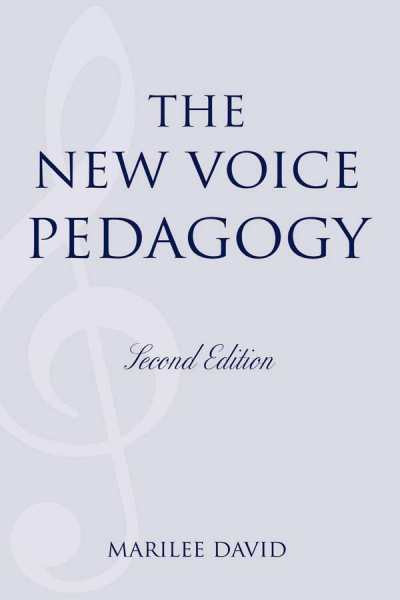
The New Voice Pedagogy
- Authors:
- Publisher:
- 2008
Summary
The simple but vital premise behind this important book is that a healthy voice is a beautiful voice, and a clear tone and pleasant sound will arise from a healthy vocal technique. Based on the concepts of voice therapy, laryngology, and voice science, The New Voice Pedagogy presents a no-nonsense look at the ways knowledge gained through modern science can be applied to teaching voice. Marilee David, an experienced teacher and performer, first explains the physiology of the voice, then examines individual aspects of singing, such as breathing, mouth position, phrasing, tone quality, pitch, resonance, and registration, and offers instruction and exercises appropriate to each component. David also considers the effects of different lifestyle factors and situations on the voice, such as singing with a cold or illness, common medications, obesity, hormones, and aging. She describes symptoms and treatments of common voice problems, including hoarseness, laryngitis, types of dysphonias, and examples of abuse and misuse, giving an overview of voice therapy and diagnostic tools. An important chapter on ethics, unique to this book, uses case studies to examine ethical questions that arise in the voice studio. New to this second edition are expanded sections on posture and kyphosis, HIV and AIDS, and the aging voice, and a helpful glossary of terms used in voice therapy, laryngology, and voice science is included. The bibliography of over three hundred books and articles provides a supplemental reading list for those interested in learning more, and a new final chapter summarizes the pedagogical concepts explored.
Search publication
Bibliographic data
- Edition
- 2/2008
- Copyright Year
- 2008
- ISBN-Print
- 978-0-8108-6042-1
- ISBN-Online
- 978-0-8108-8141-9
- Publisher
- Rowman & Littlefield, Lanham
- Language
- English
- Pages
- 253
- Product Type
- Monograph
Table of contents
- Table of Contents No access
- Figures No access
- Preface to the Second Edition No access
- Acknowledgments for the Second Edition No access
- Acknowledgments No access
- Introduction No access
- Cartilages of the Larynx No access
- External cartilages No access
- The Laryngeal Folds No access
- Suspension of the Larynx No access
- Extrinsic Muscles of the Larynx No access
- Intrinsic Muscles of the Larynx No access
- Innervation of the Vocal Cord No access
- The Structure of the Vocal Cord No access
- Phonation No access
- Pitch No access
- Kyphosis No access
- Exercise to Improve Posture No access
- Laryngeal Massage No access
- Atmosphere No access
- TM Joint No access
- Physiology of Respiration No access
- Types of Respiration No access
- Controlling the Exhaled Air No access
- Support No access
- Ending the Phrase No access
- The Elevated Larynx No access
- Harsh or Strident Tone Quality No access
- Breathy Tone as a Therapeutic Tool No access
- Tongue Position No access
- The Breathy Voice No access
- Volume or Intensity No access
- Vibrato No access
- Registration No access
- Improper Registration No access
- Register Transition No access
- The Use of Falsetto No access
- Singing in the Wrong Range No access
- Voice Classification No access
- Tone Focus or Placement No access
- Placement in the Nose and Sinuses No access
- Placement and Registration No access
- Covering No access
- Hypernasality No access
- Hyponasality No access
- Case Studies No access
- The Speaking Voice No access
- Programs of Vocal Hygiene No access
- Warming up and Warming Down No access
- Singing with a Cold or Allergies No access
- Medications No access
- When not to Sing No access
- Surgery and the Professional Voice User No access
- Laryngeal Surgery No access
- HIV and AIDS No access
- Irritating Substances No access
- Exercise No access
- Obesity and Dieting No access
- Fatigue No access
- Cheerleading No access
- Hormones and the Female Voice No access
- Thyroid No access
- Age-related Changes in the General Population No access
- Changes in the Lamina Propria of the Vocal Cords No access
- Changes in Fundamental [Speaking] Frequency (fo) No access
- Instruments of Assessment No access
- Muscle Function No access
- Examining the Vocal Cords: Videostroboscopy No access
- Therapy Approaches No access
- Voice Rest No access
- Traditional Voice Therapy No access
- "Modem" Voice Therapy: Vocal Image No access
- The New Voice No access
- Types of Dysphonias No access
- Abuse and Misuse No access
- Hyperfunction and Hypofunction No access
- Symptoms of Dysphonia No access
- Hoarseness No access
- Laryngitis No access
- Mucosal Tears No access
- Edema, Reinke's Edema No access
- Submucosal Hemorrhage No access
- The Breathy Voice: Paralysis, Bowed Cords/Glottal Chink No access
- Myasthenia Larynges No access
- Additive Lesions No access
- Nodules No access
- Polyps No access
- Cysts and Pseudocysts No access
- Contact Ulcers No access
- Gastroesophageal Reflux Disease (GERD) No access
- Other Lesions No access
- Dysphonia Plicae Ventricularis: Ventricular Dysphonia No access
- Spasmodic Dysphonia (SD)/Laryngeal Dystonia No access
- Problems of Mutation No access
- 8. Pulling It All Together: The Road to Technical Freedom No access Pages 187 - 196
- Glossary of Terms No access Pages 197 - 210
- Appendix: IPA Symbols No access Pages 211 - 214
- References No access Pages 215 - 236
- Index No access Pages 237 - 252
- About the Author No access Pages 253 - 253