, to see if you have full access to this publication.
Monograph No access
Revolutionary Economies
What Archaeology Reveals about the Birth of American Capitalism
Authors:
Publisher:
2008
Summary
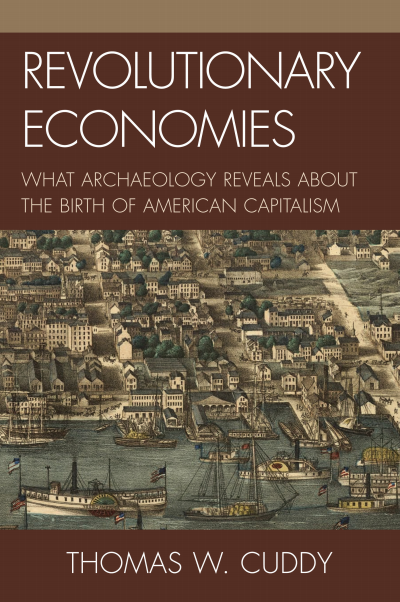
Revolutionary Economies explores the roots of American capitalism through the archaeology and history of the Chesapeake Bay region. Thomas W. Cuddy looks at the archaeological evidence concerning revolutionary-period bakeries and bakers (some of whom had been students of Adam Smith in Scotland) in Annapolis, Maryland and Alexandria, Virginia to examine the development of local production systems that characterized these important early American urban centers. Revolutionary Economies charts the stages of production from household manufacturing to larger workshops to mechanized factories and opens a window on the country's economic history. The volume's blend of archaeology, history, and economics makes it a prototypical study in historical archaeology.
Search publication
Bibliographic data
Edition
1/2008
Copyright Year
2008
ISBN-Print
978-0-7591-1178-3
ISBN-Online
978-0-7591-1229-2
Publisher
Rowman & Littlefield, Lanham
Language
English
Pages
158
Product Type
Monograph
Table of contents
ChapterPages
Contents No access
Preface No access
Ch01. Introduction No access Pages 1 - 24
Ch02. Annapolis and 99 Main Street No access Pages 25 - 42
Ch03. Fire and theGrammar Bakery No access Pages 43 - 58
Ch04. Money and Markets—The Scots Model No access Pages 59 - 82
Ch05. Alexandria and theMechanization of Baking No access Pages 83 - 112
Ch06. Capitalism in the Chesapeake No access Pages 113 - 130
Appendix. Emancipation inthe United States No access Pages 131 - 136