, to see if you have full access to this publication.
Monograph No access
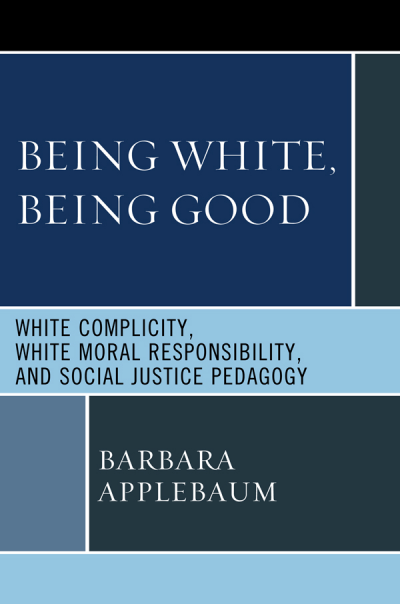
Being White, Being Good
White Complicity, White Moral Responsibility, and Social Justice Pedagogy
Authors:
Publisher:
2010
Summary
Contemporary scholars who study race and racism have emphasized that white complicity plays a role in perpetuating systemic racial injustice. Being White, Being Good seeks to explain what scholars mean by white complicity, to explore the ethical and epistemological assumptions that white complicity entails, and to offer recommendations for how white complicity can be taught. The book highlights how well-intentioned white people who might even consider themselves as paragons of antiracism might be unwittingly sustaining an unjust system that they say they want to dismantle. What could it mean for white people 'to be good' when they can reproduce and maintain racist system even when, and especially when, they believe themselves to be good? In order to answer this question, Barbara Applebaum advocates a shift in our understanding of the subject, of language, and of moral responsibility. Based on these shifts a new notion of moral responsibility is articulated that is not focused on guilt and that can help white students understand and acknowledge their white complicity. Being White, Being Good introduces an approach to social justice pedagogy called 'white complicity pedagogy.' The practical and pedagogical implications of this approach are fleshed out by emphasizing the role of uncertainty, vulnerability, and vigilance. White students who acknowledge their complicity have an increased potential to develop alliance identities and to engage in genuine cross-racial dialogue. White complicity pedagogy promises to facilitate the type of listening on the part of white students so that they come open and willing to learn, and 'not just to say no.' Applebaum also conjectures that systemically marginalized students would be more likely and willing to invest energy and time, and be more willing to engage with the systemically privileged, when the latter acknowledge rather than deny their complicity. It is a central claim of the book that acknowledging complicity encourages a willingness to listen to, rather than dismiss, the struggles and experiences of the systemically marginalized.
Search publication
Bibliographic data
Edition
1/2010
Copyright Year
2010
ISBN-Print
978-0-7391-4491-6
ISBN-Online
978-0-7391-4493-0
Publisher
Lexington, Lanham
Language
English
Pages
222
Product Type
Monograph
Table of contents
ChapterPages
Contents No access
Acknowledgments No access
Ch01. Introduction No access Pages 1 - 26
Ch02. White Ignorance and Denials of Complicity No access Pages 27 - 52
Ch03. The Subject of White Complicity No access Pages 53 - 90
Ch04. The Epistemology of Complicity No access Pages 91 - 118
Ch05. Moral Responsibility and Complicity in Philosophical Scholarship No access Pages 119 - 154
Ch06. Rearticulating White Moral Responsibility No access Pages 155 - 178
Ch07. White Complicity Pedagogy No access Pages 179 - 202