, to see if you have full access to this publication.
Textbook No access
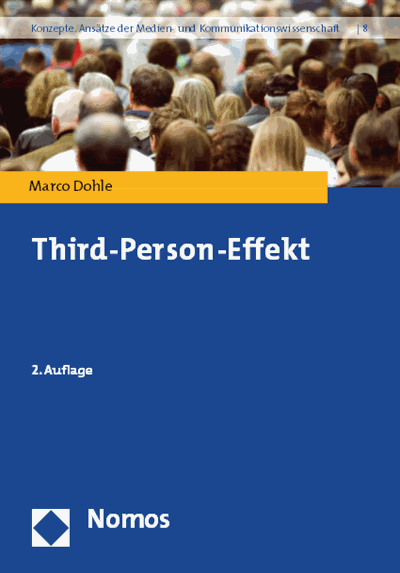
Third-Person-Effekt
- Authors:
- Series:
- Konzepte. Ansätze der Medien- und Kommunikationswissenschaft, Volume 8
- Publisher:
- 2017
Search publication
Bibliographic data
- Edition
- 2/2017
- Copyright Year
- 2017
- ISBN-Print
- 978-3-8487-4590-6
- ISBN-Online
- 978-3-8452-8838-3
- Publisher
- Nomos, Baden-Baden
- Series
- Konzepte. Ansätze der Medien- und Kommunikationswissenschaft
- Volume
- 8
- Language
- German
- Pages
- 122
- Product Type
- Textbook
Table of contents
ChapterPages
- Titelei/Inhaltsverzeichnis No access Pages 1 - 10
- Erste Grundannahme: Wahrnehmungsdifferenz No access
- 2 Zweite Grundannahme: Folgen der Wahrnehmung(sdifferenz) No access
- 3 Der Third-Person-Effekt als Theorie indirekter Medienwirkungen No access
- Einflussvariablen No access
- Theoretische Erklärungen No access
- Differenzierung der Folgen No access
- Thomas-Theorem No access
- Annahmen über die Macht der Medien No access
- 3 Wahrnehmung der Öffentlichkeit und Pluralistic Ignorance No access
- Von der Entdeckung der Third-Person-Perception hin zur Erforschung ihrer Ursachen No access
- Prüfung der Folgen: Von den Wahrnehmungsdifferenzen hin zu den Einflüssen auf andere No access
- Bestandteile einer typischen Untersuchung des Third- Person-Effekts No access
- Messung der Einflusswahrnehmungen und der Wahrnehmungsdifferenzen No access
- Messung der Folgen No access
- Methodenstudien: Third-Person-Perceptions als Abfrageeffekt? No access
- Wahrnehmungsdifferenzen und Gründe ihrer Entstehung No access
- „Gefährliche“ Medieninhalte: Wirkungsbefürchtungen und Zensurforderungen No access
- Gesundheitsverhalten und Schönheitsideale: Intendierte und nicht-intendierte Wirkungen auf dem Umweg über dritte Personen No access
- Politische Medieninhalte: Einflussvermutungen und deren Konsequenzen No access
- Journalisten, Politiker, Wissenschaftler: Wahrgenommene Medieneinflüsse bei spezifischen Befragtengruppen No access
- Wer, wie und wo sind überhaupt „die anderen“? Zum (unklaren) Konzept der Distanz No access
- Jenseits von Zensurforderungen: Die Suche nach (weiteren) Folgen unterstellter Einflüsse No access
- Integration mit anderen theoretischen Ansätzen No access
- Third-Person-Effekte und Online-Medien No access
- Optimistic Bias No access
- Attributionstheorien No access
- Schweigespirale No access
- Hostile-Media-Effekt No access
- Verknüpfung der Wahrnehmungsphänomene No access
- „Top Ten“ der Forschungsliteratur No access Pages 101 - 102
- Literaturverzeichnis No access Pages 103 - 119
- Bildnachweise No access Pages 120 - 122
Bibliography (209 entries)
No match found. Try another term.
- Ajzen, I. (2005). Attitudes, personality, and behavior (2. Aufl.). Maidenhead: Open University Press. Open Google Scholar DOI: 10.5771/9783845288383
- Andsager, J. L. & White H. A. (2007). Self versus others: Media, messages, and the third person effect. Mahwah, NJ: Lawrence Erlbaum. Open Google Scholar DOI: 10.5771/9783845288383
- Atwood, L. E. (1994). Illusions of media power: the third-person effect. Journalism Quarterly, 71, 269–281. Open Google Scholar DOI: 10.5771/9783845288383
- Banning, S. A. (2006). Third-person effects on political participation. Journalism & Mass Communication Quarterly, 83, 785–800. Open Google Scholar DOI: 10.5771/9783845288383
- Banning, S. A. & Sweetser, K. D. (2007). How much do they think it affects them and whom do they believe?: Comparing the third-person effect and credibility of blogs and traditional media. Communication Quarterly, 55, 451–466. Open Google Scholar DOI: 10.5771/9783845288383
- Barnidge, M. & Rojas, H. (2014). Hostile media perceptions, presumed media influence, and political talk: Expanding the corrective action hypothesis. International Journal of Public Opinion Research, 26, 135–156. Open Google Scholar DOI: 10.5771/9783845288383
- Bernhard, U. & Dohle, M. (2015a). Corrective or confirmative actions? Political online participation as a consequence of presumed media influences in election campaigns. Journal of Information Technology & Politics, 12, 285–302. Open Google Scholar DOI: 10.5771/9783845288383
- Bernhard, U. & Dohle, M. (2015b). Local politics online: The influence of presumed influence on local politicians’ online communication activities in Germany. Local Government Studies, 41, 755–773. Open Google Scholar DOI: 10.5771/9783845288383
- Bernhard, U. & Dohle, M. (2016). Constructive or repressive? Journalists’ reactions to the presumed political influences of online media. Studies in Communication ǀ Media, 5, 31–51. Open Google Scholar DOI: 10.5771/9783845288383
- Bernhard, U., Dohle, M. & Vowe, G. (2014). Wie werden Medien zur politischen Information genutzt und wahrgenommen? Online- und Offlinemedien im Vergleich. Media Perspektiven, o. Jg., 159–168. Open Google Scholar DOI: 10.5771/9783845288383
- Brosius, H.-B. & Engel, D. (1997). „Die Medien beeinflussen vielleicht die anderen, aber mich doch nicht“: Zu den Ursachen des Third-Person-Effekts. Publizistik, 42, 325–345. Open Google Scholar DOI: 10.5771/9783845288383
- Brosius, H.-B. & Esser, F. (1998). Mythen in der Wirkungsforschung: Auf der Suche nach dem Stimulus-Response-Modell. Publizistik, 43, 341–361. Open Google Scholar DOI: 10.5771/9783845288383
- Bryant, J. & Miron, D. (2004). Theory and research in mass communication. Journal of Communication, 54, 662–704. Open Google Scholar DOI: 10.5771/9783845288383
- Carolus, A. & Schwab, F. (2008). Third Person Effect. In N. C. Krämer, S. Schwan, D. Unz & M. Suckfüll (Hrsg.), Medienpsychologie. Schlüsselbegriffe und Konzepte (S. 269–272). Stuttgart: Kohlhammer. Open Google Scholar DOI: 10.5771/9783845288383
- Chambers, J. R. (2008). Explaining false uniqueness: Why we are both better and worse than others. Social and Personality Psychology Compass, 2, 878–894. Open Google Scholar DOI: 10.5771/9783845288383
- Chapin, J. (2000). Third-person perception and optimistic bias among urban minority at-risk youth. Communication Research, 27, 51–81. Open Google Scholar DOI: 10.5771/9783845288383
- Chen, G. M. & Ng, Y. M. M. (2017). Nasty online comments anger you more than me, but nice ones make me as happy as you. Computers in Human Behavior, 71, 181–188. Open Google Scholar DOI: 10.5771/9783845288383
- Cheng, H. & Riffe, D. (2008). Attention, perception, and perceived effects: Negative political advertising in a battleground state of the 2004 presidential election. Mass Communication and Society, 11, 177–196. Open Google Scholar DOI: 10.5771/9783845288383
- Chia, S. C. (2006). How peers mediate media influence on adolescents’ sexual attitudes and sexual behaviour. Journal of Communication, 56, 585–606. Open Google Scholar DOI: 10.5771/9783845288383
- Chia, S. C. (2007). Third-person perceptions about idealized body image and weight-loss behavior. Journalism & Mass Communication Quarterly, 84, 677–694. Open Google Scholar DOI: 10.5771/9783845288383
- Cho, H. & Han, M. (2004). Perceived effect of the mass media on self vs. other. A cross cultural investigation of the third person effect hypothesis. Journal of Asian Pacific Communication, 14, 299–318. Open Google Scholar DOI: 10.5771/9783845288383
- Choi, Y. Y., Leshner, G. & Choi, J. (2008). Third-person effects of idealized body image in magazine advertisements. American Behavioral Scientist, 52, 147–164. Open Google Scholar DOI: 10.5771/9783845288383
- Choi, J., Yang, M. & Chang, J. J. C. (2009). Elaboration of the hostile media phenomenon. The roles of involvement, media skepticism, congruency of perceived media influence, and perceived opinion climate. Communication Research, 36, 54–75. Open Google Scholar DOI: 10.5771/9783845288383
- Chung, M., Munno, G. J. & Moritz, B. (2015). Triggering participation: Exploring the effects of third-person and hostile media perceptions on online participation. Computers in Human Behavior, 53, 452–461. Open Google Scholar DOI: 10.5771/9783845288383
- Chung, S. & Moon, S.-I. (2016). Is the third-person effect real? A critical examination of rationales, testing methods, and previous findings of the third-person effect on censorship attitudes. Human Communication Research, 42, 312–337. Open Google Scholar DOI: 10.5771/9783845288383
- Cohen, J., Mutz, D. C., Price, V. & Gunther, A. C. (1988). Perceived impact of defamation: An experiment on third person effects. Public Opinion Quarterly, 52, 161–173. Open Google Scholar DOI: 10.5771/9783845288383
- Cohen, J. & Tsfati, Y. (2009). The influence of presumed media influence on strategic voting. Communication Research, 36, 359–378. Open Google Scholar DOI: 10.5771/9783845288383
- Cohen, J., Tsfati, Y. & Sheafer, T. (2008). The influence of presumed media influence in politics. Do politicians’ perceptions of media power matter? Public Opinion Quarterly, 72, 331–344. Open Google Scholar DOI: 10.5771/9783845288383
- Cohen, J. & Weimann, G. (2008). Who’s afraid of reality shows? Exploring the effects of perceived influence of reality shows and the concern over their social effects on willingness to censor. Communication Research, 35, 382–397. Open Google Scholar DOI: 10.5771/9783845288383
- David, P., Liu, K. & Myser, M. (2004). Methodological artifact or persistant bias? Testing the robustness of the third-person and reverse third-person effects for alcohol messages. Communication Research, 31, 206–233. Open Google Scholar DOI: 10.5771/9783845288383
- Davison, W. P. (1983). The third-person effect in communication. Public Opinion Quarterly, 47, 1–15. Open Google Scholar DOI: 10.5771/9783845288383
- Davison, W. P. (1996). The third-person effect revisited. International Journal of Public Opinion Research, 8, 113–119. Open Google Scholar DOI: 10.5771/9783845288383
- Davison, W. P. (2006). A personal history of world war II. How a pacifist draftee accidentally became a military government official in postwar Germany. Lincoln, NE: iUniverse. Open Google Scholar DOI: 10.5771/9783845288383
- Dewberry, D. R. (2014). The third-person effect goes to Congress. Southern Communication Journal, 79, 279–292. Open Google Scholar DOI: 10.5771/9783845288383
- Dohle, M. (2011). Third-Person-Effekte bei der Wahrnehmung von Schönheitsidealen durch Frauen und Männer. Medien & Kommunikationswissenschaft, 59, 180–198. Open Google Scholar DOI: 10.5771/9783845288383
- Dohle, M. (2016). The Third Person-Effect in Communication von W. Phillips Davison. In M. Potthoff (Hrsg.), Schlüsselwerke der Medienwirkungsforschung (S. 195–204). Wiesbaden: Springer VS. Open Google Scholar DOI: 10.5771/9783845288383
- Dohle, M. & Bernhard, U. (2014). Presumed online media influence and support for censorship: Results from a survey among German parliamentarians. International Journal of Public Opinion Research, 26, 256–268. Open Google Scholar DOI: 10.5771/9783845288383
- Dohle, M. & Bernhard, U. (2016). Third-person effect and influence of presumed media influence approach revisited. In G. Vowe & P. Henn (Hrsg.), Political communication in the online world: Theoretical approaches and research designs (S. 103–117). New York, NY: Routledge. Open Google Scholar DOI: 10.5771/9783845288383
- Dohle, M., Bernhard, U. & Kelm, O. (2017). Presumed media influences and demands for restrictions: Using panel data to examine the causal direction. Mass Communication and Society, 20, 595–613. Open Google Scholar DOI: 10.5771/9783845288383
- Dohle, M. & Hartmann, T. (2008). Alles eine Frage hoher Reichweite? Eine experimentelle Untersuchung zur Ursache der Entstehung von Hostile-Media-Effekten. Medien & Kommunikationswissenschaft, 56, 21–41. Open Google Scholar DOI: 10.5771/9783845288383
- Dohle, M. & Vowe, G. (2010). Wahrnehmung der politischen Einflüsse von Medienangeboten. Third-Person-Effekte bei Bürgern, Journalisten und Politikern im Vergleich. In C. Schemer, W. Wirth & C. Wünsch (Hrsg.), Politische Kommunikation. Wahrnehmung, Verarbeitung, Wirkung (S. 11–29). Baden-Baden: Nomos. Open Google Scholar DOI: 10.5771/9783845288383
- Dohle, M. & Vowe, G. (2012). Mediatisierung aus subjektiver Sicht. Die Einschätzung der politischen Relevanz von Medien in Deutschland 2008 bis 2010. In J. Hagenah & H. Meulemann (Hrsg.), Mediatisierung der Gesellschaft? (S. 277–295). Münster: LIT Verlag. Open Google Scholar DOI: 10.5771/9783845288383
- Duck, J. M., Hogg, M. A. & Terry, D. J. (1995). Me, us and them: political identification and the third-person effect in the 1993 Australian federal election. European Journal of Social Psychology, 25, 195–215. Open Google Scholar DOI: 10.5771/9783845288383
- Duck, J. M., Hogg, M. A., & Terry, D. J. (1999). Social identity and perceptions of media persuasion: Are we always less influenced than others? Journal of Applied Social Psychology, 29, 1879–1899. Open Google Scholar DOI: 10.5771/9783845288383
- Duck, J. M., Terry, D. J. & Hogg, M. G. (1995). The perceived influence of AIDS advertising: Third-person effects in the context of positive media content. Basic and Applied Social Psychology, 17, 305–325. Open Google Scholar DOI: 10.5771/9783845288383
- Dupagne, M., Salwen, M. B. & Paul, B. (1999). Impact of question order on the third-person effect. International Journal of Public Opinion Research, 11, 334–345. Open Google Scholar DOI: 10.5771/9783845288383
- Eisend, M. (2008). Explaining the impact of scarcity appeals in advertising. The mediating role of perceptions of susceptibility. Journal of Advertising, 37, 33–40. Open Google Scholar DOI: 10.5771/9783845288383
- Eveland, W. P. (2002). The impact of news and entertainment media on perceptions of social reality. In J. P. Dillard & M. Pfau (Hrsg.), The persuasion handbook. Developments in theory and practice (S. 691–727). Thousand Oaks, CA: Sage. Open Google Scholar DOI: 10.5771/9783845288383
- Eveland, W. P. & McLeod, D. M. (1999). The effect of social desirability on perceived media impact: Implications for third-person perceptions. International Journal of Public Opinion Research, 11, 315–333. Open Google Scholar DOI: 10.5771/9783845288383
- Eveland, W. P., Nathanson, A. I., Detenber, B. H. & McLeod, D. M. (1999). Rethinking the social distance corollary. Perceived likelihood of exposure and the third-person perception. Communication Research, 26, 275–302. Open Google Scholar DOI: 10.5771/9783845288383
- Feng, G. C. & Guo S. Z. (2012). Support for censorship: A multilevel meta-analysis of the third-person effect. Communication Reports, 25, 40–50. Open Google Scholar DOI: 10.5771/9783845288383
- Fields, J. M. & Schuman, H. (1976). Public beliefs about the beliefs of the public. Public Opinion Quarterly, 40, 427–448. Open Google Scholar DOI: 10.5771/9783845288383
- Filak, V. F. (2012). A concurrent examination of self-versus-others perceptual bias and the willingness to self-censor: A study of college newspaper editors and advisers. Journalism & Mass Communication Quarterly, 89, 299–314. Open Google Scholar DOI: 10.5771/9783845288383
- Fishbein, M., & Ajzen, I. (1975). Believe, attitude, intention, and behavior: An introduction to theory and research. Reading, MA: Addison-Wesley. Open Google Scholar DOI: 10.5771/9783845288383
- Golan, G. J. & Banning, S. A. (2008). Exploring a link between the third-person effect and the theory of reasoned action: beneficial ads and social expectations. American Behavioral Scientist, 52, 208–224. Open Google Scholar DOI: 10.5771/9783845288383
- Golan, G. J., Banning, S. A. & Lundy, L. (2008). Likelihood to vote, candidate choice, and the third-person effect: Behavioral implications of political advertising in the 2004 presidential election. American Behavioral Scientist, 52, 278–290. Open Google Scholar DOI: 10.5771/9783845288383
- Golan, G. J. & Day, A. G. (2008). The first-person effect and its behavioral consequences: A new trend in the twenty-five year history of third-person effect research. Mass Communication and Society, 11, 539–556. Open Google Scholar DOI: 10.5771/9783845288383
- Golan, G. J. & Lim, J. S. (2016). Third-person effect of ISIS’s recruitment propaganda: Online political self-efficacy and social media activism. International Journal of Communication, 10, 4681–4701. Open Google Scholar DOI: 10.5771/9783845288383
- Gunther, A. C. (1991). What we think others think. Cause and consequence in the third-person effect. Communication Research, 18, 355–372. Open Google Scholar DOI: 10.5771/9783845288383
- Gunther, A. C. (1995). Overrating the x-rating: The third-person perception and support for censorship of pornography. Journal of Communication, 45, 27–38. Open Google Scholar DOI: 10.5771/9783845288383
- Gunther, A. C. (1998). The persuasive press inference: Effects of mass media on perceived public opinion. Communications Research, 25, 486–504. Open Google Scholar DOI: 10.5771/9783845288383
- Gunther, A. C., Bolt, D., Borzekowski, D. L. G., Liebhart, J. L. & Dillard, J. P. (2006). Presumed influence on peer norms: How mass media indirectly affect adolescent smoking. Journal of Communication, 56, 52–68. Open Google Scholar DOI: 10.5771/9783845288383
- Gunther, A. C. & Chia, S. C.-Y. (2001). Predicting pluralistic ignorance: The hostile media perception and its consequences. Journalism & Mass Communication Quarterly, 78, 688–701. Open Google Scholar DOI: 10.5771/9783845288383
- Gunther, A. C. & Liebhart, J. L. (2006). Broad reach or biased source? Decomposing the hostile media effect. Journal of Communication, 56, 449–466. Open Google Scholar DOI: 10.5771/9783845288383
- Gunther, A. C. & Mundy, P. (1993). Biased optimism and the third-person effect. Journalism Quarterly, 78, 58–67. Open Google Scholar DOI: 10.5771/9783845288383
- Gunther, A. C., Perloff, R. M. & Tsfati, Y. (2007). Public opinion and the third-person effect. In W. Donsbach & M. W. Traugott (Hrsg.), The SAGE handbook of public opinion research (S. 184–191). Thousand Oaks, CA: Sage. Open Google Scholar DOI: 10.5771/9783845288383
- Gunther, A. C. & Schmitt, K. (2004). Mapping boundaries of the hostile media effect. Journal of Communication, 54, 55–70. Open Google Scholar DOI: 10.5771/9783845288383
- Gunther, A. C. & Storey, J. D. (2003). The influence of presumed influence. Journal of Communication, 53, 199–215. Open Google Scholar DOI: 10.5771/9783845288383
- Gunther, A. C. & Thorson, E. (1992). Perceived persuasive effects of product commercials and public service announcements: Third-person effects in new domains. Communication Research, 19, 574–596. Open Google Scholar DOI: 10.5771/9783845288383
- Haim, M., Kümpel, A. S. & Brosius, H.-B. (2017). Popularity cues in online media. A review of conceptualizations, operationalizations, and general effects. Paper präsentiert auf der Jahrestagung der International Communication Association, San Diego, USA. Open Google Scholar DOI: 10.5771/9783845288383
- Hartmann, T. & Dohle, M. (2005). Publikumsvorstellungen im Rezeptionsprozess. Publizistik, 50, 287–303. Open Google Scholar DOI: 10.5771/9783845288383
- Hautzer, L., Lünich, M. & Rössler, P. (2012). Social Navigation. Neue Orientierungsmuster bei der Mediennutzung im Internet. Baden-Baden: Nomos. Open Google Scholar DOI: 10.5771/9783845288383
- Heider, F. (1958). The psychology of interpersonal relations. New York: Wiley. Open Google Scholar DOI: 10.5771/9783845288383
- Henriksen, L. & Flora, J. A. (1999). Third-person perception and children. Perceived impact of pro- and anti-smoking ads. Communication Research, 26, 643–665. Open Google Scholar DOI: 10.5771/9783845288383
- Ho, S. S., Poorisat, T., Neo, R. L. & Detenber, B. H. (2014). Examining how presumed media influence affects social norms and adolescents’ attitudes and drinking behavior intentions in rural Thailand. Journal of Health Communication, 19, 282–302. Open Google Scholar DOI: 10.5771/9783845288383
- Hoffner, C. & Buchanan, M. (2002). Parents’ responses to television violence: The third-person perception, parental mediation, and support for censorship. Media Psychology, 4, 231–252. Open Google Scholar DOI: 10.5771/9783845288383
- Hoffner, C., Buchanan, M., Anderson, J. D., Hubbs, L. A., Kamigaki, S. K., Kowalczyk, L., Pastorek, A., Plotkin, R. S. (1999). Support for censorship of television violence. The role of the third-person effect and news exposure. Communication Research, 26, 726–742. Open Google Scholar DOI: 10.5771/9783845288383
- Hoffner, C., Plotkin, R. S., Buchanan, M., Anderson, J. D., Kamigaki, S. K., Hubbs, L. A., Kowalczyk, L., Silberg, K. & Pastorek, A. (2001). The third-person effect in perceptions of the influence of television violence. Journal of Communication, 51, 283–299. Open Google Scholar DOI: 10.5771/9783845288383
- Hohlfeld, R. (2005). „Der missachtete Leser revisited“. Zum Wandel von Publikumsbild und Publikumsorientierung im Journalismus. In M. Behmer, B. Blöbaum, A. Scholl & R. Stöber (Hrsg.), Journalismus im Wandel. Analysedimensionen, Konzepte, Fallstudien (S. 195–224). Wiesbaden: VS Verlag. Open Google Scholar DOI: 10.5771/9783845288383
- Hollander, S. (1979). On the strength of a newspaper endorsement. Public Opinion Quarterly, 43, 405–407. Open Google Scholar DOI: 10.5771/9783845288383
- Hoorens, V. & Ruiter, S. (1996). The optimal impact phenomenon: beyond the third person effect. European Journal of Social Psychology, 26, 599–610. Open Google Scholar DOI: 10.5771/9783845288383
- Horkheimer, M. & Adorno, T. W. (1947). Dialektik der Aufklärung. Philosophische Fragmente. Amsterdam: Querido. Open Google Scholar DOI: 10.5771/9783845288383
- Houston, B., Hansen, G. J. & Nisbett, G. S. (2011). Influence of user comments on perceptions of media bias and third-person effect in online news. Electronic News, 5, 79–92. Open Google Scholar DOI: 10.5771/9783845288383
- Huck, I. (2009). Wahrnehmungen und Wahrnehmungsphänomene in Agenda-Setting-Prozessen. Baden-Baden: Nomos. Open Google Scholar DOI: 10.5771/9783845288383
- Huck, I. & Brosius, H.-B. (2007). Der Third-Person-Effekt – Über den vermuteten Einfluss der Massenmedien. Publizistik, 52, 355–374. Open Google Scholar DOI: 10.5771/9783845288383
- Huck, I., Quiring, O. & Brosius, H. B. (2009). Perceptual phenomena in the agenda setting process. International Journal of Public Opinion Research, 21, 139–164. Open Google Scholar DOI: 10.5771/9783845288383
- Huh, J., DeLorme, D. E. & Reid, L. N. (2004). The third-person effect and its influence on behavioral outcomes in a product advertising context: The case of direct-to-consumer prescription drug advertising. Communication Research, 31, 568–599. Open Google Scholar DOI: 10.5771/9783845288383
- Huh, J. & Langteau, R. (2007a). Presumed influence of DTC prescription drug advertising. Do experts and novices think differently? Communication Research, 34, 25–52. Open Google Scholar DOI: 10.5771/9783845288383
- Huh, J. & Langteau, R. (2007b). Presumed influences of direct-to consumer (DTC) prescription drug advertising on patients. The physicians’ perspective. Journal of Advertising, 36, 151–172. Open Google Scholar DOI: 10.5771/9783845288383
- Innes, J. M. & Zeitz, H. (1988). The public’s view of the impact of mass media: a test of the ‚third person‘ effect. European Journal of Social Psychology, 18, 457–463. Open Google Scholar DOI: 10.5771/9783845288383
- Jeffres, L. W., Neuendorf, K., Bracken, C. C. & Atkin, D. (2008). Integrating theoretical traditions in media effects: Using third-person effects to link agenda-setting and cultivation. Mass Communication and Society, 11, 470–291. Open Google Scholar DOI: 10.5771/9783845288383
- Joslyn, M. R. (2003). Framing the Lewinsky affair: Third-person judgments by scandal frame. Political Psychology, 24, 829–844. Open Google Scholar DOI: 10.5771/9783845288383
- Katz, D. & Allport, F. H. (1931). Students’ attitudes. Syracuse, NY: Craftsman Press. Open Google Scholar DOI: 10.5771/9783845288383
- Kelm, O., Dohle, M. & Bernhard, U. (2017). Social media activities of political communication practitioners: The impact of strategic orientation and in-group orientation. International Journal of Strategic Communication, 11, 306–323. Open Google Scholar DOI: 10.5771/9783845288383
- Kepplinger, H. M. (2007). Reciprocal effects: Toward a theory of mass media effects on decision makers. The Harvard International Journal of Press/Politics, 12, 3–23. Open Google Scholar DOI: 10.5771/9783845288383
- Kepplinger, H. M. & Zerback, T. (2012). Direct and indirect effects of media coverage. Exploring the effects of presumed media influence on judges, prosecutors, and defendants. Studies in Communication ǀ Media, 1, 473–492. Open Google Scholar DOI: 10.5771/9783845288383
- Kim, H. (2015). Perception and emotion: The indirect effect of reported election poll results on political participation intention and support for restrictions. Mass Communication and Society, 18, 303–324. Open Google Scholar DOI: 10.5771/9783845288383
- Lambe, J. L. & McLeod, D. M. (2005). Understanding third-person perception processes: Predicting perceived impact on self and others for multiple expressive contexts. Journal of Communication, 55, 277–291. Open Google Scholar DOI: 10.5771/9783845288383
- LaPrelle, J., Hoyle, R. H., Insko, C. A. & Bernthal, P. (1990). Interpersonal attraction and descriptions of the traits of others: Ideal similarity, self similarity, and liking. Journal of Research in Personality, 24, 216–240. Open Google Scholar DOI: 10.5771/9783845288383
- Lazarsfeld, P. F. & Merton, R. K. (1948). Mass communication, popular taste, and organized social action. In L. Bryson (Hrsg.), The communication of ideas (S. 95–118). New York, London: Harper & Brothers. Open Google Scholar DOI: 10.5771/9783845288383
- Lee, F. L. F. (2010). The prevention effect of third-person perception: A study on the perceived and actual influence of polls. Mass Communication and Society, 13, 87–110. Open Google Scholar DOI: 10.5771/9783845288383
- Lee, B. K. & Tamborini, R. (2005). Third-person effect and Internet pornography: The influence of collectivism and Internet self-efficacy. Journal of Communication, 55, 292–310. Open Google Scholar DOI: 10.5771/9783845288383
- Li, X. G. (2008). Third-person effect, optimistic bias, and sufficiency resource in Internet use. Journal of Communication, 58, 568–587. Open Google Scholar DOI: 10.5771/9783845288383
- Lim, J. S. & Golan, G. J. (2011). Social media activism in response to the influence of political parody videos on YouTube. Communication Research, 38, 710–727. Open Google Scholar DOI: 10.5771/9783845288383
- Litt, E. (2012). Knock, knock. Who’s there? The imagined audience. Journal of Broadcasting & Electronic Media, 56, 330–345. Open Google Scholar DOI: 10.5771/9783845288383
- Liu, X. & Lo, V.-H. (2014). Media exposure, perceived personal impact, and third-person effect. Media Psychology, 17, 378–396. Open Google Scholar DOI: 10.5771/9783845288383
- Lo, V. & Paddon, A. R. (2000). Third-person perception and support for pornography restrictions: Some methodological problems. International Journal of Public Opinion Research, 12, 80–89. Open Google Scholar DOI: 10.5771/9783845288383
- Lo, V. H., Wei, R. & Wu, H. (2010). Examining the first, second and third-person effects of Internet pornography on Taiwanese adolescents: implications for the restriction of pornography. Asian Journal of Communication, 20, 90–103. Open Google Scholar DOI: 10.5771/9783845288383
- Marcinkowski, F. (2006). Warum täuscht sich die Öffentlichkeit über ihre eigene Meinung? Kommunikative und soziokulturelle Ursachen der Fehleinschätzung politischer Mehrheiten. Publizistik, 51, 313–332. Open Google Scholar DOI: 10.5771/9783845288383
- Maurer, M. (2010). Agenda-Setting. Baden-Baden: Nomos. Open Google Scholar DOI: 10.5771/9783845288383
- McCombs, M. E. & Shaw, D. L. (1972). The agenda-setting function of mass media. Public Opinion Quarterly, 36, 176–187. Open Google Scholar DOI: 10.5771/9783845288383
- McCroskey, L. L., McCroskey, J. C. & Richmond, V. P. (2006). Analysis and improvement of the measurement of interpersonal attraction and homophiliy. Communication Quarterly, 54, 1–31. Open Google Scholar DOI: 10.5771/9783845288383
- McLeod, D. M., Detenber, B. H. & Eveland, W. P. (2001). Behind the third-person effect: Differentiating perceptual processes for self and other. Journal of Communication, 51, 678–695. Open Google Scholar DOI: 10.5771/9783845288383
- McLeod, D. M., Eveland, W. P. & Nathanson, A. I. (1997). Support for censorship of violent and misogynic rap lyrics. An analysis of the third-person effect. Communication Research, 24, 153–174. Open Google Scholar DOI: 10.5771/9783845288383
- Meirick, P. C. (2004). Topic-relevant reference groups and dimensions of distance. Political advertising and first- and third-person effects. Communication Research, 31, 234–255. Open Google Scholar DOI: 10.5771/9783845288383
- Meirick, P. C. (2005a). Self-enhancement motivation as a third variable in the relationship between first- and third-person effects. International Journal of Public Opinion Research, 17, 473–483. Open Google Scholar DOI: 10.5771/9783845288383
- Meirick, P. C. (2005b). Rethinking the target corollary: The effects of social distance, perceived exposure, and perceived predispositions on first-person and third-person perceptions. Communication Research, 32, 822–843. Open Google Scholar DOI: 10.5771/9783845288383
- Meirick, P. C. (2006). Media schemas, perceived effects, and person perceptions. Journalism & Mass Communication Quarterly, 83, 632–649. Open Google Scholar DOI: 10.5771/9783845288383
- Milkie, M. A. (1999). Social comparisons, reflected appraisals, and mass media: The impact of pervasive beauty images on black and white girls’ self concepts. Social Psychology Quarterly, 62, 190–210. Open Google Scholar DOI: 10.5771/9783845288383
- Montoya, R. M., Horton, R. S. & Kirchner, J. (2008). Is actual similarity necessary for attraction? A meta-analysis of actual and perceived similarity. Journal of Social and Personal Relationships, 25, 889–922. Open Google Scholar DOI: 10.5771/9783845288383
- Moser, K. & Leitl, J. (2006). Der Dritte-Person-Effekt, Thema der Werbung und Distanz der „dritten Person“. Zeitschrift für Medienpsychologie, 18, 2–8. Open Google Scholar DOI: 10.5771/9783845288383
- Müller, P. (2013). National identity building through patterns of an international third-person perception in news coverage. International Communication Gazette, 75, 732–749. Open Google Scholar DOI: 10.5771/9783845288383
- Müller, P. & Hohlfeld, R. (2013). Journalistische Vorstellungen von Medienwirkungen. Dimensionen – Entstehungsbedingungen – Folgen. Medien & Kommunikationswissenschaft, 61, 166–182. Open Google Scholar DOI: 10.5771/9783845288383
- Mullen, B., Atkins, J. L., Champion, D. S., Edwards, C., Hardy, D., Story, J. E. & Vanderklok, M. (1985). The false consensus effect: A meta-analysis of 115 hypothesis tests. Journal of Experimental Social Psychology, 21, 262–283. Open Google Scholar DOI: 10.5771/9783845288383
- Mutz, D. C. (1989). The influence of perceptions of media influence: Third person effects and the public expression of opinions. International Journal of Public Opinion Research, 1, 4–23. Open Google Scholar DOI: 10.5771/9783845288383
- Mutz, D. C. (1994). The political effects of perceptions of mass opinion. Research in Micropolitics, 4, 143–167. Open Google Scholar DOI: 10.5771/9783845288383
- Mutz, D. C. (1998). Impersonal influence: How perceptions of mass collectives affect political attitudes. New York: Cambridge University Press. Open Google Scholar DOI: 10.5771/9783845288383
- Neuwirth, K. & Frederick, E. (2002). Extending the framework of third-, first-, and second-person effects. Mass Communication and Society, 5, 113–140. Open Google Scholar DOI: 10.5771/9783845288383
- Nix, J. & Pickett, J. T. (2017). Third-person perceptions, hostile media effects, and policing: Developing a theoretical framework for assessing the Ferguson effect. Journal of Criminal Justice, 51, 24–33. Open Google Scholar DOI: 10.5771/9783845288383
- Noelle-Neumann, E. (1980). Die Schweigespirale. Öffentliche Meinung – unsere soziale Haut. München: Piper. Open Google Scholar DOI: 10.5771/9783845288383
- Noguti, V. & Russell, C. A. (2014). Normative influences on product placement effects: Alcohol brands in television series and the influence of presumed influence. Journal of Advertising, 43, 46–62. Open Google Scholar DOI: 10.5771/9783845288383
- O’Gorman, H. J. & Garry, S. L. (1976). Pluralistic ignorance – a replication and extension. Public Opinion Quarterly, 40, 449–458. Open Google Scholar DOI: 10.5771/9783845288383
- Oliver, M. B., Yang, H., Ramasubramanian, S., Kim, J. & Lee, S. (2008). Exploring implications of perceived media reinforcement on third-person perceptions. Communication Research, 35, 745-769. Open Google Scholar DOI: 10.5771/9783845288383
- Paek, H., Gunther, A. C., McLeod, D. M. & Hove, T. (2011). How adolescents’ perceived media influence on peers affects smoking decisions. Journal of Consumer Affairs, 45, 123–146. Open Google Scholar DOI: 10.5771/9783845288383
- Pan, Z. D., Abisaid, J. L., Paek, H. J., Sun, Y. & Houden, D. (2005). Exploring the perceptual gap in perceived effects of media reports of opinion polls. International Journal of Public Opinion Research, 18, 340–350. Open Google Scholar DOI: 10.5771/9783845288383
- Paradise, A. & Sullivan, M. (2012). (In)visible threats? The third-person effect in perceptions of the influence of Facebook. Cyberpsychology, Behavior, and Social Networking, 15, 55–60. Open Google Scholar DOI: 10.5771/9783845288383
- Park, H. S., Lee, H. E., Choi, H. J., Lee, D. W., Ahn, J. & Park, H. (2014). Perceived similarity and third-person effect: Media coverage of the shooting incident at Virginia Polytechnic Institute and State University. Social Behavior and Personality: An international journal, 42, 539–550. Open Google Scholar DOI: 10.5771/9783845288383
- Park, S. Y. (2005). The influence of presumed media influence on woman’s desire to be thin. Communication Research, 32, 594–614. Open Google Scholar DOI: 10.5771/9783845288383
- Paul, B., Salwen, M. B. & Dupagne, M. (2000). The third-person effect: A meta-analysis of the perceptual hypothesis. Mass Communication and Society, 3, 57–85. Open Google Scholar DOI: 10.5771/9783845288383
- Peiser, W. & Peter, J. (2000). Third-person perception of television-viewing behavior. Journal of Communication, 50, 25–45. Open Google Scholar DOI: 10.5771/9783845288383
- Perloff, R. M. (1993). Third-Person effect research 1983-1992: A review and synthesis. International Journal of Public Opinion Research, 5, 167–184. Open Google Scholar DOI: 10.5771/9783845288383
- Perloff, R. M. (2002). The third-person effect. In J. Bryant & D. Zillmann (Hrsg.), Media effects: Advances in theory and research (2. Aufl., S. 489–506). Mahwah, NJ: Lawrence Erlbaum. Open Google Scholar DOI: 10.5771/9783845288383
- Perloff, R. M. (2009). Mass media, social perception, and the third-person effect. In J. Bryant & M. B. Oliver (Hrsg.), Media effects. Advances in theory and research (3. Aufl., S. 252–268). New York: Routledge. Open Google Scholar DOI: 10.5771/9783845288383
- Perloff, R. M. (2015). A three-decade retrospective on the hostile media effect. Mass Communication and Society, 18, 701–729. Open Google Scholar DOI: 10.5771/9783845288383
- Price, V., Huang, L.-N. & Tewksbury, D. (1997). Third-person effects of news coverage: Orientations toward media. Journalism & Mass Communication Quarterly 74, 525–540. Open Google Scholar DOI: 10.5771/9783845288383
- Price, V. & Tewksbury, D. (1996). Measuring the third-person effect of news: The impact of question order, contrast and knowledge. International Journal of Public Opinion Research, 8, 120–141. Open Google Scholar DOI: 10.5771/9783845288383
- Post, S. (2015). Incivility in controversies: The influence of presumed media influence and perceived media hostility on the antagonists in the German conflict over aircraft noise. Communication Research, online first. Open Google Scholar DOI: 10.5771/9783845288383
- Rauch, J. (2010). Superiority and susceptibility: How activist audiences imagine the influence of mainstream news messages on self and others. Discourse & Communication, 4, 263–277. Open Google Scholar DOI: 10.5771/9783845288383
- Reid, S. A., Byrne, S., Brundidge, J. S., Shoham, M. D. & Marlow, M. L. (2007). A critical test of self-enhancement, exposure, and self-categorization explanations for first- and third-person perceptions. Human Communication Research, 33, 143–162. Open Google Scholar DOI: 10.5771/9783845288383
- Reid, S. A. & Hogg, M. A. (2005). A self-categorization explanation for the third-person effect. Human Communication Research, 31, 129–161. Open Google Scholar DOI: 10.5771/9783845288383
- Roessing, T. (2011). Schweigespirale. Baden-Baden: Nomos. Open Google Scholar DOI: 10.5771/9783845288383
- Rössler, P. (2009). Wie Menschen die Wirkungen politischer Medienberichterstattung wahrnehmen – und welche Konsequenzen daraus resultieren. Zum Zusammenhang von politischer Willensbildung, Second- und Third-Person-Effekten. In F. Marcinkowski & B. Pfetsch (Hrsg.), Politik in der Mediendemokratie (= Politische Vierteljahresschrift – Sonderheft 42) (S. 468–495). Wiesbaden: VS Verlag. Open Google Scholar DOI: 10.5771/9783845288383
- Rojas, H. (2010). “Corrective” actions in the public sphere: How perceptions of media and media effects shape political behaviors. International Journal of Public Opinion Research, 22, 343–363. Open Google Scholar DOI: 10.5771/9783845288383
- Rojas, H., Shah, D. V. & Faber, R. F. (1996). For the good of others: Censorship and the third-person effect. International Journal of Public Opinion Research, 8, 163–186. Open Google Scholar DOI: 10.5771/9783845288383
- Ross, L. (1977). The intuitive psychologist and his shortcomings: Distortions in the attribution process. In L. Berkowitz (Hrsg.), Advances in experimental social psychology. Vol. 10 (S. 173–220). New York: Academic Press. Open Google Scholar DOI: 10.5771/9783845288383
- Ross, L., Greene, D. & House, P. (1977). The “false consensus effect”: An egocentric bias in social perception and attribution processes. Journal of Experimental Social Psychology, 133, 279–301. Open Google Scholar DOI: 10.5771/9783845288383
- Rossmann, C. (2011). Theory of Reasoned Action – Theory of Planned Behavior. Baden-Baden: Nomos. Open Google Scholar DOI: 10.5771/9783845288383
- Rucinski, D. & Salmon, C. T. (1990). The ‘other’ as the vulnerable voter: A study of the third-person effect in the 1988 U.S. presidential campaign. International Journal of Public Opinion Research, 2, 345–368. Open Google Scholar DOI: 10.5771/9783845288383
- Salwen, M. B. (1998). Perceptions of media influence and support for censorship. The third-person effect in the 1996 presidential election. Communication Research, 25, 259–285. Open Google Scholar DOI: 10.5771/9783845288383
- Salwen, M. B. & Driscoll, P. D. (1997). Consequences of third-person perception in support of press restrictions in the O. J. Simpson trial. Journal of Communication, 47, 60–78. Open Google Scholar DOI: 10.5771/9783845288383
- Salwen, M. B. & Dupagne, M. (2003). News of Y2K and experiencing Y2K: Exploring the relationship between the third-person effect and optimistic bias. Media Psychology, 5, 57–82. Open Google Scholar DOI: 10.5771/9783845288383
- Scharrer, E. (2002). Third-person perception and television violence. The role of out-group stereotyping in perceptions of susceptibility to effects. Communication Research, 29, 681–704. Open Google Scholar DOI: 10.5771/9783845288383
- Scharrer, E. & Leone, R. (2008). First-person shooters and the third-person effect. Human Communication Research, 34, 210–233. Open Google Scholar DOI: 10.5771/9783845288383
- Scherr, S. & Müller, P. (2017). How perceived persuasive intent and reactance contribute to third-person perceptions: Evidence from two experiments. Mass Communication and Society, 23, 315–335. Open Google Scholar DOI: 10.5771/9783845288383
- Schmierbach, M., Boyle, M. P. & McLeod, D. M. (2008). Understanding person perceptions: Comparing four common statistical approaches to third-person research. Mass Communication and Society, 11, 492–513. Open Google Scholar DOI: 10.5771/9783845288383
- Schütz, A. & Luckmann, T. (2003). Strukturen der Lebenswelt. Konstanz: UVK. Open Google Scholar DOI: 10.5771/9783845288383
- Schulz, A. & Rössler, P. (2013). Schweigespirale Online. Die Theorie der öffentlichen Meinung und das Internet (unter Mitarbeit von K. Bienhaus, J. Ebert, M. Kling, M. Mewes, K. Ramcke, J. Schade & A. Schorr). Baden-Baden: Nomos. Open Google Scholar DOI: 10.5771/9783845288383
- Schweiger, W. (2007). Theorien der Mediennutzung. Eine Einführung. Wiesbaden: VS Verlag. Open Google Scholar DOI: 10.5771/9783845288383
- Shen, L. & Huggins, C. (2013). Testing the model of influence of presumed influence in a boundary condition: The impact of question order. Human Communication Research, 39, 470–491. Open Google Scholar DOI: 10.5771/9783845288383
- Shen, L., Palmer, J., Kollar, L. M. M. & Comer, S. (2015). A social comparison explanation for the third-person perception. Communication Research, 42, 260–280. Open Google Scholar DOI: 10.5771/9783845288383
- Sommer, K. (2013). Wirkung von Wirtschaftsberichterstattung – eine Systematisierung. In W. Schweiger & A. Fahr (Hrsg.), Handbuch Medienwirkungsforschung (S.369–384). Wiesbaden: Springer VS. Open Google Scholar DOI: 10.5771/9783845288383
- Sommer, K., & Hofer, M. (2011, May). Influence of online comments on the perceptual and behavioral component of the third-person effect. Paper präsentiert auf der Jahrestagung der International Communication Association, Boston, USA. Open Google Scholar DOI: 10.5771/9783845288383
- Speier, H. & Davison, W. P. (1957). (Hrsg.). West German leadership and foreign policy. Evanston, IL: Row, Person and Company. Open Google Scholar DOI: 10.5771/9783845288383
- Stavrositu, C. D. & Kim, J. (2014). Social media metrics: Third-person perceptions of health information. Computers in Human Behavior, 35, 61–67. Open Google Scholar DOI: 10.5771/9783845288383
- Stiehler, H.-J. (1999). Subjektive Medientheorien – Zum Begriff. In B. Schorb & H.-J. Stiehler (Hrsg.), Idealisten oder Realisten? Die deutschen Kinder- und JugendfernsehmacherInnen und ihre subjektiven Medientheorien (S. 12–25). München: kopaed. Open Google Scholar DOI: 10.5771/9783845288383
- Sun, Y. (2013). When presumed influence turns real: An indirect route of media influence. In J. P. Dillard & L. Shen (Hrsg.), The SAGE handbook of persuasion. Developments in theory and practice (2. Aufl., S. 371–387). Thousand Oaks, CA: Sage. Open Google Scholar DOI: 10.5771/9783845288383
- Sun, Y., Pan, Z. D. & Shen, L. J. (2008). Understanding the third-person perception: Evidence from a meta-analysis. Journal of Communication, 58, 280–300. Open Google Scholar DOI: 10.5771/9783845288383
- Tal-Or, N., Cohen, J., Tsfati, Y. & Gunther, A. C. (2010). Testing causal direction in the influence of presumed media influence. Communication Research, 37, 801–824. Open Google Scholar DOI: 10.5771/9783845288383
- Tal-Or, N. & Drukman, D. (2010). Third-person perception as an impression management tactic. Media Psychology, 13, 301–322. Open Google Scholar DOI: 10.5771/9783845288383
- Tal-Or, N., Lazar, T., Angrest, T., Bloom, R., Ner, A. & Oren, Y. (2012). The first person perception: Exploring its behavioral consequences and the nature of perceived influence. Paper präsentiert auf der Jahrestagung der International Communication Association, Phoenix, USA. Open Google Scholar DOI: 10.5771/9783845288383
- Tal-Or, N. & Tsfati, Y. (2007). On the substitutability of the third-person perception. Media Psychology, 10, 231–249. Open Google Scholar DOI: 10.5771/9783845288383
- Tal-Or, N., Tsfati, Y. & Gunther, A. C. (2009). The influence of presumed media influence. Origins and implications of the third-person perception. In R. L. Nabi & M. B. Oliver (Hrsg.), The SAGE handbook of media processes and effects (S. 99–112). Thousand Oaks, CA: Sage. Open Google Scholar DOI: 10.5771/9783845288383
- Tewksbury, D. (2002). The role of comparison group size in the third-person effect. International Journal of Public Opinion Research, 14, 247–263. Open Google Scholar DOI: 10.5771/9783845288383
- Tewksbury, D., Moy, P. & Weis, D. S. (2004). Preparations for Y2K: Revisiting the behavioral component of the third-person effect. Journal of Communication, 54, 138–155. Open Google Scholar DOI: 10.5771/9783845288383
- Thomas, W. I. & Thomas, D. S. (1928). The child in America: Behavior problems and programs. New York: Knopf. Open Google Scholar DOI: 10.5771/9783845288383
- Thomsen, S. (2002). Health and beauty magazine reading and body shape concerns among a group of college woman. Journalism & Mass Communication Quarterly, 79, 988–1007. Open Google Scholar DOI: 10.5771/9783845288383
- Tsay-Vogel, M. (2016). Me versus them: Third-person effects among Facebook users. New Media & Society, 18, 1956–1972. Open Google Scholar DOI: 10.5771/9783845288383
- Tsfati, Y. (2007). Hostile media perceptions, presumed media influence, and minority alienation: The case of Arabs in Israel. Journal of Communication, 57, 632–651. Open Google Scholar DOI: 10.5771/9783845288383
- Tsfati, Y. & Cohen, J. (2003). On the effect of the “third-person effect”: Perceived influence of media coverage and residential mobility intentions. Journal of Communication, 53, 711–727. Open Google Scholar DOI: 10.5771/9783845288383
- Tsfati, Y. & Cohen, J. (2005). The influence of presumed media influence on democratic legitimacy. The case of Gaza settlers. Communication Research, 32, 794–821. Open Google Scholar DOI: 10.5771/9783845288383
- Tsfati, Y. & Cohen, J. (2013). Perceptions of media and media effects: The third-person effect, trust in media and hostile media perceptions. In A. N. Valdivia & E. Scharrer (Hrsg.), The international encyclopedia of media studies: Media effects/Media psychology (S. 5–19). Hoboken, NJ: Blackwell. Open Google Scholar DOI: 10.5771/9783845288383
- Tsfati, Y., Cohen, J. & Gunther, A. C. (2011). The influence of presumed media influence on news about science and scientists. Science Communication, 33, 143–166. Open Google Scholar DOI: 10.5771/9783845288383
- Tsfati, Y. & Livio, O. (2008). Exploring journalists’ perception of media impact. Journalism & Mass Communication Quarterly, 85, 113–130. Open Google Scholar DOI: 10.5771/9783845288383
- Vallone, R. P., Ross, L. & Lepper, M. R. (1985). The hostile media phenomenon: Biased perception and perceptions of media bias in coverage of the Beirut massacre. Journal of Personality and Social Psychology, 49, 577–585. Open Google Scholar DOI: 10.5771/9783845288383
- Vester, H.-G. (2009). Kompendium der Soziologie I: Grundbegriffe. Wiesbaden: VS Verlag. Open Google Scholar DOI: 10.5771/9783845288383
- Vowe, G. (2010). Von der Massengesellschaft zur Mediengesellschaft. Antworten der Kommunikationswissenschaft auf die Frage „Wie ist Gesellschaft möglich?“. In C. Reinemann & R. Stöber (Hrsg.), Wer die Vergangenheit kennt, hat eine Zukunft. Festschrift für Jürgen Wilke (S. 35–61) Köln: Halem. Open Google Scholar DOI: 10.5771/9783845288383
- Watson, B. R. & Riffe, D. (2013). Perceived threat, immigration policy support, and media coverage: Hostile media and presumed influence. International Journal of Public Opinion Research, 25, 459–479. Open Google Scholar DOI: 10.5771/9783845288383
- Wei, R. & Lo, V. H. (2007). The third-person effects of political attack ads in the 2004 US presidential election. Media Psychology, 9, 367–388. Open Google Scholar DOI: 10.5771/9783845288383
- Wei, R., Lo, V. H. & Golan, G. (2017). Examining the relationship between presumed influence of U.S. news about China and the support for the Chinese government’s global public relation campaign. International Journal of Communication, 11, 2964–2981. Open Google Scholar DOI: 10.5771/9783845288383
- Wei, R., Lo, V. H. & Lu, H. Y. (2007). Reconsidering the relationship between the third-person perception and optimistic bias. Communication Research, 34, 665–684. Open Google Scholar DOI: 10.5771/9783845288383
- Wei, R., Lo, V.-H., & Lu, H.-Y. (2011). Examining the perceptual gap and behavioral intention in the perceived effects of polling news in the 2008 Taiwan presidential election. Communication Research, 38, 206–277. Open Google Scholar DOI: 10.5771/9783845288383
- Weinstein, N. D. (1980). Unrealistic optimism about future life events. Journal of Personality and Social Psychology, 39, 806–820. Open Google Scholar DOI: 10.5771/9783845288383
- Willnat, L. (1996). Mass media and political outspokenness in Hong Kong: Linking the third-person effect and the spiral of silence. International Journal of Public Opinion Research, 8, 187–212. Open Google Scholar DOI: 10.5771/9783845288383
- Wolf, S. (2008). Medienwirkungen aus Rezipientensicht. Third-Person-Wahrnehmungen in sozialen Netzwerken. München: Verlag Reinhard Fischer. Open Google Scholar DOI: 10.5771/9783845288383
- Xu, J. & Gonzenbach, W. J. (2008). Does a perceptual discrepancy lead to action? A meta-analysis of the behavioral component of the third-person effect. International Journal of Public Opinion Research, 20, 375–385. Open Google Scholar DOI: 10.5771/9783845288383
- Yoo, W., Yang, J. & Cho, E. (2016). How social media influence college students’ smoking attitudes and intentions. Computers in Human Behavior, 64, 173–182. Open Google Scholar DOI: 10.5771/9783845288383
- Youn, S., Faber, R. J. & Shah, D. V. (2000). Restricting gambling advertising and the third-person effect. Psychology & Marketing, 17, 633–649. Open Google Scholar DOI: 10.5771/9783845288383
- Zhao, X. Q. & Cai, X. M. (2008). From self-enhancement to supporting censorship: The third-person effect process in the case of Internet pornography. Mass Communication and Society, 11, 437–462. Open Google Scholar DOI: 10.5771/9783845288383
- Zhong, Z. J. (2009). Third-person perceptions and online games: A comparison of perceived antisocial and prosocial game effects. Journal of Computer-Mediated Communication, 14, 286–306. Open Google Scholar DOI: 10.5771/9783845288383