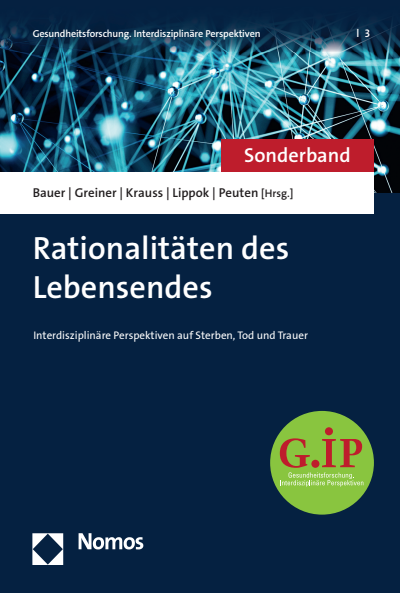
, to see if you have full access to this publication.
Edited Book Partial access
Rationalitäten des Lebensendes
Interdisziplinäre Perspektiven auf Sterben, Tod und Trauer- Editors:
- | | | |
- Series:
- Gesundheitsforschung. Interdisziplinäre Perspektiven, Volume 3
- Publisher:
- 2020
Search publication
Bibliographic data
- Edition
- 1/2020
- Copyright Year
- 2020
- ISBN-Print
- 978-3-8487-6101-2
- ISBN-Online
- 978-3-7489-0125-9
- Publisher
- Nomos, Baden-Baden
- Series
- Gesundheitsforschung. Interdisziplinäre Perspektiven
- Volume
- 3
- Language
- German
- Pages
- 326
- Product Type
- Edited Book
Table of contents
ChapterPages
- Titelei/Inhaltsverzeichnis Partial access Pages 1 - 8
- Authors:
- 1. Die Thanatologie als akademische Disziplin in Geschichte und Gegenwart No accessAuthors:
- Authors:
- 2.1 Gesundheit und Medizin am Lebensende No accessAuthors:
- 2.2 Forschung als sozialer Protest: Thanatologie zwischen Chance und Risiko No accessAuthors:
- 2.3 Konstruktionen des Sterbens zwischen Tabu und Sichtbarkeit – Das Lebensende und die Medien No accessAuthors:
- Authors:
- 3.1 Auf der Suche nach dem ‚guten Tod‘ – Sterberäume zwischen Biopolitik und Selbstverantwortung No accessAuthors:
- 3.2 Care am Lebensende No accessAuthors:
- 3.3 Optionssteigerung in der Sterbekultur No accessAuthors:
- Literatur No accessAuthors:
- Authors:
- 1. Einleitung: Sterbevorsorge im Alltag No accessAuthors:
- Authors:
- 2.1 Die Beratung No accessAuthors:
- 2.2 Die Arbeit am Dokument No accessAuthors:
- 2.3 Die Bevollmächtigung No accessAuthors:
- 3. Fazit No accessAuthors:
- Literatur No accessAuthors:
- Authors: | | |
- 1. Hinführung No accessAuthors: | | |
- 2. Care am Lebensende, Ethik und die Relevanz gesundheitlichen Vorausplanens No accessAuthors: | | |
- 3. Massenmediale Darstellungen von Lebensende und Vorausplanen und ihre Bedeutung für individuelle Lebenswelten No accessAuthors: | | |
- Authors: | | |
- Authors: | | |
- 4.1.1 Polarisierende Mediendarstellungen und normative Thematisierungen des Sterbens No accessAuthors: | | |
- 4.1.2 Fokus auf individuelle ‚Gegenwehr‘: Gesundheitliches Vorausplanen als Mittel zur Wahrung der eigenen Autonomie No accessAuthors: | | |
- Authors: | | |
- 4.2.1 Sterbehilfe No accessAuthors: | | |
- 4.2.2 Gesundheitliches Vorausplanen No accessAuthors: | | |
- 5. Zusammenfassung und Diskussion No accessAuthors: | | |
- Literatur No accessAuthors: | | |
- Authors:
- 1. Einführung – Zur Soziologie des Sterbens No accessAuthors:
- Authors:
- 2.1 Institutionalisiertes Sterben No accessAuthors:
- 2.2. Individualisiertes Sterben No accessAuthors:
- 3. Forschungsbedarf im Bereich der ambulanten Pflege Sterbender No accessAuthors:
- Authors:
- 4.1 Fokusgruppen-Interview mit den drei Organisator*innen des Modellprojekts No accessAuthors:
- 4.2 Präsentation und Teilnehmer*innen des Modellprojekts No accessAuthors:
- 4.3 Feldforschung zu AAPD – Exkurs ambulante Pflege Sterbender No accessAuthors:
- Authors:
- 4.4.1 Offene Antworten: Die AAPD ohne Worte No accessAuthors:
- 4.4.2 Handlungsbedarf: Individuelle Perspektiven und Themenschwerpunkte No accessAuthors:
- 4.4.3 Gründe für Sterbebegleitung: Beziehung und Selbstbewusstsein No accessAuthors:
- 5. Fazit No accessAuthors:
- Literatur No accessAuthors:
- Authors:
- 1. Einleitung No accessAuthors:
- 2. Selbstverständnis und Zielsetzung der Hospizbewegung No accessAuthors:
- 3. Die Hospizarbeit und die „neuere Institutionalisierung des Sterbens“ No accessAuthors:
- 4. Grundzüge der ethnomethodologischen Blickführung No accessAuthors:
- Authors:
- 5.1. Die Hospizarbeit als „Ordinary Action“ No accessAuthors:
- 5.2. Die ‚Eigenrationalität‘ der Hospizarbeit zwischen Individualisierung und Medikalisierung No accessAuthors:
- 5.3. Hospizbewohner*innen und Angehörige als „Unit of Care“ No accessAuthors:
- 5.4. Das Hospiz als ‚Ort des Sterbens‘ No accessAuthors:
- 5.5. Die Rezentrierung des Sterbegeschehens No accessAuthors:
- 6. Zusammenfassung und Ausblick No accessAuthors:
- Literatur No accessAuthors:
- Authors:
- 1. Einleitung No accessAuthors:
- 2. Hintergrund und Forschungsstand No accessAuthors:
- Authors:
- 3.1 Methodologische Einbettung von Erfahrungen No accessAuthors:
- 3.2 Erfahrungen der Pflegepraxis No accessAuthors:
- 3.3 Methodischer Zugang: Storytelling No accessAuthors:
- Authors:
- 4.1 In der Stille No accessAuthors:
- 4.2 Zum Schutz No accessAuthors:
- 4.3 Die Grenzen No accessAuthors:
- Authors:
- 5.1 Informelle Reflexionsräume Palliativer Praxis No accessAuthors:
- 5.2 Formale Reflexionsräume Palliativer Praxis No accessAuthors:
- 6. Fazit No accessAuthors:
- 7. Literatur No accessAuthors:
- Authors:
- 1. Einleitung: Spezialisierte ambulante Palliativversorgung (SAPV) in Deutschland No accessAuthors:
- Authors:
- 2.1 Rationalitäten und der Wohlfahrtsstaat No accessAuthors:
- 2.2 Sterben und der Wandel im Gesundheitssystem No accessAuthors:
- 2.3 Dienstleistung versus Care? No accessAuthors:
- Authors:
- 3.1 Sterben und Zeit No accessAuthors:
- 3.2 Zeit haben No accessAuthors:
- 3.3 Zeit für einen angemessenen Umgang mit der außergewöhnlichen Situation No accessAuthors:
- 3.4 Sich Zeit nehmen No accessAuthors:
- 3.5 Zeit als Mittel zum Zweck No accessAuthors:
- 3.6 Zeit als Ressource: Zeitoptimierung, Zeitknappheit und zu wenig Zeit No accessAuthors:
- 3.7 Angehörige als Zeitressource No accessAuthors:
- 4. Fazit: Rationalitäten der SAPV in Deutschland No accessAuthors:
- Literatur No accessAuthors:
- Authors:
- Authors:
- 1.1 Aktueller Diskurs No accessAuthors:
- 1.2 Diskrepanz zwischen bevorzugtem und häufigstem Sterbeort No accessAuthors:
- Authors:
- 2.1 Vorstellungen und Wünsche der Betroffenen No accessAuthors:
- 2.2 Mehrdimensionale, miteinzubeziehende Aspekte am Lebensende No accessAuthors:
- Authors:
- 3.1 Würdetherapie No accessAuthors:
- 3.2 Narrative Medicine No accessAuthors:
- 3.3 Ausblick für die Weiterentwicklung der Versorgung von Sterbenden im Krankenhaus No accessAuthors:
- 4. Fazit No accessAuthors:
- Literatur No accessAuthors:
- Authors:
- 1. Einleitung No accessAuthors:
- 2. Die Lesbarkeit des Sterbens No accessAuthors:
- Authors:
- 3.1 Reiche Alltagspraxis – Herstellung symmetrischer Muster von Betroffenheit No accessAuthors:
- 3.2 Die schwierige Familie – Schnittstellenmanagement zwischen Organisation und Familie No accessAuthors:
- 3.3 Der selbstbestimmte Patient – Das Aushalten des ‚wilden‘ Willens No accessAuthors:
- Authors:
- No accessAuthors:
- Literatur No accessAuthors:
- Authors:
- 1. Einleitung No accessAuthors:
- 2. Sichtbarkeit von Sterben, Trauern und Gedenken in und durch Medien No accessAuthors:
- 3. Facetten digitaler Sterbe- und Erinnerungskultur No accessAuthors:
- 4. Online-Kommunikation als Bewältigungsstrategie No accessAuthors:
- 5. Der digitale Nachlass als Spur des digitalen Selbst No accessAuthors:
- 6. Kultureller Wandel und Multioptionalität in der digitalen Gesellschaft No accessAuthors:
- Literatur No accessAuthors:
- Authors:
- 1. Einleitung No accessAuthors:
- 2. Stabilisierungen No accessAuthors:
- 3. Bedeutungsumbrüche No accessAuthors:
- 4. Die Ordnung des Sterbens No accessAuthors:
- Literatur No accessAuthors:
- Authors:
- Literatur: No accessAuthors:
- G.IP – Gesundheitsforschung. Interdisziplinäre Perspektiven No access Pages 319 - 319
- ZIG – Zentrum für Interdisziplinäre Gesundheitsforschung No access
- Autor*innen- und Herausgeber*innenverzeichnis No access Pages 321 - 326