, to see if you have full access to this publication.
Monograph No access
Defining Hybrid Homeschools in America
Little Platoons
Authors:
Publisher:
2020
Summary
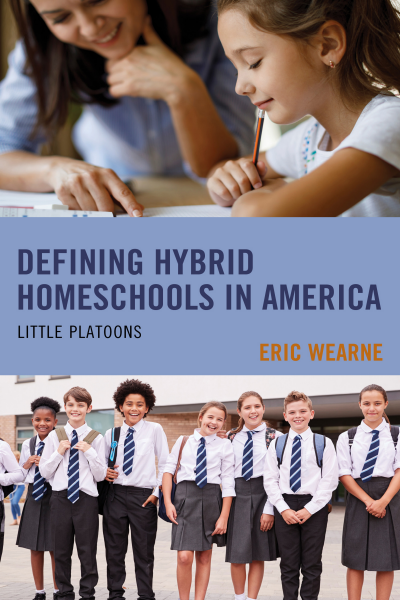
Defining Hybrid Homeschools in America: Little Platoons explores the idea of hybrid homeschools, where students attend a formal school setting for part of the week and are homeschooled the rest of the week. Eric Wearne observes that school choice in America typically comes in two forms: programs set up for disadvantaged students, and the more common form of choice that wealthy parents can exercise—paying private tuition or moving to a more desirable school district. While disadvantaged families in many places and wealthy families everywhere can exercise choice when it comes to schooling, a sizeable group typically gets left out of those options—the large number of families who are too wealthy to access state or local programs, but not wealthy enough to pay for private schooling or moving expenses. Wearne argues that this is a long-term weakness for school choice in America; the middle class is generally a well-off demographic, but is almost completely unserved when it comes to this large aspect of their children’s lives. However, one low-cost option has arisen to address this niche: hybrid home schools. Wearne cites existing research to argue for this model’s efficacy for the middle class as a strong example of a healthy civil society and examines how policy definitions are breaking down and evolving in education as we challenge the existing definitions of schooling.
Keywords
Search publication
Bibliographic data
Edition
1/2020
Copyright Year
2020
ISBN-Print
978-1-7936-0633-4
ISBN-Online
978-1-7936-0634-1
Publisher
Lexington, Lanham
Language
English
Pages
152
Product Type
Monograph
Table of contents
ChapterPages
Contents No access
Acknowledgments No access
Prologue No access
Chapter 1 Introduction No access Pages 1 - 18
Chapter 2 Homeschooling + Hybrid Homeschools Defined No access Pages 19 - 34