, to see if you have full access to this publication.
Monograph No access
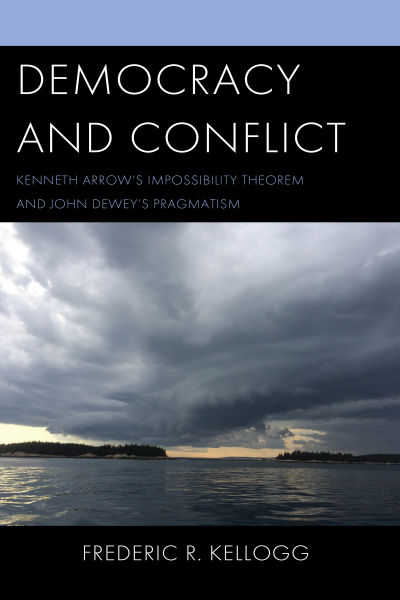
Democracy and Conflict
Kenneth Arrow's Impossibility Theorem and John Dewey's Pragmatism
Authors:
Publisher:
2023
Summary
The economist Kenneth Arrow proved in 1951 that a society of diverse individual preferences could only by ordered by dictatorship. His impossibility theorem is still an axiom of contemporary welfare economics and has never been seriously challenged. The American philosopher John Dewey, who died in 1952, had claimed that voting and electoral mechanisms do not define democratic self-government. His broad conception of social conflict addresses preference diversity and resolves Arrow’s impossibility.
Since the 1980s, political scientists have focused on decision through democratic “deliberation.” Dewey saw that conversation alone is inadequate for resolution of conflicts in a democracy. Conflict is accompanied by discourse, but preferences are grounded in habits. Social habits resist adjustment in response to discourse alone, but demonstrably adjust in the process of conflict resolution, Preference conflict is distinguished from Marxist and later models, as a discovery and transformation process. It advances an original, updated theory of social conflict in a democracy relevant to today's problematic situations from discrimination to climate change and political polarization.
Keywords
Search publication
Bibliographic data
Edition
1/2023
Copyright Year
2023
ISBN-Print
978-1-7936-5428-1
ISBN-Online
978-1-7936-5429-8
Publisher
Lexington, Lanham
Language
English
Pages
166
Product Type
Monograph
Table of contents
ChapterPages
Foreword No access
Introduction No access
Chapter 1: Kenneth Arrow’s General Possibility Theorem No access Pages 1 - 12