, to see if you have full access to this publication.
Monograph No access
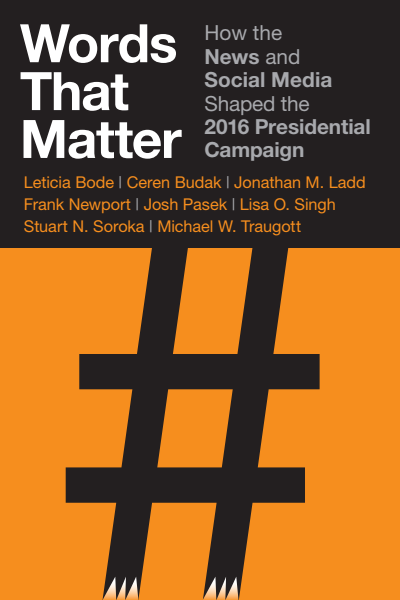
Words That Matter
How the News and Social Media Shaped the 2016 Presidential Campaign
Authors:
| |
Publisher:
2020
Summary
How the 2016 news media environment allowed Trump to win the presidency
The 2016 presidential election campaign might have seemed to be all about one man. He certainly did everything possible to reinforce that impression. But to an unprecedented degree the campaign also was about the news media and its relationships with the man who won and the woman he defeated.
Words that Matter assesses how the news media covered the extraordinary 2016 election and, more important, what information—true, false, or somewhere in between—actually helped voters make up their minds. Using journalists' real-time tweets and published news coverage of campaign events, along with Gallup polling data measuring how voters perceived that reporting, the book traces the flow of information from candidates and their campaigns to journalists and to the public.
The evidence uncovered shows how Donald Trump's victory, and Hillary Clinton's loss, resulted in large part from how the news media responded to these two unique candidates. Both candidates were unusual in their own ways, and thus presented a long list of possible issues for the media to focus on. Which of these many topics got communicated to voters made a big difference outcome.
What people heard about these two candidates during the campaign was quite different. Coverage of Trump was scattered among many different issues, and while many of those issues were negative, no single negative narrative came to dominate the coverage of the man who would be elected the 45th president of the United States. Clinton, by contrast, faced an almost unrelenting news media focus on one negative issue—her alleged misuse of e-mails—that captured public attention in a way that the more numerous questions about Trump did not.
Some news media coverage of the campaign was insightful and helpful to voters who really wanted serious information to help them make the most important decision a democracy offers. But this book also demonstrates how the modern media environment can exacerbate the kind of pack journalism that leads some issues to dominate the news while others of equal or greater importance get almost no attention, making it hard for voters to make informed choices.
Keywords
Search publication
Bibliographic data
Copyright Year
2020
ISBN-Print
978-0-8157-3191-7
ISBN-Online
978-0-8157-3192-4
Publisher
Rowman & Littlefield, Lanham
Language
English
Pages
backcover1
Product Type
Monograph
Table of contents
ChapterPages
Table of Contents No access
Acknowledgments No access
The Changed Information Environment of Presidential Campaigns No access Pages 1 - 10
What Might Have Made News: Big Issues, Historic Candidates, and Hillary Clinton's Strange Email Scandal No access Pages 11 - 34
What the Media Covered, Journalists Tweeted, and the Public Heard about the Candidates No access Pages 35 - 60
The August 2015 Republican Debate: A Study of Information Flow in the 2015-2016 Republican Nomination Contest No access Pages 61 - 82
The Language and Tone of the 2016 Campaign No access Pages 83 - 98
The Things People Heard about Trump and Clinton No access Pages 99 - 126
Public Attention to Events in the 2016 Election; What Mattered? No access Pages 127 - 152
Fake News Production and Consumption No access Pages 153 - 178
Conclusions: Determining What (Words) Mattered No access Pages 179 - 192
Appendix: Data and Methods No access Pages 193 - 214