, to see if you have full access to this publication.
Book Titles No access
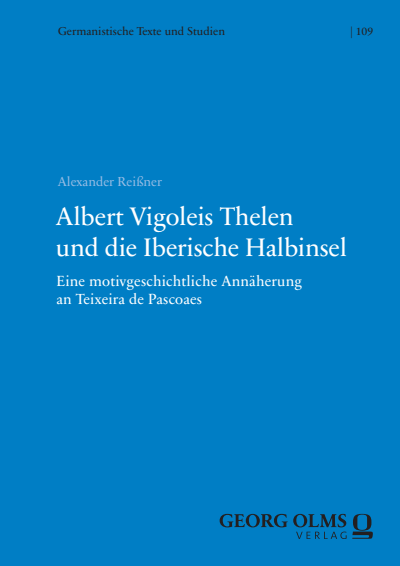
Albert Vigoleis Thelen und die Iberische Halbinsel
Eine motivgeschichtliche Annäherung an Teixeira de Pascoaes- Authors:
- Series:
- Germanistische Texte und Studien, Volume 109
- Publisher:
- 2024
Summary
The work of writer Albert Vigoleis Thelen (1903–1989) is almost unrivalled in the German literary landscape. It is certain that Thelen, as a cosmopolitan and frequent reader, was inspired by several trends at once. He eagerly quoted mystics, German writers and philosophers. He benefited greatly from Dutch literature and its representatives, with whom Thelen was in lively dialogue. However, this comparative study follows the thesis that the pivotal point for Thelenʼs understanding of literature is to be found on the Iberian Peninsula and in particular in his critical dialogue with the Portuguese poet and mystic Teixeira de Pascoaes (1877–1952), with whom he was also in personal contact.
Keywords
Search publication
Bibliographic data
- Copyright year
- 2024
- ISBN-Print
- 978-3-487-16784-8
- ISBN-Online
- 978-3-487-16785-5
- Publisher
- Georg Olms Verlag, Baden-Baden
- Series
- Germanistische Texte und Studien
- Volume
- 109
- Language
- German
- Pages
- 278
- Product type
- Book Titles
Table of contents
ChapterPages
- Titelei/Inhaltsverzeichnis No access Pages 1 - 8
- 1. Vorwort No access Pages 9 - 14
- 2.1.1. Allgemeiner Abriss über den Positivismus No access
- 2.1.2. Der Erste Weltkrieg No access
- 2.1.3. Die Gegenbewegung: von Mises No access
- 2.1.4. Vitalismus: Bergson No access
- 2.1.5. Die metaphysische Reaktion No access
- 2.1.6. Unamuno No access
- 2.2.1. Die Iberische Erneuerung No access
- 2.2.2. Die Wissenschaft No access
- 2.2.3. Die Geschichtsschreibung No access
- 2.2.4. Die Wahrheit No access
- 2.2.5. Die Phantasie No access
- 2.2.6. Der Dichter No access
- 2.3.1. Der Wissenschaftler No access
- 2.3.2. Etwas zu Thelens Wahrheitsbegriff No access
- 2.3.3. Die Führerepisode No access
- 2.3.4. Zeitungsaustellung Pressa No access
- 2.3.5. Phantasie und Wahrheit No access
- 2.3.6. Legende No access
- 3.1.1. Der Gläubige No access
- 3.1.2. Mystik No access
- 3.1.3. Mystik und Amtskirche No access
- 3.1.4. Schmerz No access
- 3.1.5. Die Leib-Seele-Spaltung No access
- 3.1.6. Die Zeit No access
- 3.1.7. Die Sprache No access
- 3.2.1. Der Zweifel No access
- 3.2.2. Die Sünde No access
- 3.2.3. Die Kirche No access
- 3.2.4. Saudade No access
- 3.2.5. Der positivistische Glaube No access
- 3.2.6. Die Mystik No access
- 3.3.1. Die Kirche No access
- 3.3.2. Die Theologie No access
- 3.3.3. Der Gläubige No access
- 3.3.4. Die Mystik No access
- 3.3.5. Gott No access
- 3.3.6. Die Schöpfung No access
- 3.3.7. Geliehene Existenz No access
- 4.1.1. Das Gesicht Europas No access
- 4.1.2. Jacob Burckhardt No access
- 4.1.3. Arthur Schopenhauer No access
- 4.1.4. Friedrich Nietzsche No access
- 4.1.5. José Ortega y Gasset No access
- 4.1.6. Miguel de Unamuno No access
- 4.2.1. Das Frauenbild No access
- 4.2.2. Masse und Individuum No access
- 4.2.3. Darwinismus No access
- 4.2.4. Der exemplarische Charakter No access
- 4.2.5. Nero No access
- 4.2.6. Der Christ No access
- 4.2.7. Die erhabene Tat No access
- 4.2.8. Napoleon und Paulus No access
- 4.2.9 Unsterblichkeit No access
- 4.3.1. Die Masse No access
- 4.3.2. Der Bürger No access
- 4.3.3. Der Adel No access
- 4.3.4. Faschismus No access
- 4.3.5. Spanien und Deutschland No access
- 4.3.6. Individuum No access
- 4.3.7. Das Frauenbild No access
- 5. Nachwort No access Pages 253 - 262
- 6. Literaturliste No access Pages 263 - 278