, to see if you have full access to this publication.
Monograph No access
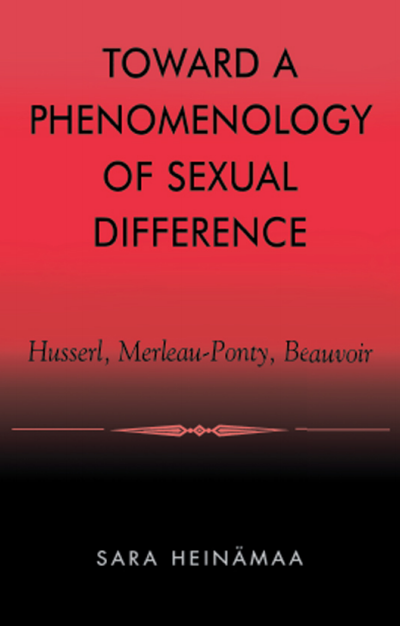
Toward a Phenomenology of Sexual Difference
Husserl, Merleau-Ponty, Beauvoir
Authors:
Publisher:
2004
Summary
Simone de Beauvoir's Le Deuxi_me Sexe has been studied extensively since its appearance in 1949. Through the years, certain passages have taken on prestige; others are seen as unimportant to understanding Beauvoir's argument. In Toward a Phenomenology of Sexual Difference, Sara HeinSmaa rediscovers those neglected passages in her quest to follow Beauvoir's line of thinking. HeinSmaa, like some other recent philosophers, finds that Le Duexi_me Sexe is a philosophical inquiry, not the empirical study it is commonly thought to be. Others who view Beauvoir's masterpiece as a work of philosophy argue it is a criticism not only of Sartrean phenomenology, but of phenomenology as a whole. HeinSmaa thinks differently. She finds that Beauvoir's starting point is the Husserlian idea of the living body that she found developed in Merleau-Ponty's PhZnomZnologie de la perception. So when Beavoir wrote Le Duexi_me Sexe, she was writing not as Sartre's pupil, but as a scholar in the tradition of Husserl and Merleau-Ponty.
Search publication
Bibliographic data
Edition
1/2004
Copyright Year
2004
ISBN-Print
978-0-8476-9785-4
ISBN-Online
978-0-585-46190-8
Publisher
Rowman & Littlefield, Lanham
Language
English
Pages
159
Product Type
Monograph
Table of contents
ChapterPages
Table of Contents No access
List of Abbreviations No access
Introduction No access
Chapter 1: The Philosopher and the Writer No access Pages 1 - 20
Chapter 2: The Living Body No access Pages 21 - 52
Chapter 3: Sexual and Erotic Bodies No access Pages 53 - 80
Chapter 4: Questions about Women No access Pages 81 - 100
Chapter 5: A Genealogy of Subjection No access Pages 101 - 124
Chapter 6: The Mythology of Femininity No access Pages 125 - 136