, to see if you have full access to this publication.
Monograph No access
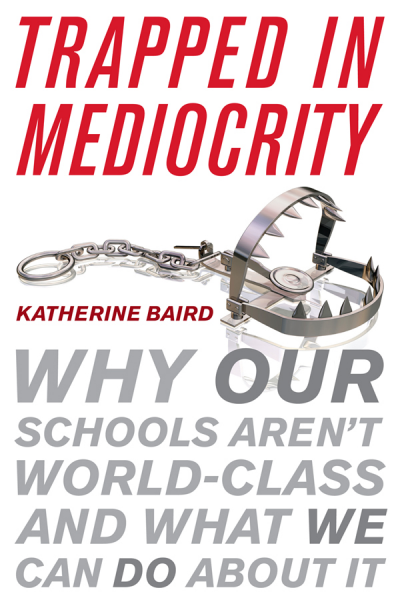
Trapped in Mediocrity
Why Our Schools Aren't World-Class and What We Can Do About It
Authors:
Publisher:
2012
Summary
Our students aren’t learning, we’re falling behind other countries, and many of our college graduates are even functionally illiterate. We offer our kids a weak and poorly thought out curriculum; too many teachers do not make good use of classroom time and follow lesson plans that are superficial and repetitive; almost all state governments define “proficiency” at low levels of competency; and because kids with very uneven skills populate a classroom, teachers spend considerable time on review before introducing new material. This dismal picture is tempered by the fact that the hard work and dedication of countless teachers and administrators means that many students get an excellent education. But it doesn’t temper it much. As a group, even our top students are not as strong as are those in a large majority of other rich countries.
But it doesn’t have to be this way. Katherine Baird, an economist, starts by clearly spelling out how our educational system is trapped in mediocrity. Yet, she doesn’t just expose where we are. She identifies the steps to get out of the trap. We need to (1) dramatically reform our education’s governance structure, (2) establish high expectations for all students, (3) provide adequate support to meet those expectations, and (4) introduce strong incentives for students to work hard in school so they do their part in meeting higher standards. Clearly, it isn’t as simple as it sounds, but Baird carefully examines each factor that has led to the current state in education and then spells out how a combination of policies will weaken the forces that keep our schools mediocre and instead make them ones worth copying
Search publication
Bibliographic data
Edition
1/2012
Copyright Year
2012
ISBN-Print
978-1-4422-1547-4
ISBN-Online
978-1-4422-1549-8
Publisher
Rowman & Littlefield, Lanham
Language
English
Pages
244
Product Type
Monograph
Table of contents
ChapterPages
Contents No access
Acknowledgments No access
Introduction No access Pages 1 - 12
Chapter 1. A Historical and Comparative Perspective on the United States’ Educational System No access
Chapter 2. Just How Low Are Our Educational Standards? No access
Chapter 3. The Consequences of Low Expectations for Student Effort No access
Chapter 4. Low Standards Compromise Higher Education’s Mission No access
Chapter 5. Reduced Productivity and Increased Wage Disparities No access
Chapter 6. Low Standards Harm Those We Assume Are Helped No access
Chapter 7. The Tyranny of Too Many Voices, or “Too Many Cooks Spoil the Broth” No access
Chapter 8. Exit, Voice, and the “Something for Everyone” Curriculum No access
Chapter 9. Soft America Meets Hard America:The Perceived High Costs and Low Benefits of High Expectations No access