, to see if you have full access to this publication.
Edited Book No access
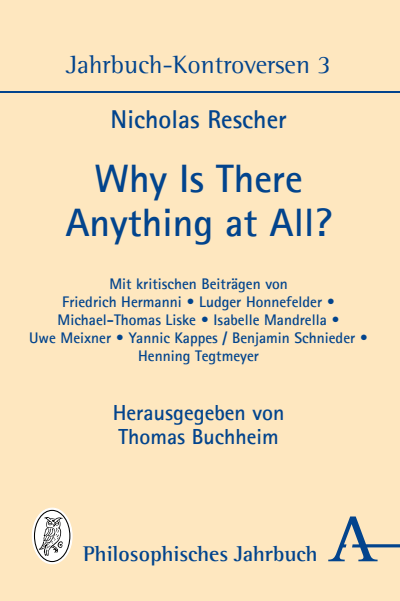
Why Is There Anything at All?
Jahrbuch-Kontroversen 3- Editors:
- |
- Publisher:
- 2019
Keywords
Search publication
Bibliographic data
- Copyright Year
- 2019
- ISBN-Print
- 978-3-495-48934-5
- ISBN-Online
- 978-3-495-81739-1
- Publisher
- Karl Alber, Baden-Baden
- Language
- German
- Pages
- 200
- Product Type
- Edited Book
Table of contents
ChapterPages
- Titelei/Inhaltsverzeichnis No access Pages 1 - 4
- Inhalt No access Pages 5 - 6
- Vorwort des Herausgebers No access Pages 7 - 8
- 1. The Question No access
- 2. Distributive explanation cannot do the job? No access
- 3. The need for oddity: Abandoning causality No access
- The Turn to Metaphysical Possibility No access
- The Turn to Eliminative Value No access
- 5. The crux is not causal production but possibility elimination No access
- 6. Explaining the optimality principle: Self-explanation as the pivot No access
- 7. More on optimalism No access
- 8. The standard of metaphysical value: Noophelia and the pivotal role of intelligence No access
- 9. Reason’s self-reliance is not vicious but virtuous No access
- 10. The perspective of theology No access
- 11. Historical contextualization No access
- BIBLIOGRAPHY No access
- I. Ist die Welt erklärungsbedürftig? No access
- II. Ist die Welt distributiv erklärbar? No access
- III. Ist die Welt axiogenetisch erklärbar? No access
- IV. Ist die Welt ontotheologisch erklärbar? No access
- 1. Siglen No access
- 2. Weitere Literatur No access
- I. No access
- II. No access
- III. No access
- IV. No access
- V. No access
- 1.1 Johannes Duns Scotus No access
- 1.2 Thomas von Aquin No access
- 1.3 Leibniz No access
- 2. Weitere Literatur No access
- 1. Aristoteles’ Konzeption: Die Faktizität ist vorausgesetzt, wenn sinnvoll nach dem Warum gefragt werden soll No access
- 2.1 Wenn mit dem Möglichsein bereits das Wirklichsein gegeben ist, bedeutet dies Notwendigkeit No access
- 2.2 Sind sittliche Werte in sich selbst gegründet? No access
- 2.3 Die Konzeptionen einer causa sui und der Essenz Gottes, die die Existenz einschließt, implizieren, dass eine Selbstbegründung nur beim Notwendigen denkbar ist No access
- 3.1 Ist die Darstellung als Gottes Wahl des Besten oder die als Wettstreit subsistierender Möglicher die eigentliche? No access
- 3.2 Inwiefern begründet das Optimierungsprinzip sich selbst? No access
- 3.3 Leibniz verwirft in „De rerum originatione radicali“ entschieden ein sich selbst begründendes kontingent Existierendes No access
- 4.1 Es gibt notwenige Zusammenhänge, aber es ist problematisch, ein notwendig Seiendes zu konzipieren No access
- 4.2 Lässt sich sinnvoll nur Kontingentes begründen und gilt Leibniz’ Prinzip des zureichenden Grundes daher nur vom Kontingenten? No access
- 4.3 Können wir die Selbstoptimierung der Welt in natürlichen Evolutionsprozessen und Gottes Wahl einer bestmöglichen Ordnung als komplementäre Sichtweisen betrachten? No access
- 1. Siglen No access
- 2. Weitere Literatur No access
- I. No access
- II. No access
- III. No access
- IV. No access
- 1. Siglen No access
- 2. Weitere Literatur No access
- 1. There is more than one concept of existence – Comments on section 1 No access
- 2. Distributive and collective explanation are not so very different – Comments on section 2 No access
- 3. Causality is relevant to answering the Leibnizian Question – Comments on section 3 No access
- 4. Mere rejection is not enough – Comments on section 4 No access
- 5. Massive implausibility – Comments on section 5 No access
- 6. The Optimality Principle is neither self-explaining nor self-sustaining, and it is not helpful – Comments on section 6 No access
- 7. Optimalism is not needed – Comments on section 7 No access
- 8. Overestimation of intelligence and lack of consistency – Comments on section 8 No access
- 9. Self-sufficient reason? – Comments on section 9 No access
- 10. God is not the equivalent of a principle – Comments on sections 10 and 11 No access
- § 1. Where It all Started No access
- § 2a. The Shallowest Question No access
- § 2b. Further Grand and Shallow Questions No access
- § 3. ‘42’ – In Search of a Question No access
- § 4a. Companions of Questions: Inquisitive Interests No access
- § 4b. Inquisitive Interests in More Profound Answers No access
- § 4c. Any Right at All? No access
- § 5. Profound Answers to the First Question: Explanations by Status No access
- § 6. Profound Answers to the First Question: The Optimality Principle No access
- § 7. Conclusion No access
- BIBLIOGRAPHY No access
- 1. A meaningful question No access
- 2. Leibnizian ruminations No access
- 3. Optimalism as an explanatory principle No access
- 4. Theism No access
- 5. Conclusion No access
- BIBLIOGRAPHY No access
- Preliminaries No access
- 1. The Problem of Contingent Existence No access
- 2. The Methodology of Grounding No access
- 3. Contingency Problems No access
- 4. The Problem of Explanation and Grounding: What Is One Asking for? No access
- 5. Substance Bias and Theology No access
- 6.The Principle of Sufficient Reason No access
- 7. Explaining Existence No access
- 8. The Optimality Principle No access
- 9. Counterfactual Problems No access
- 10. World Optimality No access
- 11. Why Rationality? No access
- 12. The Rationale of Optimalism No access
- 13. Why not Perfection? No access
- 14. The Problem of Creative Production No access
- 15. Leibniz against Spinoza No access
- 16. Leibnizian Optimalism and Problems of World Improvement No access
- 17. Optimalism and Reason’s Self-Reliance No access
- 18. Is Optimalism Purposive? No access
- 19. Optimality and Theism No access
- 20. Concluding Observations No access
- REFERENCES No access
- § 1. A Question, a Simple Answer, and a Series of Confusions No access
- § 2. The Optimality Principle No access
- § 3. Optimality and Optimism No access
- BIBLIOGRAPHY No access
- 1. Letztbegründung No access
- 2. Inwiefern ist das in sich begründete Sein das Letzte? No access
- 3. Lässt sich ein Übergang von der Möglichkeit zur Wirklichkeit ohne das kausale Wirken eines Schöpfergottes durch den Optimalismus erklären? No access
- 4. Lässt sich das faktische Existieren von etwas als vernünftig begründen, indem zugleich das mögliche Nichtexistieren vernünftig erklärbar ist? No access
- LITERATURVERZEICHNIS No access
- 1. Rescher on collective and distributive explanations No access
- 2. Rescher’s attack on traditional metaphysics No access
- 3. The central point of controversy No access
- 4. Rescher on how this world can be the best of all possible worlds No access
- 5. Lamenting the badness of what (its badness notwithstanding) just has to be the best? No access
- 6. Every world, if it is the actual world, is the best of all possible worlds? No access
- 7. How to explain why something exists contingently No access
- BIBLIOGRAPHY No access