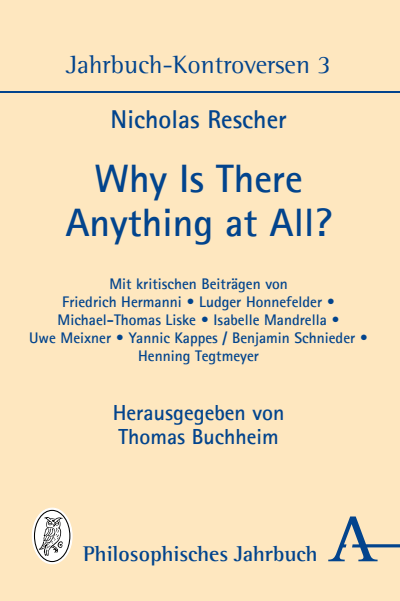
Why Is There Anything at All?
Jahrbuch-Kontroversen 3- Herausgeber:innen:
- |
- Verlag:
- 2019
Zusammenfassung
Mit einem Initiativartikel von Nicholas Rescher, einem der profiliertesten Metaphysiker der Gegenwart, wird die dritte Jahrbuch-Kontroverse eröffnet, diesmal zu einem klassisch metaphysischen Hauptthema, nämlich der Frage von Leibniz: »Warum gibt es überhaupt etwas und nicht vielmehr nichts?« Mag zunächst der Gedanke naheliegend erscheinen, dass da, wo nichts ist, auch keinerlei fundierende Gründe bestehen können, mit Rückgriff auf die sich begründen ließe, dass überhaupt etwas existiert. So zeigt Rescher doch auf, dass sehr wohl rationale Erwägungen möglich sind, die der Annahme, dass überhaupt etwas ist, in genereller Weise den Vorzug geben gegenüber der Auffassung, dass nichts existiert. Der Existenz zumindest mancher Dinge wohnt ein solcher rationaler Vorzug oder »optimality« inne, dass demgegenüber ›nichts‹ als eine bloß nachgeordnete und darum voraussetzungsreichere Angelegenheit erscheint. Der Band enthält neben dem Initiativaufsatz die zwischen 2016 und 2017 im Philosophischen Jahrbuch erschienenen kritischen Diskussionsbeiträge von Friedrich Hermanni, Ludger Honnefelder, Michael-Thomas Liske, Isabelle Mandrella, Uwe Meixner, Benjamin Schnieder und Henning Tegtmeyer. Auf diese Diskussionsbeiträge zu seinem Initiativtext folgt eine ausführliche Replik Nicholas Reschers, die sich mit den Positionen und Argumenten seiner deutschen Kollegen auseinandersetzt.
Schlagworte
Publikation durchsuchen
Bibliographische Angaben
- Copyrightjahr
- 2019
- ISBN-Print
- 978-3-495-48934-5
- ISBN-Online
- 978-3-495-81739-1
- Verlag
- Karl Alber, Baden-Baden
- Sprache
- Deutsch
- Seiten
- 200
- Produkttyp
- Sammelband
Inhaltsverzeichnis
- Titelei/Inhaltsverzeichnis Kein Zugriff Seiten 1 - 4
- Inhalt Kein Zugriff Seiten 5 - 6
- Vorwort des Herausgebers Kein Zugriff Seiten 7 - 8
- 1. The Question Kein Zugriff
- 2. Distributive explanation cannot do the job? Kein Zugriff
- 3. The need for oddity: Abandoning causality Kein Zugriff
- The Turn to Metaphysical Possibility Kein Zugriff
- The Turn to Eliminative Value Kein Zugriff
- 5. The crux is not causal production but possibility elimination Kein Zugriff
- 6. Explaining the optimality principle: Self-explanation as the pivot Kein Zugriff
- 7. More on optimalism Kein Zugriff
- 8. The standard of metaphysical value: Noophelia and the pivotal role of intelligence Kein Zugriff
- 9. Reason’s self-reliance is not vicious but virtuous Kein Zugriff
- 10. The perspective of theology Kein Zugriff
- 11. Historical contextualization Kein Zugriff
- BIBLIOGRAPHY Kein Zugriff
- I. Ist die Welt erklärungsbedürftig? Kein Zugriff
- II. Ist die Welt distributiv erklärbar? Kein Zugriff
- III. Ist die Welt axiogenetisch erklärbar? Kein Zugriff
- IV. Ist die Welt ontotheologisch erklärbar? Kein Zugriff
- 1. Siglen Kein Zugriff
- 2. Weitere Literatur Kein Zugriff
- I. Kein Zugriff
- II. Kein Zugriff
- III. Kein Zugriff
- IV. Kein Zugriff
- V. Kein Zugriff
- 1.1 Johannes Duns Scotus Kein Zugriff
- 1.2 Thomas von Aquin Kein Zugriff
- 1.3 Leibniz Kein Zugriff
- 2. Weitere Literatur Kein Zugriff
- 1. Aristoteles’ Konzeption: Die Faktizität ist vorausgesetzt, wenn sinnvoll nach dem Warum gefragt werden soll Kein Zugriff
- 2.1 Wenn mit dem Möglichsein bereits das Wirklichsein gegeben ist, bedeutet dies Notwendigkeit Kein Zugriff
- 2.2 Sind sittliche Werte in sich selbst gegründet? Kein Zugriff
- 2.3 Die Konzeptionen einer causa sui und der Essenz Gottes, die die Existenz einschließt, implizieren, dass eine Selbstbegründung nur beim Notwendigen denkbar ist Kein Zugriff
- 3.1 Ist die Darstellung als Gottes Wahl des Besten oder die als Wettstreit subsistierender Möglicher die eigentliche? Kein Zugriff
- 3.2 Inwiefern begründet das Optimierungsprinzip sich selbst? Kein Zugriff
- 3.3 Leibniz verwirft in „De rerum originatione radicali“ entschieden ein sich selbst begründendes kontingent Existierendes Kein Zugriff
- 4.1 Es gibt notwenige Zusammenhänge, aber es ist problematisch, ein notwendig Seiendes zu konzipieren Kein Zugriff
- 4.2 Lässt sich sinnvoll nur Kontingentes begründen und gilt Leibniz’ Prinzip des zureichenden Grundes daher nur vom Kontingenten? Kein Zugriff
- 4.3 Können wir die Selbstoptimierung der Welt in natürlichen Evolutionsprozessen und Gottes Wahl einer bestmöglichen Ordnung als komplementäre Sichtweisen betrachten? Kein Zugriff
- 1. Siglen Kein Zugriff
- 2. Weitere Literatur Kein Zugriff
- I. Kein Zugriff
- II. Kein Zugriff
- III. Kein Zugriff
- IV. Kein Zugriff
- 1. Siglen Kein Zugriff
- 2. Weitere Literatur Kein Zugriff
- 1. There is more than one concept of existence – Comments on section 1 Kein Zugriff
- 2. Distributive and collective explanation are not so very different – Comments on section 2 Kein Zugriff
- 3. Causality is relevant to answering the Leibnizian Question – Comments on section 3 Kein Zugriff
- 4. Mere rejection is not enough – Comments on section 4 Kein Zugriff
- 5. Massive implausibility – Comments on section 5 Kein Zugriff
- 6. The Optimality Principle is neither self-explaining nor self-sustaining, and it is not helpful – Comments on section 6 Kein Zugriff
- 7. Optimalism is not needed – Comments on section 7 Kein Zugriff
- 8. Overestimation of intelligence and lack of consistency – Comments on section 8 Kein Zugriff
- 9. Self-sufficient reason? – Comments on section 9 Kein Zugriff
- 10. God is not the equivalent of a principle – Comments on sections 10 and 11 Kein Zugriff
- § 1. Where It all Started Kein Zugriff
- § 2a. The Shallowest Question Kein Zugriff
- § 2b. Further Grand and Shallow Questions Kein Zugriff
- § 3. ‘42’ – In Search of a Question Kein Zugriff
- § 4a. Companions of Questions: Inquisitive Interests Kein Zugriff
- § 4b. Inquisitive Interests in More Profound Answers Kein Zugriff
- § 4c. Any Right at All? Kein Zugriff
- § 5. Profound Answers to the First Question: Explanations by Status Kein Zugriff
- § 6. Profound Answers to the First Question: The Optimality Principle Kein Zugriff
- § 7. Conclusion Kein Zugriff
- BIBLIOGRAPHY Kein Zugriff
- 1. A meaningful question Kein Zugriff
- 2. Leibnizian ruminations Kein Zugriff
- 3. Optimalism as an explanatory principle Kein Zugriff
- 4. Theism Kein Zugriff
- 5. Conclusion Kein Zugriff
- BIBLIOGRAPHY Kein Zugriff
- Preliminaries Kein Zugriff
- 1. The Problem of Contingent Existence Kein Zugriff
- 2. The Methodology of Grounding Kein Zugriff
- 3. Contingency Problems Kein Zugriff
- 4. The Problem of Explanation and Grounding: What Is One Asking for? Kein Zugriff
- 5. Substance Bias and Theology Kein Zugriff
- 6.The Principle of Sufficient Reason Kein Zugriff
- 7. Explaining Existence Kein Zugriff
- 8. The Optimality Principle Kein Zugriff
- 9. Counterfactual Problems Kein Zugriff
- 10. World Optimality Kein Zugriff
- 11. Why Rationality? Kein Zugriff
- 12. The Rationale of Optimalism Kein Zugriff
- 13. Why not Perfection? Kein Zugriff
- 14. The Problem of Creative Production Kein Zugriff
- 15. Leibniz against Spinoza Kein Zugriff
- 16. Leibnizian Optimalism and Problems of World Improvement Kein Zugriff
- 17. Optimalism and Reason’s Self-Reliance Kein Zugriff
- 18. Is Optimalism Purposive? Kein Zugriff
- 19. Optimality and Theism Kein Zugriff
- 20. Concluding Observations Kein Zugriff
- REFERENCES Kein Zugriff
- § 1. A Question, a Simple Answer, and a Series of Confusions Kein Zugriff
- § 2. The Optimality Principle Kein Zugriff
- § 3. Optimality and Optimism Kein Zugriff
- BIBLIOGRAPHY Kein Zugriff
- 1. Letztbegründung Kein Zugriff
- 2. Inwiefern ist das in sich begründete Sein das Letzte? Kein Zugriff
- 3. Lässt sich ein Übergang von der Möglichkeit zur Wirklichkeit ohne das kausale Wirken eines Schöpfergottes durch den Optimalismus erklären? Kein Zugriff
- 4. Lässt sich das faktische Existieren von etwas als vernünftig begründen, indem zugleich das mögliche Nichtexistieren vernünftig erklärbar ist? Kein Zugriff
- LITERATURVERZEICHNIS Kein Zugriff
- 1. Rescher on collective and distributive explanations Kein Zugriff
- 2. Rescher’s attack on traditional metaphysics Kein Zugriff
- 3. The central point of controversy Kein Zugriff
- 4. Rescher on how this world can be the best of all possible worlds Kein Zugriff
- 5. Lamenting the badness of what (its badness notwithstanding) just has to be the best? Kein Zugriff
- 6. Every world, if it is the actual world, is the best of all possible worlds? Kein Zugriff
- 7. How to explain why something exists contingently Kein Zugriff
- BIBLIOGRAPHY Kein Zugriff