, to see if you have full access to this publication.
Monograph No access
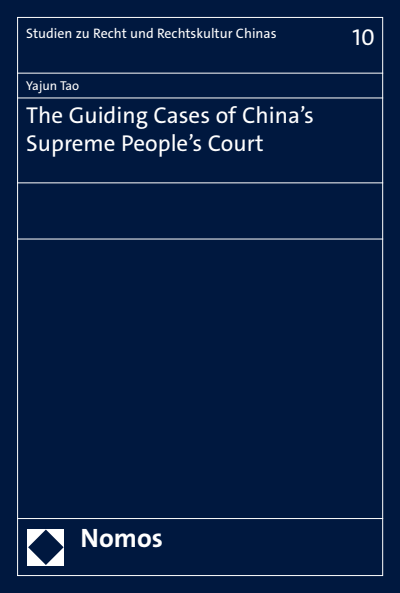
The Guiding Cases of China's Supreme People's Court
- Authors:
- Series:
- Studien zu Recht und Rechtskultur Chinas, Volume 10
- Publisher:
- 2023
Summary
This book studies the so-called guiding cases of the Supreme People's Court of the People's Republic of Chi-na. The guiding cases are selected by the Supreme People's Court from the judgments that have come into force and are published. Besides judicial interpretations, guiding cases are another tool the Supreme People's Court uses to attempt to influence the decisions and judgments of lower courts, but the results are not as explicit as they might be. An attempt is made in this book to explore, from different perspectives, the reasons why the guiding cases have not had the effect expected by the Supreme People's Court.
Keywords
Search publication
Bibliographic data
- Copyright Year
- 2023
- ISBN-Print
- 978-3-7560-0603-8
- ISBN-Online
- 978-3-7489-4139-2
- Publisher
- Nomos, Baden-Baden
- Series
- Studien zu Recht und Rechtskultur Chinas
- Volume
- 10
- Language
- English
- Pages
- 458
- Product Type
- Monograph
Table of contents
ChapterPages
- Titelei/Inhaltsverzeichnis No access Pages 1 - 14
- I. Subject matter No access
- II. Central research question No access
- 1. The ambiguous binding effect as a reason for the low application rate No access
- 2. The limited number of guiding cases as a reason for the low application rate No access
- 3. Chinese legal education as a reason for the low application rate No access
- 4. The content of guiding cases as a reason for their low application rate No access
- 5. The quality of guiding cases as a reason for the low application rate No access
- IV. Structure No access
- V. Research methods No access
- I. Introduction No access
- 1. Research on the cases issued by the SPC before 1985 No access
- a. Research on the objectives and content No access
- b. Research on the structure No access
- c. Research on the binding effect of guiding cases No access
- 3. Research on the objectives of the guiding cases system No access
- III. Cases and policy No access
- a. Raising public awareness of trial work and the socialist legal system No access
- b. Providing guidance and reference to lower courts No access
- a. Selection procedure No access
- b. Various types of typical cases No access
- a. Abstract of adjudication No access
- b. Focus of dispute No access
- 4. The impact of the SPC’s Gazette typical cases No access
- 5. The SPC Gazette’s typical cases and guiding cases No access
- a. Experiment in Henan No access
- aa. Sichuan High People’s Court No access
- bb. The Chengdu Intermediate People’s Court No access
- c. Experiment in Tianjin No access
- d. Experiment in Zhejiang No access
- aa. Similarities of local experimentation No access
- bb. The SPC’s attitude toward local courts’ experimentation No access
- a. The official establishment of the guiding cases system No access
- b. The regulations of the guiding cases system No access
- aa. Limiting the discretion of judges No access
- bb. Replacing official replies and simple replies of the SPC No access
- cc. Introducing guiding cases in addition to typical cases No access
- 1. Development of the similar-case searching mechanism No access
- 2. Practice of similar-case searching in local level courts No access
- 3. Combination of guiding cases and similar-case searching No access
- VII. Summary No access
- I. Introduction No access
- 1. Research on the issue of legal binding effect and guiding cases No access
- 2. Research on the factual binding effect No access
- a. Guiding cases as a new form of judicial interpretation No access
- b. Replacing judicial interpretations with guiding cases No access
- c. Guiding cases as a new legal source No access
- 1. “Refer to” in the context of the Administrative Litigation Law No access
- a. “Shall refer to” and “can refer to” No access
- b. “Shall refer to” and factual binding effect No access
- aa. Performance management and supervision by higher courts No access
- bb. Full consideration of guiding cases No access
- cc. Factual binding effect in the sense of the German legal system No access
- d. Ambiguous binding effect and low application rate No access
- a. The binding effect of guiding cases and China’s constitutional system No access
- b. Legal binding effect of judicial interpretations No access
- aa. The SPC as the highest authority in the court system No access
- bb. Legal basis for the guiding cases system according to the SPC No access
- cc. Lack of authorization from the legislator No access
- d. Strategic adjustments of the SPC No access
- a. Key points of adjudication No access
- b. Scope of the factual binding effect of guiding cases No access
- c. Key points of adjudication and application of guiding cases No access
- IV. Summary No access
- I. Introduction No access
- 1. Research on the selection procedure No access
- 2. Research on the editing of guiding cases No access
- 3. Research on the efficiency of the selection procedure No access
- III. Overall selection procedure according to SPC documents No access
- 1. SPC Research Office No access
- 2. Case Guidance Office No access
- 3. Trial divisions of the SPC No access
- 4. Temporary procedure of the guiding cases system No access
- 5. SPC circuit courts No access
- 6. SPC adjudication committee No access
- 1. Unbalanced contribution to guiding case applications No access
- 2. High courts No access
- 3. Intermediate and basic courts No access
- 4. Search and preparation work relating to potential guiding cases No access
- a. Application of directive cases No access
- b. Publication of directive cases No access
- c. Structure of directive cases No access
- d. Trial work documents of high courts No access
- e. Limited capacity of research offices at local levels No access
- 1. Keywords No access
- 2. Basic facts No access
- 3. Reasoning part No access
- 1. Evaluation No access
- 2. Rewards No access
- VIII. Summary No access
- I. Introduction No access
- 1. Research on the substantial standards of guiding cases No access
- 2. Research on the classification of guiding cases No access
- 1. Positive social effect No access
- 2. Avoiding controversial issues No access
- 3. Typicality and representativeness No access
- a. Cases applying new law No access
- b. Cases responding to public concerns No access
- 2. Cases correcting mistakes in applying the law No access
- 3. Cases that change the law No access
- a. Providing definitions of legal concepts No access
- b. Applying analogy and extensive interpretation No access
- c. Filling legal loopholes No access
- d. Providing evidence rules No access
- V. Summary No access
- I. Introduction No access
- 1. Research on the general statistics No access
- 2. Research on judges’ guiding-case applications No access
- 3. Research on parties’ references to guiding cases No access
- 4. Research on the comparison points No access
- 5. Research on guiding cases and administrative organs No access
- 1. Active application No access
- 2. Judges’ preference for implicit application No access
- 3. Pragmatic application of cases No access
- a. Judges’ training No access
- b. Legal education in colleges and universities No access
- 1. In pursuit of interests by parties No access
- 2. Guiding cases proposed by parties without response from judges No access
- 1. Key points of adjudication No access
- 2. Guiding cases as arguments No access
- 3. Citation of the reasoning part in guiding cases No access
- 4. Flexible application of guiding cases No access
- 1. Difference in facts No access
- 2. Difference in law application No access
- 3. Insufficient proof No access
- a. Influence on administrative regulation No access
- b. Influence on local government rules No access
- a. Influence on administrative organs in judicial practice No access
- b. Limted influence on administrative organs in executive practice No access
- VIII. Summary No access
- Chapter 7: Conclusion No access Pages 397 - 410
- Appendix No access Pages 411 - 426
- List of References No access Pages 427 - 458