, to see if you have full access to this publication.
Monograph No access
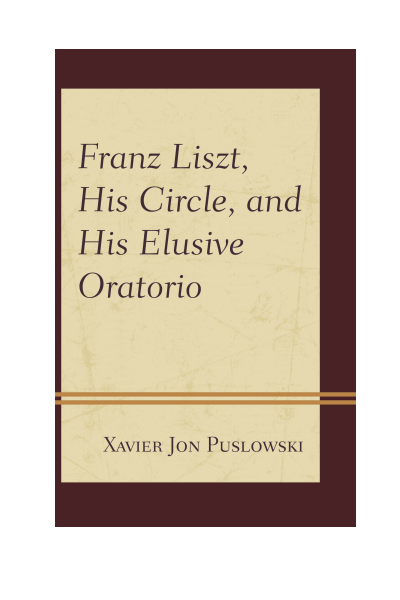
Franz Liszt, His Circle, and His Elusive Oratorio
Authors:
Publisher:
2014
Summary
Many scholars, concert pianists, and classical music fans deem Franz Liszt the preeminent pianist of the nineteenth century. In Franz Liszt, His Circle, and His Elusive Oratorio, Xavier Puslowski engages in a detailed study of the links between Liszt, his contemporaries, and his milieu. Drawing on Liszt’s famous Saint Stanislas Oratorio as a focal point, Puslowski brings together the history of the Romantic period in classical music and the intersection of key figures and historical events in his story of Liszt’s achievements told from a distinctly historicist perspective.
Readers get a new view of Liszt as Puslowski brings together a remarkable cast of characters. Friend and rival, Frederic Chopin, stands tall as a symbol of Poland’s fight for independence; the remarkable French “people’s poet” Pierre Beranger makes his entrance; virtuoso violinist Niccolo Paganini takes center stage later in Liszt’s life; the indefatigable French composer Hector Berlioz and the domineering Richard Wagner assume their roles in this musical drama; and finally two of Poland’s premier violinists, Karol Lipinski and Henryk Wieniawski, stand side by side with Russian pianist Anton Rubinstein, as the story of Liszt’s influence reaches across national boundaries and time itself to make its presence felt.
Search publication
Bibliographic data
Edition
1/2014
Copyright Year
2014
ISBN-Print
978-1-4422-3802-2
ISBN-Online
978-1-4422-3803-9
Publisher
Rowman & Littlefield, Lanham
Language
English
Pages
193
Product Type
Monograph
Table of contents
ChapterPages
Contents No access
Preface No access
Chapter One: Romanticism and the Musical Background No access Pages 1 - 8
Chapter Two: Youth and the Prodigy No access Pages 9 - 14
Chapter Three: Béranger and the 1830 Revolution No access Pages 15 - 38
Chapter Four: Paganini and His Crucial Influence No access Pages 39 - 50
Chapter Five: Liszt and the Polish Pianist No access Pages 51 - 64
Chapter Six: Chopin and the Polish Bowman No access Pages 65 - 72
Chapter Seven: Chopin and Polish Romanticism No access Pages 73 - 80
Chapter Eight: Liszt and the Great Virtuosity No access Pages 81 - 94
Chapter Nine: Chopin and His Letters No access Pages 95 - 98
Chapter Ten: The Princess and Settlement at Weimar No access Pages 99 - 128
Chapter Eleven: Liszt and His Three Lives No access Pages 129 - 136
Chapter Twelve: Wieniawski and the Hard-Earned Years No access Pages 137 - 146
Chapter Thirteen: Liszt and the Polish Oratorio No access Pages 147 - 158
Chapter Fourteen: The Survivor and His Friends No access Pages 159 - 166
Chapter Fifteen: The Decline and End No access Pages 167 - 172