Book Titles Open Access Full access
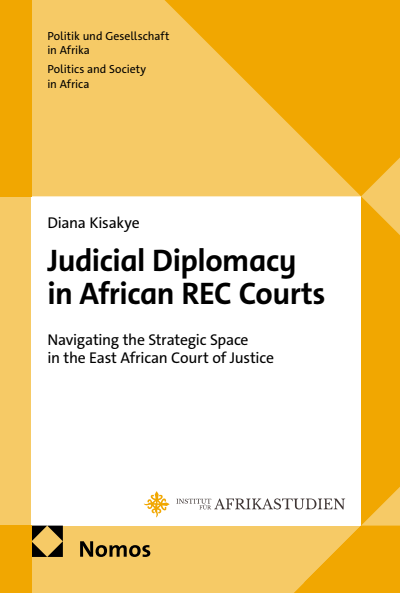
Judicial Diplomacy in African REC Courts
Navigating the Strategic Space in the East African Court of Justice- Authors:
- Series:
- Politik und Gesellschaft in Afrika | Politics and Societies in Africa, Volume 16
- Publisher:
- 2025
Summary
This book offers an intricate account of the legal, socio-economic, and political considerations that young international courts go through while trying to establish institutional authority. Drawing on a wealth of original ethnographic and archival data, it advances our understanding of international adjudication beyond prevailing state-centric explanations. Through the lens of judicial diplomacy, it offers a window into understanding the contemporary transformations of international judicial relations. It foregrounds judicial on-bench and off-bench activities as equally important attributes of the judicial process. This Title is also Available as Open Access.
Keywords
Search publication
Bibliographic data
- Copyright year
- 2025
- ISBN-Print
- 978-3-7560-2016-4
- ISBN-Online
- 978-3-7489-5553-5
- Publisher
- Nomos, Baden-Baden
- Series
- Politik und Gesellschaft in Afrika | Politics and Societies in Africa
- Volume
- 16
- Language
- English
- Pages
- 318
- Product type
- Book Titles
Table of contents
ChapterPages
- Acknowledgements
- Abbreviations and Acronyms
- 1.1 Research Questions
- 1.2 Project Rationale
- 1.3 Project Aims
- 1.4 Dissertation Outline
- 2.1 Realist Explanations
- 2.2 Rational Choice Institutionalism
- 2.3.1 Trustee Theories
- 2.3.2 Constrained Independence Theory
- 2.3.3 The Altered Politics Framework
- 2.4 Constructivist Accounts
- 2.5.1 Extraversion Explanations
- 2.5.2 Critical Studies of African ICs
- 2.5.3 Neither Agents nor Trustees
- 2.6.1 Defining Judicial Diplomacy
- 2.6.2 Theoretical Take of Thesis
- 3.1 Case Selection
- 3.2.1 Case Mapping
- 3.2.2.1 Selecting Research Participants
- 3.2.2.2 Interview Methods Appendix
- 3.2.2.3 Interview Summary
- 3.2.3 Participant Observation
- 3.3 Navigating Access Limitations
- 3.4 Analytic Approach
- 3.5 Reflections on Positionality
- 4.1.1 EACJ Mandate
- 4.1.2 Composition and Leadership
- 4.2.1 Meagre Budget Allocation
- 4.2.2 Ad hoc Service and Double Agency
- 4.2.3 Opaque Judicial Appointments
- 4.2.4 Not an Appellate Court!
- 4.3 Resistance in a Strategic Space
- 5.1 Judicial Biographies
- 5.2.1 Mobilising Judicial Allies
- 5.2.2 Legal Norm Socialisation
- 5.3 From “Legal Cocoon” to Initial Backlash
- 5.4.1 Formally Recording Pressures
- 5.4.2 Reactive Scholarly Engagement
- 5.4.3 Expansive Interpretation of Legal Principles
- 5.5 East Africa Law Society to the Rescue
- 5.6 The Makings of a “Bold” Bench
- 6.1.1 Drawing Inspiration from Other ICs
- 6.1.2 Mapping the Human Rights Trajectory
- 6.2.1 Evidence and Fact-finding Assistance
- 6.2.2 Initiating Strategic Litigation
- 6.3.1 Streamlining EAC Institutions
- 6.3.2.1 Jurisdictional Limitations
- 6.3.2.2 Avoidance through the Statute of Limitations
- 6.3.2.3 Vague Explanations
- 6.3.3.1 Opening of Sub-registries
- 6.3.3.2 Engaging Academic Audiences
- 6.4 From Human Rights to Commercial Bench
- 7.1 Cooperative Solutions over Litigation
- 7.2 Limited Jurisdiction
- 7.3.1 Beyond Declaratory Orders
- 7.3.2 The BAT case: Pushback against a Trendsetter
- 7.3.3 The Emergence of Silent Compliance
- 7.4.1 Intervention in Megapolitical Disputes
- 7.4.2 Challenging Judicial Appointments
- 7.5.1 Between Avoidance and Activism
- 7.5.2 Whither Consensual Decision-making?
- 7.6.1 Lobbying for Funding
- 7.6.2 Localisation of Hearings
- 7.6.3 Forging Judicial Alliances
- 7.6.4 Allies in the Media and Academy
- 7.6.5 Digital Socialisation
- 7.7 Towards a “Commercial” Bench
- 8.1 The Significance of Appointments
- 8.2.1 Judicial Diplomacy On-bench
- 8.2.2 Judicial Diplomacy Off-bench
- 8.2.3 On the Role of Allies
- 8.3 Unexpected Interventions
- 9.1 Main Findings
- 9.2 Lessons and Implications for Research and Policy
- Chapter 3
- Chapter 4
- Chapter 5
- Chapter 6
- BibliographyPages 295 - 318 Download chapter (PDF)