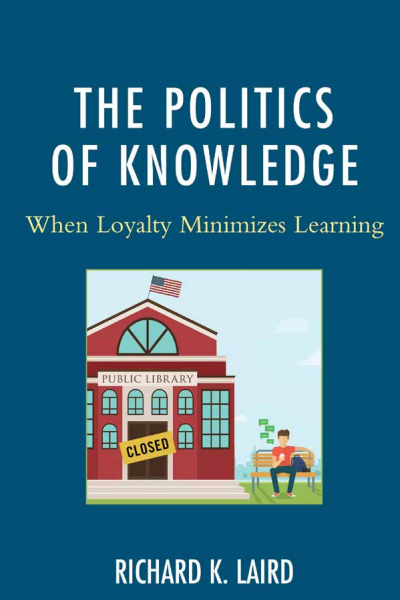
The Politics of Knowledge
When Loyalty Minimizes Learning- Authors:
- Publisher:
- 2019
Summary
Whether or not the U.S. is in decline can be debated, but there is evidence that its political system is becoming less able to solve major problems. This is in part because loyalty to a belief or an ideology may be taking priority over learning how to understand the problems. This work attempts to revitalize the importance of learnability by reviewing some fundamentals of who we are, how the system works, and why learning is difficult. Humans driven by opinions and perceptions tend to discount politics similar to the way they might discount science, yet it was the study of science and politics that brought much of mankind to remarkably higher standards of living. Government, and the economic system it implemented, was initially designed for the purpose of channeling self-interests into public benefits. Understanding what an inclusive political culture is, or why there is a Constitution, for example, could be useful toward restoring the credibility of our central political organization, the core of society’s stability and development. We are losing respect for our government’s decision-making ability, but in a democracy, citizens must be held more accountable for who their government is. The hypothesis is that if more humans are more learnable, we will increase the possibilities for finding the “best” solutions to big problems.
Search publication
Bibliographic data
- Edition
- 1/2019
- Copyright Year
- 2019
- ISBN-Print
- 978-1-4985-7599-7
- ISBN-Online
- 978-1-4985-7600-0
- Publisher
- Lexington, Lanham
- Language
- English
- Pages
- 300
- Product Type
- Monograph
Table of contents
- Contents No access
- The Dangers of Discounting Knowledge No access
- Not Preachin’ to the Choir No access
- Notes No access
- More, or Less, On College No access
- Making a Comparison for More Learning No access
- Dealing with the Inevitable Dilemmas No access
- A Comment on “Easier and/or Faster” No access
- Notes No access
- ERRGH! Fire! . . . hmm . . . not so bad No access
- From Simple Groups to “Civilized” Society to the Modern State to the Civilization of Society No access
- Words to Reading to Knowledge to Learning No access
- An “Extra-Strength” Interlude No access
- The Shift to Technological Determinism No access
- . . . AND Economic Indeterminism No access
- The Best Is History? No access
- Notes No access
- The Foundations No access
- A Little More Enlightenment No access
- Delving Deeper, But Has Much Changed in Our Thinking? No access
- Attempts to Put Thinking into Practice No access
- Notes No access
- What’s So Funny ’Bout Truth, Justice, and Virtue No access
- Is “Self-knowledge” Necessary? No access
- Changing agents? No access
- “Can I Get a Second on That Emotion?” No access
- Practical Application to Priority? No access
- Notes No access
- Establishing a Baseline No access
- What Overrides Rational? No access
- Risk Aversion and the Effects of Framing No access
- The Individual’s Dilemma, or Distraction No access
- Notes No access
- The Resulting Disproportionality No access
- Power Law Distributions and Policy No access
- The Path of Most Assistance No access
- Notes No access
- Nature versus Nurture: More Update than Debate No access
- Parents and Peers, Norms and Institutions No access
- Human Universals No access
- The difficulty of do-it-yourself-knowledge No access
- Notes No access
- The Evolution of Modern Democracy No access
- What are the ingredients to a successful democracy? No access
- What is the underlying reason for persistent underdevelopment and instability? No access
- Is Democracy a converging global norm? No access
- Is Democracy in Danger? No access
- Notes No access
- Sorry to give the War of Independence such short shrift, BUT . . . No access
- A Convention-motivating event No access
- What was the Constitution for? No access
- About that “pure” democracy No access
- Notes No access
- Initial flaws in the system No access
- Settling on the Majors No access
- The Institutional Reasons No access
- Pros and Cons (The “TPS” Report) No access
- The widening divide No access
- Notes No access
- Demand or not demand No access
- Why is it a public good? No access
- Strategy of the commons No access
- Why isn’t it a public good? No access
- Notes No access
- Chapter 13 No access
- Understanding something doesn’t mean you like it or agree with it No access
- PC versus RC? No access
- From Doctorate to Indoctrinate? No access
- Why are we so loyal to an idea? No access
- Evolutionary “bio-political” theories No access
- PC and the Press No access
- Notes No access
- Starting at the beginning No access
- Redefining the PTTA (as in Parent-Teacher-Taxpayer Accountability) No access
- Instill the importance of learning in children early No access
- Teach learning as a process No access
- Teach to the students, not to the class No access
- Turn distractions into enhancements (or eliminate them) No access
- Make college more affordable, and less wasteful No access
- Summing up (without using much math) No access
- Notes No access
- What was the original definition? No access
- From utility to futility No access
- From deliberation to dysfunction No access
- Guardians of the government No access
- Notes No access
- Limiting has its limits No access
- Initiating ourselves out of “better” legislators? No access
- The Rando-meritocracy No access
- Exploring options rather than answering objections No access
- And let’s not forget . . . No access
- Notes No access
- Our Digital Dilemma No access
- The “Dumbing-down” syndrome? No access
- Widening the Divide No access
- Fear of e-democracy No access
- The 2-1 Borda Count Voting Scheme No access
- Notes No access
- So, what’s the problem? No access
- DEALING WITH a Disconnected Economy No access
- Counter-complexity? No access
- Technological Underminimism? No access
- More of a Direction than a Solution No access
- A more interconnected, inclusive, capitalism No access
- Notes No access
- Bibliography No access Pages 267 - 290
- Index No access Pages 291 - 298
- About the Author No access Pages 299 - 300