, to see if you have full access to this publication.
Monograph No access
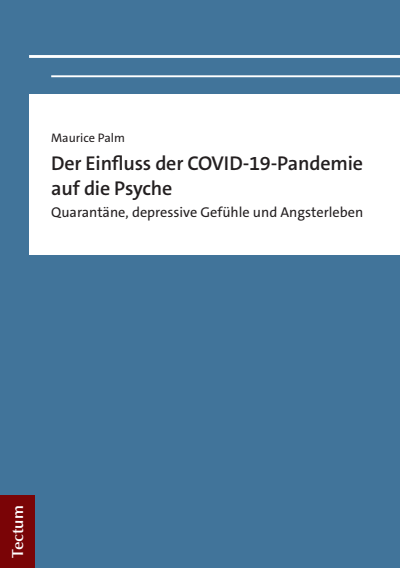
Der Einfluss der COVID-19-Pandemie auf die Psyche
Quarantäne, depressive Gefühle und Angsterleben- Authors:
- Publisher:
- 2022
Keywords
Search publication
Bibliographic data
- Copyright Year
- 2022
- ISBN-Print
- 978-3-8288-4801-6
- ISBN-Online
- 978-3-8288-7912-6
- Publisher
- Tectum, Baden-Baden
- Language
- German
- Pages
- 76
- Product Type
- Monograph
Table of contents
ChapterPages
- Titelei/Inhaltsverzeichnis No access Pages I - XXIV
- 1 Einleitung No access Pages 1 - 4
- 2 Literaturrückblick No access Pages 5 - 10
- 3 Theoretischer Hintergrund No access Pages 11 - 18
- 4 Methodisches Vorgehen No access Pages 19 - 22
- 5 Daten und deskriptive Statistiken No access Pages 23 - 30
- 6.1 Ergebnisse für das Angsterleben von Männern No access
- 6.2 Ergebnisse für die depressiven Gefühle von Männern No access
- 6.3 Ergebnisse für das Angsterleben von Frauen No access
- 6.4 Ergebnisse für die depressiven Gefühle von Frauen No access
- 7 Diskussion No access Pages 51 - 54
- Literaturverzeichnis No access Pages 55 - 60
- Appendix 1 – Modellauswahl No access Pages 61 - 66
- Appendix 2 – Variablen No access Pages 67 - 68
- Appendix 3 – Grafische Darstellungen der Variablen No access Pages 69 - 76
Bibliography (51 entries)
No match found. Try another term.
- Baxter, A. J., Scott, K. M., Vos, T., & Whiteford, H. A. (2012). Global prevalence of anxiety disorders: a systematic review and meta-regression. Psychological Medicine, 43(5), 897–910. doi:10.1017/S003329171200147X Open Google Scholar DOI: 10.5771/9783828879126
- Bem, S. L. (1981). Gender schema theory: A cognitive account of sex typing. Psychological Review, 88(4), 354−364. doi:10.1037/0033-295X.88.4.354 Open Google Scholar DOI: 10.5771/9783828879126
- Berkmann, L. F., Glass, T., Brissette, I., & Seeman, T. E. (2000). From Social Integration to Health: Durkheim in the New Millenium. Social Science and Medicine, 51(6), 843−857. doi:10.1016/s0277-9536(00)00065-4 Open Google Scholar DOI: 10.5771/9783828879126
- Brooks, S. K., Webster, R. K., Smith, L. E., Woodland, L., Wessely, S., Greenberg, N., & Rubin, G. J. (2020). The psychological impact of quarantine and how to reduce it: rapid review of the evidence. The Lancet, 395, 912−920. doi:10.1016/S0140-6736(20)30460-8 Open Google Scholar DOI: 10.5771/9783828879126
- Casagrande, M., Favieri, F., Tambelli, R., & Forte, G. (2020). The enemy who sealed the world: effects quarantine due to the COVID-19 on sleep quality, anxiety, and psychological distress in the Italian population. Sleep Medicine, 75, 12–20. doi:10.1016/j.sleep.2020.05.011 Open Google Scholar DOI: 10.5771/9783828879126
- CentERdata (2019). Health > Wave 12. Longitudinal Wave. Verfügbar unter https://www.dataarchive.lissdata.nl/study_units/view/977 [25.05.2021] Open Google Scholar DOI: 10.5771/9783828879126
- CentERdata (2020). Effects of the Outbreak of Covid-19 > Part 1. Longitudinal Wave. Verfügbar unter https://www.dataarchive.lissdata.nl/study_units/view/929 [25.05.2021] Open Google Scholar DOI: 10.5771/9783828879126
- Chtourou, H., Trabelsi, K., H’mida, C., Boukhris, O., Glenn, J. M., Brach, M., Bentlage, E., Bott, N., Shephard, R. J., Ammar, A., & Bragazzi, N. L. (2020). Staying Physically Active During the Quarantine and Self-Isolation Period for Controlling and Mitigating the COVID-19 Pandemic: A Systematic Overview of the Literature. Frontiers in Psychology, 11, 1708. doi:10.3389/fpsyg.2020.01708 Open Google Scholar DOI: 10.5771/9783828879126
- Clark, E., Fredricks, K., Woc-Colburn, L. Bottazzi, M. E., & Weatherhead, J. (2020). Disproportionate impact of the COVID-19 pandemic on immigrant communities in the United States. PLoS Neglected Tropical Diseases, 14(7). doi:10.1371/journal.pntd.0008484 Open Google Scholar DOI: 10.5771/9783828879126
- Cobb, S. (1976). Social support as a moderator of life stress. Psychosomatic Medicine, 38(5), 300–314. doi:10.1097/00006842-197609000-00003 Open Google Scholar DOI: 10.5771/9783828879126
- Cohen, S., & Wills, T. A. (1985). Stress, social support, and the buffering hypothesis. Psychological Bulletin, 98(2), 310–357. doi:10.1037/0033-2909.98.2.310 Open Google Scholar DOI: 10.5771/9783828879126
- DGPPN (Deutsche Gesellschaft für Psychiatrie, Psychosomatik und Nervenheilkunde e. V.). (2015). S3-Leitlinie/Nationale VersorgungsLeitlinie. Unipolare Depression. Langfassung. 2. Auflage. Version 5. Verfügbar unter https://www.awmf.org/uploads/tx_szleitlinien/nvl-005l_S3_Unipolare_Depression_2017-05.pdf [11.09.2021] Open Google Scholar DOI: 10.5771/9783828879126
- Fancourt, D., Steptoe, A., & Bu, F. (2020). Trajectories of anxiety and depressive symptoms during enforced isolation due to COVID-19: longitudinal analyses of 36,520 adults in England. Lancet Psychiatry, 8(2), 141−149. doi:10.1016/S2215-0366(20)30482-X Open Google Scholar DOI: 10.5771/9783828879126
- Fernandez, R. S., Crivelli, L., Guimet, N. M., Allegri, R. F., & Pedreira, M. E. (2020). Psychological distress associated with COVID-19 quarantine: Latent profile analysis, outcome prediction and mediation analysis. Journal of Affective Disorders, 277, 75–84. doi:10.1016/j.jad.2020.07.133 Open Google Scholar DOI: 10.5771/9783828879126
- Gan, Y., Ma, J., Wu, J., Chen, Y., Zhu, H., & Hall, B. J. (2020). Immediate and delayed psychological effects of province-wide lockdown and personal quarantine during the COVID-19 outbreak in China. Psychological Medicine, 1−12. doi:10.1017/S0033291720003116 Open Google Scholar DOI: 10.5771/9783828879126
- Gonzales-Sanguino, C., Ausin, B., Castellanos, M. A., Saiz, J., Lopez-Gomez, A., Ugidos, C., & Munoz, M. (2020). Mental health consequences during the initial stage of the 2020 Coronavirus pandemic (COVID-19) in Spain. Brain, Behavior, and Immunity, 87, 172–176. doi:10.1016/j.bbi.2020.05.040 Open Google Scholar DOI: 10.5771/9783828879126
- Guadagno, L. (2020). Migrants and the COVID-19 pandemic: An initial analysis. Migration Research Series N60. International Organization for Migration (IOM). Open Google Scholar DOI: 10.5771/9783828879126
- Hallgren, M., Kandola, A., Stubbs, B., Nguyen, T.-T.-D., Wallin, P., Andersson, G., & Ekblom-Bak, E. (2020). Associations of exercise frequency and cardiorespiratory fitness with symptoms of depression and anxiety – a cross-sectional study of 36,595 adults. Mental Health and Physical Activity, 19, 100351. doi:10.1016/j.mhpa.2020.100351 Open Google Scholar DOI: 10.5771/9783828879126
- Henssler, J., Stock, F., van Bohemen, J., Walter, H., Heinz, A., & Brandt, L. (2020). Mental health effects of infection containment strategies: quarantine and isolation—a systematic review and meta‑analysis. European Archives of Psychiatry and Clinical Neuroscience. doi:10.1007/s00406-020-01196-x Open Google Scholar DOI: 10.5771/9783828879126
- Holt-Lunstad, J., Smith, T. B., Baker, M., Harris, T., & Stephenson, D. (2015). Loneliness and Social Isolation as Risk Factors for Mortality: A Meta-Analytic Review. Perspectives on Psychological Science, 10(2), 227–237. doi:10.1177/1745691614568352 Open Google Scholar DOI: 10.5771/9783828879126
- Hossain, M., Sultana, A., & Purohit, N. (2020). Mental health outcomes of quarantine and isolation for infection prevention: a systematic umbrella review of the global evidence. Epidemiology and Health, 42, 1–11. doi:10.4178/epih.e2020038 Open Google Scholar DOI: 10.5771/9783828879126
- Khan, A. H., Sultana, S., Hossain, S., Hasan, M. T., Ahmed, H. U., & Sikder, T. (2020). The impact of COVID-19 pandemic on mental health & wellbeing among home-quarantined Bangladeshi students: A cross-sectional pilot study. Journal of Affective Disorders, 277, 121–128. doi:10.1016/j.jad.2020.07.135 Open Google Scholar DOI: 10.5771/9783828879126
- Knoll, N. & Schwarzer, R. (2005). Soziale Unterstützung. In R. Schwarzer (Hrsg.), Gesundheitspsychologie. Enzyklopädie der Psychologie (333–349). Göttingen: Hogrefe. Open Google Scholar DOI: 10.5771/9783828879126
- Lake, R. I. E., Eaves, L. J., Maes, H. H. M., Heath, A. C., & Martin, N. G. (2000). Further evidence against the environmental transmission of individual differences in neuroticism from a collaborative study of 45,850 twins and relatives on two continents. Behavior Genetics, 30(3), 223−233. doi:10.1016/j.cpr.2009.05.003 Open Google Scholar DOI: 10.5771/9783828879126
- Lazarus, R. S. & Folkman, S. (1984). Stress, appraisal, and coping. New York, NY: Springer. Open Google Scholar DOI: 10.5771/9783828879126
- Lei, L., Huang, X., Zhang, S., Yang, J., Yang, L., & Xu, M. (2020). Comparison of Prevalence and Associated Factors of Anxiety and Depression Among People Affected by versus People Unaffected by Quarantine During the COVID-19 Epidemic in Southwestern China. Medical Science Monitor, 26, doi:10.12659/MSM.924609 Open Google Scholar DOI: 10.5771/9783828879126
- Long, J. S., & Freese, J. (2006). Regression Models for Categorical Dependent Variables Using Stata (2. Aufl.). Texas: Taylor & Francis. Open Google Scholar DOI: 10.5771/9783828879126
- Liu, N., Zhang, F., Wie, C., Jia, Y., Shang, Z., Sun, L., Wu, L., Sun, Z., Zhuo, Y., Wang, Y., & Liu, W. (2020). Prevalence and predictors of PTSS during COVID-19 outbreak in China hardest-hit areas: Gender differences matter. Psychiatry Research, 287, 112921. doi:10.1016/j.psychres.2020.112921 Open Google Scholar DOI: 10.5771/9783828879126
- McFadden, D. (1977). Quantitative Methods for analyzing travel behavior of individuals: Some recent developments. Cowles Foundation Discussion Paper 474. Verfügbar unter https://core.ac.uk/download/pdf/6448852.pdf [21.09.2021] Open Google Scholar DOI: 10.5771/9783828879126
- McLean, C. P. & Anderson, E. R. (2020). Brave men and timid women? A review of the gender differences in fear and anxiety. Clinical Psychology Review, 29(6), 496-505. doi:10.1016/j.cpr.2009.05.003 Open Google Scholar DOI: 10.5771/9783828879126
- Mischler, F. (2021). Verdienstunterschiede zwischen Männern und Frauen. Eine Ursachenanalyse auf Grundlage der Verdienststrukturerhebung 2018. WISTA – Wirtschaft und Statistik, 4, 110–126. Open Google Scholar DOI: 10.5771/9783828879126
- Özdin, S. & Özdin, S. B. (2020). Levels and predictors of anxiety, depression and health anxiety during COVID-19 pandemic in Turkish society: The importance of gender. International Journal of Social Psychiatry, 66(5), 504−511. doi:10.1177/0020764020927051 Open Google Scholar DOI: 10.5771/9783828879126
- Peng, M., Mo, B., Liu, Y., Xu, M., Song, X., Liu, L., Fang, Y., Guo, T., Ye, J., Yu, Z., Deng, Q., & Zhang, X. (2020). Prevalence, risk factors and clinical correlates of depression in quarantined population during the COVID-19 outbreak. Journal of Affective Disorders, 275, 119–124. doi:10.1016/j.jad.2020.06.035 Open Google Scholar DOI: 10.5771/9783828879126
- Perrin, A. (2015). Social Media Usage: 2005-2015. Verfügbar unter https://www.secretintelligenceservice.org/wp-content/uploads/2016/02/PI_2015-10-08_Social-Networking-Usage-2005-2015_FINAL.pdf [26.02.2021] Open Google Scholar DOI: 10.5771/9783828879126
- Robichaud, M., Dugas, M. J., & Conway, M. (2003). Gender differences in worry and associated cognitive-behavioral variables. Journal of Anxiety Disorders, 17, 501−516. doi.org/10.1016/S0887-6185(02)00237-2 Open Google Scholar DOI: 10.5771/9783828879126
- Ross, C. E., & Mirowsky, J. (2002). Age and the gender gap in the sense of personal control. Social Psychology Quarterly, 65(2), 125−145. doi:10.2307/3090097 Open Google Scholar DOI: 10.5771/9783828879126
- Rotter, J. B. (1966). Generalized expectancies for internal versus external control of reinforcement. Psychological Monographs: General and Applied, 80(1), 1–28. doi:10.1037/h0092976 Open Google Scholar DOI: 10.5771/9783828879126
- Statistisches Bundesamt (2020). Erwerbstätigenquoten 1991 bis 2020. Verfügbar unter https://www.destatis.de/DE/Themen/Arbeit/Arbeitsmarkt/Erwerbstaetigkeit/Tabellen/erwerbstaetigenquoten-gebietsstand-geschlecht-altergruppe-mikrozensus.html [09.09.2021] Open Google Scholar DOI: 10.5771/9783828879126
- Stoetzer, M.-W. (2020). Regressionsanalyse in der empirischen Wirtschafts- und Sozialforschung Band 2. Komplexe Verfahren. Berlin: Springer. Open Google Scholar DOI: 10.5771/9783828879126
- Streiner, D. L. (2003). Starting at the beginning: An introduction to coefficient alpha and internal consistency. Journal of Personality Assessment, 80(1), 99–103. doi:10.1207/S15327752JPA8001_18 Open Google Scholar DOI: 10.5771/9783828879126
- Tang, W., Hu, T., Hu, B., Jin, C., Wang, G., Xie, C., Chen, S., & Xu, J. (2020). Prevalence and correlates of PTSD and depressive symptoms one month after the outbreak of the COVID-19 epidemic in a sample of homequarantined Chinese university students. Journal of Affective Disorders, 274, 1–7. doi:10.1016/j.jad.2020.05.009 Open Google Scholar DOI: 10.5771/9783828879126
- Tang, F., Liang, J., Zhang, H., Kelifa, M. M., He, Q., & Wang, P. (2021). COVID-19 related depression and anxiety among quarantined respondents. Psychology & Health, 36(2), 164–178. doi:10.1080/08870446.2020.1782410 Open Google Scholar DOI: 10.5771/9783828879126
- Viana, R. B. & de Lira, C. A. B. (2020). Exergames as Coping Strategies for Anxiety Disorders During the COVID-19 Quarantine Period. Games for Health Journal, 9(3), 147-149. doi:10.1089/g4h.2020.0060 Open Google Scholar DOI: 10.5771/9783828879126
- WHO (2020a). Novel Coronavirus(2019-nCoV). Situation Report – 10. Verfügbar unter https://www.who.int/docs/default-source/coronaviruse/situation-reports/20200130-sitrep-10-ncov.pdf [08.02.2021] Open Google Scholar DOI: 10.5771/9783828879126
- WHO. (2020b). Novel Coronavirus(2019-nCoV). Situation Report – 51. Verfügbar unter https://www.who.int/docs/default-source/coronaviruse/situation-reports/20200311-sitrep-51-covid-19.pdf [08.02.2021] Open Google Scholar DOI: 10.5771/9783828879126
- WHO. (2021). WHO Coronavirus Disease (COVID-19) Dashboard. Verfügbar unter https://covid19.who.int/ [21.09.2021] Open Google Scholar DOI: 10.5771/9783828879126
- Wittchen, H.-U. & Hoyer, J. (2011). Klinische Psychologie & Psychotherapie (2. Aufl.). Heidelberg: Springer. Open Google Scholar DOI: 10.5771/9783828879126
- Xin, M., et al. (2020). Negative cognitive and psychological correlates of mandatory quarantine during the initial COVID-19 outbreak in China. American Psychologist, 75(5), 607–617. doi:10.1037/amp0000692 Open Google Scholar DOI: 10.5771/9783828879126
- Xiong, J., Lipsitz, O., Nasri, F., Lui, L. M. W., Gill, H., Phan, L., Chen-Li, D., Iacobucci, M., Ho, R., Majeed, A., McIntyre, R. S. (2020). Impact of COVID-19 pandemic on mental health in the general population: A systematic review. Journal of Affective Disorders, 277, 55–64. doi:10.1016/j.jad.2020.08.001 Open Google Scholar DOI: 10.5771/9783828879126
- Zhu, S., Wu, Y., Zhu, C. Hong, W., Yu, Z., Chen, Z., Chen, Z., Jiang, D., & Wang, Y. (2020). The immediate mental health impacts of the COVID-19 pandemic among people with or without quarantine managements. Brain, Behavior, and Immunity, 87, 56–58. doi:10.1016/j.bbi.2020.04.045 Open Google Scholar DOI: 10.5771/9783828879126
- Zuckerman, M. (1999). Vulnerability to psychopathology: A biosocial model. American Psychological Association. doi:10.1037/10316-000 Open Google Scholar DOI: 10.5771/9783828879126