, to see if you have full access to this publication.
Monograph No access
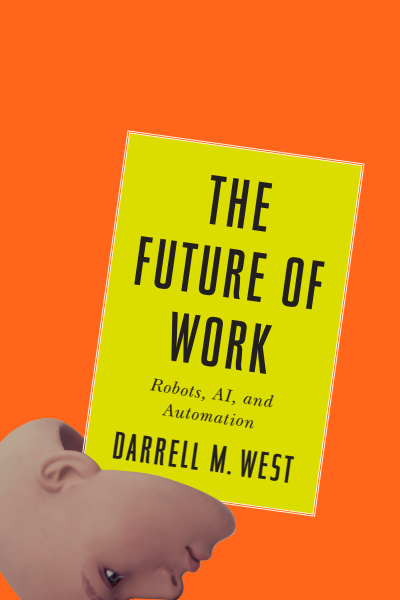
The Future of Work
Robots, AI, and Automation
Authors:
Publisher:
2018
Summary
Looking for ways to handle the transition to a digital economy
Robots, artificial intelligence, and driverless cars are no longer things of the distant future. They are with us today and will become increasingly common in coming years, along with virtual reality and digital personal assistants.
As these tools advance deeper into everyday use, they raise the question—how will they transform society, the economy, and politics? If companies need fewer workers due to automation and robotics, what happens to those who once held those jobs and don't have the skills for new jobs? And since many social benefits are delivered through jobs, how are people outside the workforce for a lengthy period of time going to earn a living and get health care and social benefits?
Looking past today's headlines, political scientist and cultural observer Darrell M. West argues that society needs to rethink the concept of jobs, reconfigure the social contract, move toward a system of lifetime learning, and develop a new kind of politics that can deal with economic dislocations. With the U.S. governance system in shambles because of political polarization and hyper-partisanship, dealing creatively with the transition to a fully digital economy will vex political leaders and complicate the adoption of remedies that could ease the transition pain. It is imperative that we make major adjustments in how we think about work and the social contract in order to prevent society from spiraling out of control.
This book presents a number of proposals to help people deal with the transition from an industrial to a digital economy. We must broaden the concept of employment to include volunteering and parenting and pay greater attention to the opportunities for leisure time. New forms of identity will be possible when the "job" no longer defines people's sense of personal meaning, and they engage in a broader range of activities. Workers will need help throughout their lifetimes to acquire new skills and develop new job capabilities. Political reforms will be necessary to reduce polarization and restore civility so there can be open and healthy debate about where responsibility lies for economic well-being.
This book is an important contribution to a discussion about tomorrow—one that needs to take place today.
Keywords
Search publication
Bibliographic data
Copyright Year
2018
ISBN-Print
978-0-8157-3293-8
ISBN-Online
978-0-8157-3294-5
Publisher
Rowman & Littlefield, Lanham
Language
English
Pages
backcover1
Product Type
Monograph
Table of contents
ChapterPages
Table of Contents No access
Preface No access
Robots No access
Artificial Intelligence No access
The Internet of Things No access
Rethinking Work No access
A New Social Contract No access
Lifetime Learning No access
Is Politics Up to the Task? No access
Economic and Political Reform No access
Notes No access Pages 167 - 194
Index No access Pages 195 - backcover1
Similar publications
from the topics "Bildung allgemein"
Edited Book No access
Amina Kielblock, Stephan Kielblock, Christoph Bülau, Anna- Maria Seemann