, to see if you have full access to this publication.
Monograph No access
Applicative Justice
A Pragmatic Empirical Approach to Racial Injustice
Authors:
Publisher:
2016
Summary
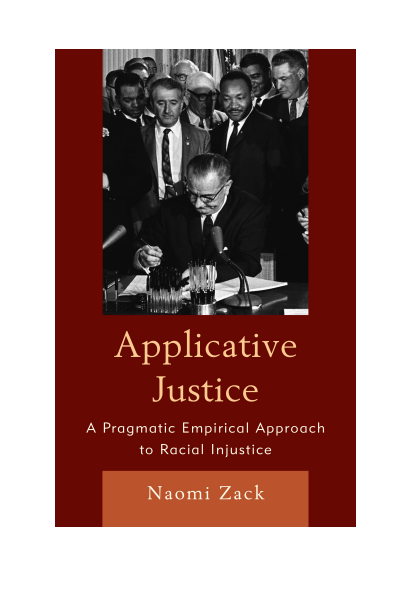
Naomi Zack pioneers a new theory of justice starting from a correction of current injustices. While the present justice paradigm in political philosophy and related fields begins from John Rawls’s 1970 Theory of Justice, Zack insists that what people in reality care about is not justice as an ideal, but injustice as a correctable ill. For a way to describe real injustice and the society in which it occurs, Zack resurrect Arthur Bentley’s key insight that government and law (or political life) is a constant process of contending interest groups throughout society. Bentley’s main idea allows for a resolution of the contradiction between formal legal equality for U.S. minorities and post-civil rights practical inequality. Just law and unjust practice co-exist as a fact of political life. The correction of injustice in reality requires applicative justice, in a comparison between those who are treated unjustly with those who are treated justly, and the design of effective measures to equalize such treatment. Zack's theory of applicative justice offers a revolutionary reorientation of society's pursuit of justice, seeking to undo injustice in a practical and fully achievable way.
Search publication
Bibliographic data
Edition
1/2016
Copyright Year
2016
ISBN-Print
978-1-4422-6000-9
ISBN-Online
978-1-4422-6002-3
Publisher
Rowman & Littlefield, Lanham
Language
English
Pages
236
Product Type
Monograph
Table of contents
ChapterPages
Contents No access
Preface No access
Introduction No access Pages 1 - 8
1 Ideal Theory, Nonideal Theory, and Empirical Political Theory No access Pages 9 - 34
2 Limits of Law and Government No access Pages 35 - 64
3 Ideal Equality and Real Inequality No access Pages 65 - 88
4 The Distribution of Procedural Justice No access Pages 89 - 116
5 Discourse, Prophecy, and Atmosphere No access Pages 117 - 144
6 The Discourse of Political Activism No access Pages 145 - 174
7 Postscript: An Invitation to the Reader No access Pages 175 - 182
Notes No access Pages 183 - 216
Select Bibliography No access Pages 217 - 226
Index No access Pages 227 - 234
About the Author No access Pages 235 - 236
Similar publications
from the topics "Soziologie allgemein"
Edited Book Full access
Karen Kastenhofer, Marius Albiez, Pauline Riousset, Constanze Scherz, Michael Decker