, to see if you have full access to this publication.
Monograph No access
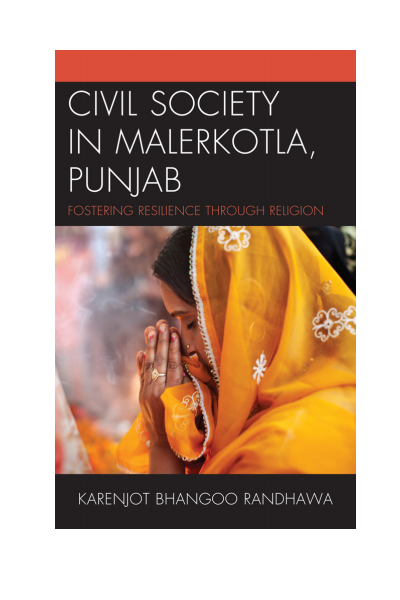
Civil Society in Malerkotla, Punjab
Fostering Resilience through Religion
Authors:
Publisher:
2012
Summary
Civil Society in Malerkotla, Punjab: Fostering Resilience through Religion by Karenjot Bhangoo Randhawa explores the direct role that religion plays in conflict and peace that has often been difficult to isolate. This study extends previous work on peace and conflict resolution by looking at a town which has witnessed many outbreaks of violence in the past but still holds peace as the norm.
The former princely state of Malerkotla, Punjab is a place where riots did not occur during Partition. In this unique Muslim majority town, there are four distinct religious groups that live in close proximity to each other. Yet, the overall pattern of peaceful plurality in the town has resulted in the transcendence of violence even when the threat looms close by. The unique case of Malerkotla, Punjab provides an opportunity to look more closely and critically at Sikhs and their relationship with Muslims in India.
As a case study, this work captures the overall pattern of Sikh-Muslim interaction in a town that can transcend conflict and make peace the norm. Randhawa uncovers how religious associations, expressions and activities have helped to build social capital and stabilize peace. This book also emphasizes interreligious understanding, cross-cultural awareness, and conflict transformation, and discusses how interfaith communities can work together to bridge understanding in order to prevent violence.
Keywords
Search publication
Bibliographic data
Edition
1/2012
Copyright Year
2012
ISBN-Print
978-0-7391-6737-3
ISBN-Online
978-0-7391-6738-0
Publisher
Lexington, Lanham
Language
English
Pages
127
Product Type
Monograph
Table of contents
ChapterPages
Contents No access
Preface No access
Introduction No access Pages 1 - 10
1 Evolution of Theories No access Pages 11 - 20
2 Civil Society No access Pages 21 - 58
3 Sikhism and Islam No access Pages 59 - 74
4 Perspectives from Malerkotla No access Pages 75 - 94