, to see if you have full access to this publication.
Monograph No access
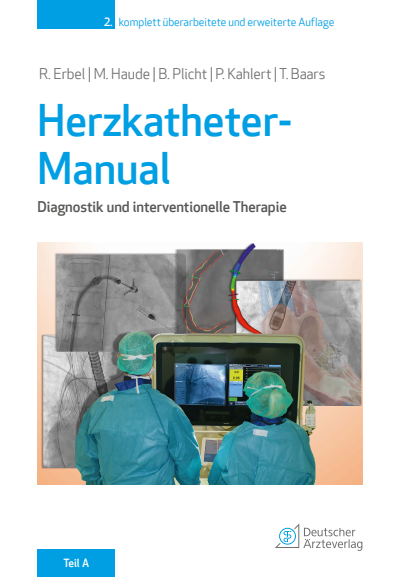
Herzkatheter-Manual
Diagnostik und interventionelle Therapie- Authors:
- | | | |
- Publisher:
- 2024
Keywords
Search publication
Bibliographic data
- Edition
- 2/2024
- Copyright Year
- 2024
- ISBN-Print
- 978-3-7691-1312-9
- ISBN-Online
- 978-3-7691-1315-0
- Publisher
- Dt. Ärzteverlag, Köln
- Language
- German
- Pages
- L|171
- Product Type
- Monograph
Table of contents
ChapterPages
- Titel Teil A No access
- Impressum Teil A No access
- Vorwort No access
- Geleitwort zur 2. Auflage No access
- Herausgeber- und Autorenverzeichnis No access
- Verzeichnis der Abkürzungen und Akronyme No access
- Gesamtübersicht No access
- Inhaltsverzeichnis Teil A No access
- 1.1 Beginn der invasiven Kardiologie No access
- 1.2 Koronarangiografie No access
- 1.3 Koronare Bypassoperation No access
- 1.4 Swan-Ganz-Katheter No access
- 1.5 Akute Infarktbehandlung No access
- 1.6.1 Steuerbarer Draht No access
- 1.6.2 Perfusionsballonkatheter No access
- 1.6.3 Monorail-Katheter No access
- 1.6.4 Hochfrequente Rotationsangioplastie No access
- 1.7.1 Medikamentenbeschichtete Stents (DES) No access
- 1.7.2 Temporäre Stents No access
- 1.7.3 Bioresorbierbare Polymerstents zur koronaren Stentimplantation No access
- 1.7.4 Bioresorbierbarer Polymerstent mit Everolimus-Beladung No access
- 1.7.5 Temporäre, bioresorbierbare Metallstents No access
- 1.8.1 Aortenklappenvalvuloplastie und -implantation No access
- 1.8.2 Pulmonalklappenimplantation No access
- 1.8.3 Mitralklappeninterventionen No access
- 1.8.4 Trikuspidalklappeninterventionen No access
- 1.9.1 PFO-Verschluss No access
- 1.9.2 Interatriale Septostomie No access
- 1.9.3 Ablation der hypertrophen obstruktiven Kardiomyopathie (HOCM) No access
- 1.10.1 Aortenisthmusstenose No access
- 1.10.2 Aortenaneurysmen/Aortendissektion No access
- 1.10.3 Interventionelle Therapie der Lungenembolie No access
- 1.11 Schlussfolgerung No access
- 2.1 Indikation und Kontraindikation No access
- 2.2 Voruntersuchung und Anamnese No access
- 2.3 Aufklärung des Patienten No access
- 2.4.1 Prämedikation No access
- 2.4.2 Kontrastmittel und Kontrastmittelallergie No access
- 2.4.3 Niereninsuffizienz No access
- 2.4.4 Schilddrüsenfunktion No access
- 2.4.5 Endokarditisprophylaxe No access
- 2.4.6 Anlage eines Blasenkatheters No access
- 2.5.1 Der Patient im HKL No access
- 2.5.2 Untersuchungsplanung und -protokoll No access
- 2.6.1 Vorbereiten der Punktion No access
- 2.7 Medikamente im HKL No access
- 3.1.1 Vorgehen No access
- 3.2.1 Punktion der A. femoralis No access
- 3.2.2 Punktion der A. radialis No access
- 3.2.3 Alternative Zugangswege No access
- 3.2.4 Ultraschallgesteuerte Punktion No access
- 3.3 Venöse Punktion No access
- 3.4.1 Manuelle Kompression No access
- 3.4.2 Druckverband No access
- 3.4.3 Verschlusssysteme No access
- 3.4.4 Verschluss mit Nahtsystemen No access
- 3.4.5 Verschluss der A. radialis No access
- 3.5.1 Risikogruppen No access
- 3.5.2 Blutungsprävention nach Punktion No access
- 3.5.3 Blutungen an der Punktionsstelle nach dem Eingriff No access
- 3.5.4 Leistenhämatom und retroperitoneale Blutung No access
- 3.5.5 Iatrogenes Aneurysma spurium No access
- 4.1.1 Grundlagen No access
- 4.1.2 Strahlenexposition – natürliche und in der Medizin No access
- 4.2.1 Fluoroskopie vs. Filmaufnahmen (Akquisition) No access
- 4.2.2 Expositionszeit No access
- 4.2.3 Abstand des Patienten zur Röntgenröhre und zum Bildwandler No access
- 4.2.4 Einblenden des Nutzstrahlenfeldes No access
- 4.2.5 Rationaler Einsatz von Röntgenprojektionen No access
- 4.3.1 Strahlenschutzbereiche: Kontroll- und Überwachungsbereich No access
- 4.3.2 Bauliche und technische Maßnahmen No access
- 4.3.3 Persönliche Maßnahmen No access
- 4.3.4 Assistenzpersonal No access
- 4.3.5 Referenzwerte No access
- 4.3.6 Krebsrisiko No access
- 4.3.7 Arbeitsrechtliche Vorsorge No access
- 4.3.8 Personenüberwachung No access
- 4.3.9 Meldewesen No access
- 5.1.1 Segmenteinteilung der Koronararterien No access
- 5.1.2 Koronarvenöses System – Koronarsinus – Thebesius-Klappe – Vieussens-Klappe – Thebesius-Venen No access
- 5.1.3 Koronaranomalien No access
- 5.2.1 Theoretische Grundlagen No access
- 5.2.2 Praktische Durchführung No access
- 5.2.3 Befundung von Lävokardiogramm und Aortogramm No access
- 5.3.1 Theoretische Grundlagen No access
- 5.3.2 Praktische Durchführung No access
- 5.3.3 Befundung No access
- 5.4.1 Einleitung No access
- 5.4.2 Voraussetzungen für den Untersucher No access
- 5.4.3 Wahl der Punktionsstelle No access
- 5.4.4 Vorbereiten der Punktionsstelle No access
- 5.4.5 Auswahl der Schleuse No access
- 5.4.6 Schleusenlänge No access
- 5.4.7 Vermeidung von Spasmen No access
- 5.4.8 Anatomie und mögliche Probleme beim Vorführen des Drahtes No access
- 5.4.9 Grenzen der Methode No access
- 5.4.10 Auswahl der Schleusen und Katheter No access
- 5.4.11 Beenden der Untersuchung No access
- 5.4.12 Spasmen beim Schleusenrückzug No access
- 5.4.13 Verschluss der A. radialis No access
- 5.4.14 Weitere mögliche Komplikationen No access
- 5.4.15 Verschluss der Punktionsstelle No access
- 5.4.16 Vorteile und Sicherheit des Zugangs via A. radialis No access
- 5.4.17 Zusammenfassung No access
- 6.1 Quantitative Koronarografie (QCA) No access
- 6.2.1 Einführung No access
- 6.2.2 Technische Details No access
- 6.2.3 Mögliche Komplikationen No access
- 6.2.4 Pathophysiologie der Koronardurchblutung No access
- 6.2.5 ICD-Normalwerte No access
- 6.2.6 Intrakoronare Dopplerdrahtanwendung No access
- 6.3.1 Einführung No access
- 6.3.2 Durchführung der Druckdrahtmessung No access
- 6.3.3 Formel zur Berechnung der fraktionellen Flussreserve (FFR) und abgeleiteter Parameter No access
- 6.3.4 FFR-Normalwert und Ischämiegrenze No access
- 6.3.5 Limitationen der Methode No access
- 6.3.6 Adenosingabe No access
- 6.3.7 Pitfalls No access
- 6.3.8 Studienlage No access
- 6.3.9 iFR-Bestimmung No access
- 6.3.10 Klinische Anwendung der FFR- und iFR-Messung No access
- 6.3.11 QCA-basierte FFR No access
- 6.4.1 Einleitung No access
- 6.4.2 Technik No access
- 6.4.3 Anwendung im Katheterlabor No access
- 6.4.4 Gewebedifferenzierung No access
- 6.4.5 Gefäßaufbau No access
- 6.4.6 Atherosklerose der Koronararterien No access
- 6.4.7 Virtuelle Histologie (VH) No access
- 6.4.8 Positives/kompensatorisches Remodeling No access
- 6.4.9 Negatives Remodeling No access
- 6.4.10 Auswertung No access
- 6.4.11 Sicherheit und Nebenwirkungen No access
- 6.4.12 Normalwerte und Grenzwerte No access
- 6.4.13 Indikationsstellung und Studienlage No access
- 6.5.1 Technik und Methodik No access
- 6.5.2 Praktische Durchführung der OCT No access
- 6.5.3 Bildanalyse No access
- 6.6.1 Koronare mikrovaskuläre Erkrankung (CMD) No access
- 6.6.2 Chronisches Koronarsyndrom (CCS) No access
- 6.7.1 Hintergrund No access
- 6.7.2 Definition No access
- 6.7.3 Klinik No access
- 6.7.4 Diagnostik: Vasomotionstests No access
- 7.1.1 Sondierung No access
- 7.1.2 Nullabgleich No access
- 7.1.3 HZV-Messung No access
- 7.1.4 Rückzug des Katheters No access
- 7.2 Druckkurven im Rechtsherzkatheter No access
- 7.3.1 Vaskulärer Widerstand („vascular resistance“, VR) No access
- 7.3.2 Systemischer Gefäßwiderstand (SVR) No access
- 7.3.3 Pulmonaler Gefäßwiderstand (PVR) No access
- 7.3.4 HZV- und Shunt-Berechnung No access
- 7.4 Klassifizierung der pulmonalen Hypertonie No access
- 7.5 Pulmonalisangiografie No access
- 7.6.1 Technische Daten zu Drucksensoren No access
- 7.6.2 Klinische Empfehlung No access
- 7.6.3 Anwendungsempfehlungen No access
- 7.6.4 Komplikationen bei Sensorimplantation No access
- 7.6.5 Klinische Studienergebnisse bei Herzinsuffizienz No access
- 7.7.1 Allgemeines Vorgehen No access
- 7.7.2 Gorlin-Formeln zur Berechnung der Klappenöffnungsfläche (KÖF) No access
- 7.7.3 Mitralklappenstenose (MKS) No access
- 7.7.4 Mitralklappeninsuffizienz (MI) No access
- 7.7.5 Aortenklappenstenose (AS) No access
- 7.7.6 Aortenklappeninsuffizienz (AI) No access
- 7.8.1 Einleitung No access
- 7.8.2 Differenzierung von Pericarditis constrictiva und restriktiver Kardiomyopathie No access
- 7.8.3 Hämodynamische Evaluation No access
- 7.8.4 Feuchte Pericarditis constrictiva No access
- 7.9.1 Allgemeines Vorgehen No access
- 7.9.2 Restriktive Kardiomyopathie No access
- 7.9.3 Dilatative Kardiomyopathie (DCM) No access
- 7.10 Gefäßverschluss nach Rechtsherzkatheter No access
- 8.1.1 Rechtsventrikuläre Biopsie No access
- 8.1.2 Linksventrikuläre Biopsie No access
- 8.1.3 Transradiale Biopsie No access
- 8.1.4 Biopsie unter Echokontrolle No access
- 8.1.5 EKG-geführte Biopsie – vor Schrittmacherimplantation – nach Vorhofablation No access
- 8.2 Kontrolle nach Myokardbiopsie No access
- 8.3 Komplikationen No access
- 8.4 Indikation zur Myokardbiopsie No access
- 9.1 Einleitung No access
- 9.2 Technische Ausstattung No access
- 9.3.1 Einleitung No access
- 9.3.2 Technik der intrakardialen Ultraschalldiagnostik No access
- 9.3.3 Intrakardiale Bildgebung No access
- 9.3.4 Anwendung No access
- 9.3.5 Intraaortaler Ultraschall No access
- 9.3.6 Intrapulmonaler Ultraschall No access
- 9.4 Transthorakales Monitoring bei Myokardbiopsien No access
- 9.5 Septalastablation bei HOCM: Transthorakales Monitoring No access
- 9.6 Klappenvalvuloplastie, -implantation und -rekonstruktion No access
- 9.7 Notfallsituationen No access
- 10.1.1 Einleitung No access
- 10.1.2 Thrombozytenaggregationshemmung No access
- 10.1.3 Thrombozytenfunktionshemmer No access
- 10.1.4 Therapiewechsel zwischen den P2Y12-Hemmern No access
- 10.1.5 DAPT und PCI bei stabiler KHK No access
- 10.1.6 DAPT und PCI bei Patienten mit akutem Koronarsyndrom No access
- 10.1.7 Faktor-Xa-Inhibitor Rivaroxaban No access
- 10.1.8 DAPT für Patienten mit Indikation zur oralen Antikoagulation No access
- 10.1.9 Neue therapeutische Ansätze mit NOAK No access
- 10.1.10 Thrombinantagonisten No access
- 10.2 Dokumentation und Befundung No access
- 10.3.1 Interne Qualitätssicherung No access
- 10.3.2 Externe Qualitätssicherung – QS No access
- 11.1 Einleitung No access
- 11.2 Sofort verfügbare Standardnotfallmedikamente No access
- 11.3 Bradykarde Herzrhythmusstörungen No access
- 11.4.1 Transkutane Schrittmachertherapie No access
- 11.4.2 Perkutane temporäre Schrittmacherimplantation No access
- 11.5 Tachykarde Herzrhythmusstörungen No access
- 11.6.1 Defibrillation No access
- 11.6.2 Mechanische Reanimationshilfen No access
- 11.6.3 Fazit No access
- 11.7 Hypertensiver Notfall No access
- 11.8 Lungenödem No access
- 11.9 „No-reflow“-Phänomen, Koronarperforation, Schlaganfall, Embolien No access
- 11.10.1 Klinik No access
- 11.10.2 Bestimmung der Ergussmenge im Echokardiogramm No access
- 11.10.3 Echokardiografie No access
- 11.10.4 Mögliche Ursachen einer falsch positiven Diagnose eines Perikardergusses No access
- 11.10.5 Perikardpunktion No access
- 11.10.6 Perikardfensterung No access
- 12.1 Einleitung No access
- 12.2 Häufigkeiten No access
- 12.3 Leitlinienempfehlungen No access
- 12.4.1 Prüfung der Indikation No access
- 12.4.2 Prüfung der Eignung No access
- 12.5.1 Aufklärungsgespräch No access
- 12.5.2 Gesonderte Informationen zur Stentimplantation No access
- 12.6 Besonderheiten aufgrund der verkürzten Kontaktzeit No access
- 12.7 Ambulante PTCA – Studienlage No access
- 12.8 Gesetzlich verpflichtende Qualitätssicherung No access
- 13.1 Einleitung No access
- 13.2 Angeborene Herzfehler und Lebensqualität No access
- 13.3.1 Fehlbildungen des rechtsventrikulären Ausflusstraktes und der Pulmonalarterien No access
- 13.3.2 Aortenstenosen No access
- 13.3.3 Aortenisthmusstenose No access
- 13.3.4 Ventrikelseptumdefekte No access
- 13.3.5 Vorhofseptumdefekt No access
- 13.3.6 Persistierender Ductus arteriosus Botalli No access
- 13.3.7 Truncus arteriosus communis No access
- 13.3.8 Fallot-Tetralogie (Tetrade) und Fallot-Pentalogie (Tetrade + ASD) No access
- 13.3.9 Transposition der großen Gefäße No access
- 13.3.10 Trikuspidalatresie No access
- 13.3.11 Ebstein-Anomalie No access
- 13.3.12 Hypoplastisches Linksherzsyndrom No access
- 13.3.13 Endokardfibroelastose (EFE) No access
- 13.4.1 Fontan-Operation No access
- 13.4.2 Arterielle Switch-Operation bei TGA No access
- 13.4.3 Vorhofumkehr nach Senning oder Mustard No access
- 13.4.4 Rastelli-Operation No access
- 13.4.5 Glenn-Anastomose bei univentrikulärem Herz No access
- 13.4.6 Blalock-Taussig-Shunt, Waterston-Anastomose, Potts-Anastomose No access
- 13.5 Herzrhythmusstörungen No access
- 13.6.1 Clefts, Krypten, Divertikel No access
- 13.6.2 Non-Compaction-Kardiomyopathie No access
- 13.7.1 Klinische Befunde No access
- 13.7.2 EKG No access
- 13.7.3 TTE No access
- 13.7.4 Röntgen-Thorax No access
- 13.7.5 CT/MRT No access
- 13.7.6 Therapie No access
- 13.7.7 Prognose No access
- 14.1.1 Personal No access
- 14.1.2 Hygienemaßnahmen No access
- 14.1.3 Bauliche und strukturelle Voraussetzungen No access
- 14.1.4 OP-Bereitschaft No access
- 14.1.5 Kardiologische Besprechung No access
- 14.1.6 Kardiochirurgische Besprechung No access
- 14.2.1 Einleitung No access
- 14.2.2 Aortendissektionen No access
- 14.2.3 Aortenklappenimplantation No access
- 14.2.4 Kathetergestützte Mitralklappeneingriffe No access
- 14.2.5 Lungenembolie No access
- 14.2.6 Hybrid-ACVB und -PCI No access
- 14.3.1 Einleitung No access
- 14.3.2 Netzwerkstruktur No access
- 14.3.3 Elektronische Terminplanung No access
- 14.3.4 Digitale Elektrokardiografie No access
- 14.3.5 Digitale Angiografie mit Integration IVUS No access
- 14.3.6 Digitale Archivierung und Bildverteilung im DICOM-Format No access
- 14.3.7 Befunderstellung und Arztbriefschreibung No access
- 14.3.8 Produktivitätszuwachs durch das CVIS No access
- Stichwortverzeichnis No access
- Titel Teil B No access
- Impressum Teil B No access
- Verzeichnis der Abkürzungen und Akronyme No access
- Gesamtübersicht No access
- Inhaltsverzeichnis Teil B No access
- 15.1 Einleitung No access
- 15.2.1 Einleitung No access
- 15.2.2 Diagnostik No access
- 15.2.3 Indikationen zur PCI No access
- 15.3.1 Hülsen und Führungsdrähte No access
- 15.3.2 Führungskatheter No access
- 15.3.3 Ballonkatheter No access
- 15.3.4 Koronare Stents No access
- 15.3.5 Stentthrombosen No access
- 15.3.6 Stentbrüche, Stentfrakturen No access
- 15.4 Mechanismus der PCI No access
- 15.5.1 Wahl des Führungskatheters No access
- 15.5.2 Y-Konnektor No access
- 15.5.3 Sondierung der Koronarstenose No access
- 15.5.4 Auswahl des Ballons/Stents No access
- 15.5.5 Restenosierung No access
- 15.5.6 Stentimplantation No access
- 15.5.7 Erfolgskriterien No access
- 15.5.8 IVUS-geführte PCI No access
- 15.6.1 Vorbereitung No access
- 15.6.2 Praktischer Ablauf No access
- 15.7.1 Buddy-wire-Technik No access
- 15.7.2 Buddy-in-jail-Technik No access
- 15.7.3 Doppeldraht-Technik No access
- 15.7.4 Flip-Flop-Technik No access
- 15.7.5 Nato-Methode No access
- 15.8 Unmittelbare Nachbehandlung No access
- 15.9 Koronare Komplikationen nach PCI No access
- 15.10.1 Einleitung No access
- 15.10.2 Typische Vorgehensweise No access
- 15.11.1 Grundlagen No access
- 15.11.2 Material und Eigenschaften No access
- 15.11.3 Studienlage No access
- 15.11.4 Klinische Anwendung No access
- 15.11.5 Spezielle Läsionen No access
- 15.11.6 Läsionspräparation No access
- 15.11.7 Durchführung der BRS-Implantation No access
- 15.11.8 Komplikationen No access
- 15.11.9 Intravaskuläre Bildgebung No access
- 16.1 Intervention an aortokoronaren Bypässen No access
- 16.2.1 Einleitung No access
- 16.2.2 Definition, Klassifikation und Ätiologie No access
- 16.2.3 Optimale angiografische Darstellung und hämodynamische Bedeutung No access
- 16.2.4 Datenlage zur interventionellen Therapie No access
- 16.2.5 Hauptschritte bei der Intervention No access
- 16.2.6 Zusammenfassung No access
- 16.3.1 Einleitung No access
- 16.3.2 Diagnostik und Planung No access
- 16.3.3 Auswahl der Führungskatheter No access
- 16.3.4 PCI der Ostiumstenose No access
- 16.3.5 Stentimplantation No access
- 16.4.1 Hintergrund No access
- 16.4.2 Mechanismus der Restenose No access
- 16.4.3 Definitionen und klinische apparative Diagnostik No access
- 16.4.4 Klinische Präsentation No access
- 16.4.5 Übersicht über die Behandlung der ISR No access
- 16.4.6 Behandlung der ISR mit Stents und beschichteten Ballons: Polymerproblematik No access
- 16.5.1 Einleitung No access
- 16.5.2 Systembeschreibung: Rotablator/Rotapro No access
- 16.5.3 Systembeschreibung: Diamondback 360 No access
- 16.5.4 Nutzungstechnik: Rotablator/Rotapro No access
- 16.5.5 Nutzungstechnik: Diamondback 360 No access
- 16.5.6 Prämedikation und Spülung bei Rotablation No access
- 16.5.7 Prämedikation und Spülung bei orbitaler Atherektomie No access
- 16.5.8 Auswahl der Führungskatheter No access
- 16.5.9 Auswahl der Größe des Rotablatorkopfes No access
- 16.5.10 Auswahl der Kopfgröße für die orbitale Atherektomie No access
- 16.5.11 Einbringen des RotaWire No access
- 16.5.12 Einbringen des ViperWire No access
- 16.5.13 Positionieren des Rotablators No access
- 16.5.14 Positionieren des Diamondback 360 No access
- 16.5.15 Vorschieben des Rotablatorkopfes No access
- 16.5.16 Vorschieben des Diamondback 360 No access
- 16.5.17 Durchführung der Rotablation No access
- 16.5.18 Durchführung der orbitalen Atherektomie No access
- 16.5.19 PCI nach Rotablation No access
- 16.5.20 PCI nach orbitaler Atherektomie No access
- 16.5.21 Potenzielle Komplikationen No access
- 16.5.22 Indikationen zur Rotablation No access
- 16.5.23 Indikationen zur orbitalen Atherektomie No access
- 16.5.24 Anforderung an Operateure für die Rotablation No access
- 16.6.1 Einführung No access
- 16.6.2 Auswahl der Instrumente No access
- 16.6.3 Technik der Rekanalisation verschlossener Gefäße No access
- 16.6.4 Prüfung des Gefäßverlaufs No access
- 16.7.1 Einführung No access
- 16.7.2 Pathologische Anatomie der Hauptstammstenose inklusive Hauptstammäquivalent No access
- 16.7.3 Invasive Diagnostik der Hauptstammstenose No access
- 16.7.4 PCI der Hauptstammstenose No access
- 16.7.5 Anforderungen an Untersucher und HKL bei Intervention einer ungeschützten Hauptstammstenose No access
- 16.7.6 Vergleich von PCI und Bypassoperation No access
- 16.8.1 Einführung No access
- 16.8.2 Modifizierte Ballonkatheter No access
- 16.8.3 Excimerlaser No access
- 16.8.4 Rotablation No access
- 16.8.5 Vergleichende Untersuchungen No access
- 16.8.6 Alternative Entwicklung: koronare Lithotripsie No access
- 16.8.7 Vorgehen bei verkalkten Stenosen No access
- 17.1.1 Einleitung No access
- 17.1.2 Chest pain unit No access
- 17.1.3 ACS ohne ST-Strecken-Hebungen (NSTE-ACS) No access
- 17.1.4 ACS mit ST-Strecken-Hebungen (STEMI) No access
- 17.1.5 ACS mit unauffälligem Koronarbefund (MINOCA) No access
- 17.1.6 Endovaskuläre Kühlung nach Reanimation No access
- 17.1.7 Adjuvante Medikation No access
- 17.1.8 Intrakoronare Thrombusaspiration No access
- 17.1.9 Prä-/Postkonditionierung No access
- 17.1.10 Praktisch-technische Aspekte der Infarkt-PCI No access
- 17.2.1 Einleitung No access
- 17.2.2 Pathophysiologie No access
- 17.2.3 Risikofaktoren und Determinanten No access
- 17.2.4 Diagnose No access
- 17.2.5 Therapie No access
- 17.2.6 Prävention No access
- 17.2.7 Schlussfolgerung No access
- 17.3.1 Einleitung No access
- 17.3.2 Klassifikation No access
- 17.3.3 Risikofaktoren No access
- 17.3.4 Klinik No access
- 17.3.5 Therapie No access
- 17.3.6 Komplikationen No access
- 17.3.7 Prognose No access
- 17.4.1 Einleitung No access
- 17.4.2 Risikofaktoren No access
- 17.4.3 Folgeerscheinungen No access
- 17.4.4 Vorsichtsmaßnahmen No access
- 17.4.5 Bild des Schlaganfalls im Rahmen einer HKU No access
- 17.4.6 Therapie No access
- 17.4.7 Zusammenfassung No access
- 17.5.1 Einleitung No access
- 17.5.2 Risikofaktoren No access
- 17.5.3 Klinik No access
- 17.5.4 Therapieoptionen No access
- 17.6.1 Einleitung No access
- 17.6.2 Paradoxe Embolie No access
- 17.6.3 Direkte Embolie No access
- 17.6.4 Periinterventionelle Embolie No access
- 17.6.5 Diagnose No access
- 17.6.6 Therapie No access
- 17.6.7 Prognose No access
- 17.7.1 Einleitung No access
- 17.7.2 Bergung größerer Fremdkörper No access
- 17.7.3 Bergung von Koronarstents No access
- 17.7.4 Allgemeine Prinzipien der Bergung No access
- 17.7.5 Klinische Fallbeispiele No access
- 18.1 Einleitung No access
- 18.2.1 Prinzip und hämodynamische Effekte No access
- 18.2.2 Evidenz No access
- 18.2.3 Kontraindikationen No access
- 18.2.4 Entwöhnung (Weaning) No access
- 18.3.1 Prinzip und hämodynamische Effekte No access
- 18.3.2 Evidenz No access
- 18.3.3 Mögliche Komplikationen No access
- 18.3.4 Kontraindikationen No access
- 18.3.5 Entwöhnung (Weaning) No access
- 18.4.1 Prinzip und hämodynamische Effekte No access
- 18.4.2 Evidenz No access
- 18.4.3 Mögliche Komplikationen No access
- 18.4.4 Kontraindikationen No access
- 18.4.5 Entwöhnung (Weaning) No access
- 18.5.1 Prinzip und hämodynamische Effekte No access
- 18.5.2 Evidenz No access
- 18.6.1 Prinzip und hämodynamische Effekte No access
- 18.6.2 Evidenz No access
- 18.7.1 Prinzip und hämodynamische Effekte No access
- 18.7.2 Evidenz No access
- 18.7.3 Mögliche Komplikationen No access
- 18.7.4 Mögliche Kontraindikationen No access
- 18.7.5 Entwöhnung (Weaning) No access
- 19.1.1 Anatomie No access
- 19.1.2 Pathophysiologie No access
- 19.1.3 Prävalenz/Inzidenz No access
- 19.1.4 Klinische Befunde No access
- 19.2 Diagnostik No access
- 19.3.1 CFA-Verschlusstechniken No access
- 19.3.2 Coil-Embolisierung No access
- 19.4 Prognose No access
- 19.5 Schlussfolgerung No access
- 20.1.1 Ätiologie und Diagnostik der Aortenklappenstenose No access
- 20.1.2 Therapie der sklerosierenden, verkalkenden Aortenklappenstenose No access
- 20.1.3 Kathetergeführte TAVI No access
- 20.1.4 Ausblick No access
- 20.2.1 Ätiologie und Diagnostik No access
- 20.2.2 Indikationen zur Operation No access
- 20.2.3 HKU bei chronischer AI No access
- 20.2.4 Perkutane TAVI bei chronischer AI No access
- 20.3.1 Indikation No access
- 20.3.2 Technik der Mitralklappenvalvuloplastie No access
- 20.3.3 Erfolgsrate und Komplikationen No access
- 20.3.4 Ausblick No access
- 20.4.1 Grundlagen No access
- 20.4.2 Kathetergestützte End-zu-End-Reparatur mittels MitraClip No access
- 20.4.3 Kathetergestützte End-zu-End-Reparatur mittels Pascal No access
- 20.4.4 Indirekte Mitralklappenanuloplastie mit dem Carillon Mitral Contour System No access
- 20.4.5 Direkte Mitralklappenanuloplastie No access
- 20.4.6 Sehnenfadenersatz mittels Neochordae No access
- 20.4.7 Transkatheter-Mitralklappenersatz No access
- 20.5.1 Grundlagen No access
- 20.5.2 End-zu-End-Adaptation der Trikuspidalklappensegel No access
- 20.5.3 Direkte Trikuspidalklappenanuloplastie No access
- 20.5.4 Transkatheter-Trikuspidalklappenersatz No access
- 20.5.5 FORMA No access
- 20.6.1 Einleitung No access
- 20.6.2 Vorhofseptumdefekt No access
- 20.6.3 Persistierendes Foramen ovale No access
- 20.6.4 Atriales Septumaneurysma No access
- 20.6.5 Diagnostik (TTE/TEE) No access
- 20.6.6 Indikation zum ASD-Verschluss No access
- 20.6.7 Indikation zum PFO-Verschluss No access
- 20.6.8 Technik des ASD-/PFO-Verschlusses No access
- 20.7.1 Vorbemerkung No access
- 20.7.2 Interventionelle Verfahren No access
- 20.7.3 Durchführung der Prozedur am Beispiel des Amplatzer Cardiac Plugs/Amulet No access
- 20.7.4 Patientenauswahl No access
- 20.8.1 Grundlagen No access
- 20.8.2 Pathophysiologie No access
- 20.8.3 Klinik und Diagnostik No access
- 20.8.4 Therapieoptionen No access
- 20.8.5 Prognose No access
- 20.8.6 Ausblick No access
- 20.9.1 Grundlagen No access
- 20.9.2 Indikationen No access
- 20.9.3 Interventionelle Vorgehensweise No access
- 20.9.4 Periinterventionelle medikamentöse Therapie und Follow-up No access
- 20.9.5 Prognose No access
- 20.9.6 Ausblick No access
- 21.1 Einleitung und Klinik No access
- 21.2 Nichtinvasive Diagnostik No access
- 21.3 Herzkatheterdiagnostik No access
- 21.4 PTA und Stentimplantation/Korrektur-OP No access
- 21.5.1 Ballonexpandierende Stents No access
- 21.5.2 Selbstexpandierende Stents No access
- 21.5.3 Membranbeschichtete Stents No access
- 21.6 Erfolgskontrolle No access
- 21.7.1 Technische Komplikationen No access
- 21.7.2 Komplikationen im Bereich der Aortenwand No access
- 21.7.3 Periphere vaskuläre Komplikationen No access
- 21.7.4 Neurologische und zerebrovaskuläre Komplikationen No access
- 21.8 Komplikationen nach Krankenhausentlassung No access
- 22.1 Einleitung No access
- 22.2.1 Akute Typ-A-Dissektion No access
- 22.2.2 Akute Non-A-non-B-Dissektion No access
- 22.2.3 Akute Typ-B-Dissektion No access
- 22.2.4 Thorakales Aortenaneurysma No access
- 22.2.5 Postdissektionsaneurysmen No access
- 22.2.6 Penetrierendes arteriosklerotisches Ulkus (PAU) No access
- 22.2.7 Intramurales Hämatom (IMH) No access
- 22.2.8 Traumatische Aortenrupturen No access
- 22.2.9 Abdominelles Aortenaneurysma No access
- 22.2.10 Abdominales PAU No access
- 22.3.1 Non-A-non-B-Dissektion No access
- 22.3.2 Neue Nomenklatur akuter Aortendissektionen No access
- 22.4 Neue Entwicklungen No access
- 22.5 Risikoeinschätzung No access
- 22.6 Zugangswege und deren Handhabung No access
- 22.7 Prothesenwahl No access
- 22.8 Neuromonitoring und weitere Organprotektion No access
- 22.9 Endoleaks und andere Surrogatparameter No access
- 22.10 Nachsorge No access
- 22.11 Zusammenfassung No access
- 23.1 Einführung No access
- 23.2.1 Definition No access
- 23.2.2 Konzeption I – die HKR als primärer Behandlungsansatz No access
- 23.2.3 Konzeption II – die HKR für Hochrisikopatienten oder Patienten ohne weitere Behandlungsoption No access
- 23.2.4 Konzeption III – der Hybrid-Kombinationseingriff (KHK + Klappenvitium) No access
- 23.2.5 Zeitliche Abfolge der einzelnen Revaskularisationsverfahren No access
- 23.2.6 Studienlage zur HKR No access
- 23.2.7 Chirurgische Techniken bei HKR No access
- 23.2.8 HKR bei akutem Koronarsyndrom No access
- 23.3.1 Mittels PCI bei Myokardinfarkt nach koronarer Bypasschirurgie No access
- 23.3.2 Mittels ACB bei Hochrisiko-PCI, fehlgeschlagener oder komplikativer PCI No access
- 23.3.3 KHK und pAVK – simultane koronare und peripherendovaskuläre Revaskularisation mittels ACB-Operation, PTA und Stentimplantation No access
- 23.4 Akutes Aortensyndrom (AAS) No access
- 23.5.1 Transapikale Aortenklappenimplantation (TA-TAVI) No access
- 23.5.2 Direkte transaortale Aortenklappenimplantation (TAo-TAVI) No access
- 23.6 Ausblick No access
- 24.1.1 Pathogenese und Pathophysiologie No access
- 24.1.2 Diagnostik No access
- 24.1.3 Endovaskuläre Therapie No access
- 24.1.4 Chirurgische Therapie der NAST No access
- 24.2.1 Hintergrund der renalen Denervierung No access
- 24.2.2 Indikationen und Kontraindikationen No access
- 24.2.3 Radiologische Voraussetzungen No access
- 24.2.4 Prinzip und praktische Durchführung No access
- 24.2.5 Komplikationen und Risiken No access
- 24.2.6 Nachuntersuchungen des Patienten No access
- 24.2.7 Prognose No access
- 25.1 Einführung No access
- 25.2 Definition No access
- 25.3.1 Virchow-Trias No access
- 25.3.2 Risikofaktoren No access
- 25.4.1 Klinische Risikostratifizierung No access
- 25.4.2 Elektrokardiogramm No access
- 25.4.3 Echokardiogramm No access
- 25.4.4 Computertomografie No access
- 25.4.5 Kompressions-US-Untersuchung No access
- 25.4.6 Lungenperfusionsszintigrafie No access
- 25.4.7 Pulmonalisangiografie No access
- 25.4.8 Kardiale Biomarker und D-Dimer No access
- 25.5 Diagnostische und therapeutische Algorithmen No access
- 25.6 Prognostische Bedeutung No access
- 25.7.1 Antikoagulation No access
- 25.7.2 Thrombolyse No access
- 25.7.3 Chirurgische Thrombektomie No access
- 25.7.4 Invasive Therapiestrategien – katheterbasierte Therapie (CDT) No access
- 25.8 LE-Expertenteams als zukunftsweisende Form der Zusammenarbeit No access
- 26.1 Einführung No access
- 26.2 VR-Simulation in der Kardiologie No access
- 26.3.1 VIST No access
- 26.3.2 ANGIO Mentor No access
- 26.3.3 CathLabVR No access
- 26.3.4 CATHIS No access
- 26.4.1 Hybridsimulation No access
- 26.4.2 VR-Simulator und full-scale Mannequin No access
- 26.5 Simulationstraining in der Kardiologie: Rolle des Trainers No access
- 26.6 Anforderungen an Simulationskurse in der invasiven Kardiologie No access
- 26.7 In-situ-Training No access
- 26.8 Studienergebnisse – Validierung der Simulation No access
- 26.9 Zusammenfassung und Perspektive No access
- Stichwortverzeichnis No access
- Literatur Vowort No access
- Literatur Kapitel 1 No access
- Literatur Kapitel 2 No access
- Literatur Kapitel 3 No access
- Literatur Kapitel 4 No access
- Literatur Kapitel 5 No access
- Literatur Kapitel 6.1 No access
- Literatur Kapitel 6.2 No access
- Literatur Kapitel 6.3 No access
- Literatur Kapitel 6.4 No access
- Literatur Kapitel 6.5 No access
- Literatur Kapitel 6.6 No access
- Literatur Kapitel 6.7 No access
- Literatur Kapitel 7 No access
- Literatur Kapitel 8 No access
- Literatur Kapitel 9 No access
- Literatur Kapitel 10.1 No access
- Literatur Kapitel 10.2 No access
- Literatur Kapitel 10.3 No access
- Literatur Kapitel 11 No access
- Literatur Kapitel 12 No access
- Literatur Kapitel 13 No access
- Literatur Kapitel 14 No access
- Literatur Kapitel 15.1 No access
- Literatur Kapitel 15.2 No access
- Literatur Kapitel 15.3.1–15.3.3 No access
- Literatur Kapitel 15.3.4 No access
- Literatur Kapitel 15.3.5–15.3.6 No access
- Literatur Kapitel 15.4–15.10 No access
- Literatur Kapitel 15.11 No access
- Literatur Kapitel 16.1 No access
- Literatur Kapitel 16.2 No access
- Literatur Kapitel 16.3 No access
- Literatur Kapitel 16.4 No access
- Literatur Kapitel 16.5 No access
- Literatur Kapitel 16.6 No access
- Literatur Kapitel 16.7 No access
- Literatur Kapitel 16.8 No access
- Literatur Kapitel 17.1 No access
- Literatur Kapitel 17.2 No access
- Literatur Kapitel 17.3 No access
- Literatur Kapitel 17.4 No access
- Literatur Kapitel 17.5 No access
- Literatur Kapitel 17.6 No access
- Literatur Kapitel 17.7 No access
- Literatur Kapitel 18 No access
- Literatur Kapitel 19 No access
- Literatur Kapitel 20.1 No access
- Literatur Kapitel 20.2 No access
- Literatur Kapitel 20.3 No access
- Literatur Kapitel 20.4 No access
- Literatur Kapitel 20,.5 No access
- Literatur Kapitel 20.6 No access
- Literatur Kapitel 20.7 No access
- Literatur Kapitel 20.8 No access
- Literatur Kapitel 20.9 No access
- Literatur Kapitel 21 No access
- Literatur Kapitel 22 No access
- Literatur Kapitel 23 No access
- Literatur Kapitel 24 No access
- Literatur Kapitel 25 No access
- Literatur Kapitel 26 No access