, to see if you have full access to this publication.
Monograph No access
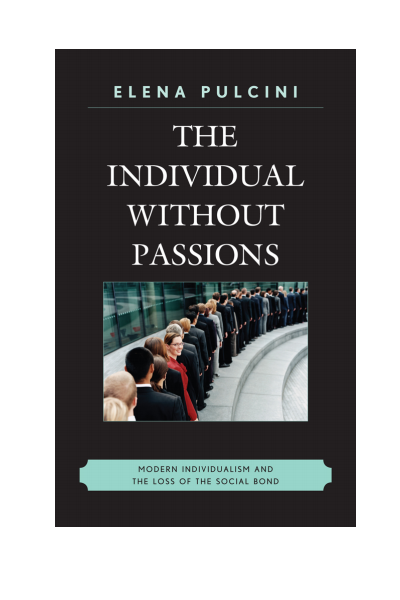
The Individual Without Passions
Modern Individualism and the Loss of the Social Bond
Authors:
Publisher:
2012
Summary
The Individual without Passions: Modern Individualism and the Loss of the Social Bond offers an innovative look at an extremely timely and important issue—individualism—from the point of view of a theory of passions. This book underlines the importance of the problem of the passions in both forming individual identity and building the social bond. Drawing inspiration from classic authors that represent fundamental milestones along the route of modern individualism—from Montaigne to Hobbes, from Locke to Smith, from Rousseau to Tocqueville—The Individual without Passions puts forward new hypotheses that contrast with the consolidated views of contemporary reflection, both modern and postmodern.
Elena Pulcini argues that passions are crucial not only when they are strong (homo oeconomicus), but also when absent or weak (homo democraticus), in both cases producing pathological effects on the Self and the social bond. Finally, this book underlines that the image of the modern individual does not end with the egoistical passions and that it is possible to reactivate empathetic and solidaristic passions; furthermore, it proposes the hypothesis that the solidaristic passions go to fight the egoistical passions. This hypothesis seems confirmed and is most evident in the phenomenon of the gift (as interpreted by Marcel Mauss and his contemporary heirs), the “hidden” testimony of a desire for belonging which enables us to propose a new figure of the individual—homo reciprocus.
Keywords
Search publication
Bibliographic data
Edition
1/2012
Copyright Year
2012
ISBN-Print
978-0-7391-6657-4
ISBN-Online
978-0-7391-6658-1
Publisher
Lexington, Lanham
Language
English
Pages
214
Product Type
Monograph
Table of contents
ChapterPages
Contents No access
Acknowledgments No access
Introduction No access Pages 1 - 10
Abbreviations of the Main Classical Works Quoted in the Text No access Pages 11 - 12
Chapter One: From the Ethics of Honorto Self-Preservation No access Pages 13 - 46
Chapter Two: Between Acquisitive Passion and Passion of the Self: Homo Oeconomicus No access Pages 47 - 72
Chapter Three: The Critique of Acquisitive Individualism and the Search for Authenticity No access Pages 73 - 104
Chapter Four: The Disappearance of the Passions: Homo Democraticus No access Pages 105 - 146
Chapter Five: The Passion of Giving and theCommunitarian Individual: Homo Reciprocus No access Pages 147 - 190