, to see if you have full access to this publication.
Monograph No access
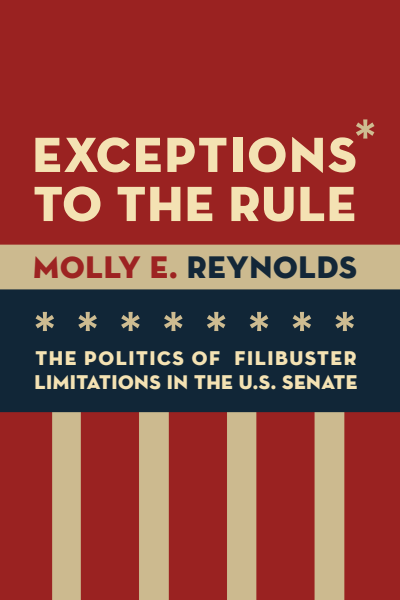
Exceptions to the Rule
The Politics of Filibuster Limitations in the U.S. Senate
Authors:
Publisher:
2017
Summary
Special rules enable the Senate to act despite the filibuster. Sometimes.
Most people believe that, in today's partisan environment, the filibuster prevents the Senate from acting on all but the least controversial matters. But this is not exactly correct. In fact, the Senate since the 1970s has created a series of special rulesdescribed by Molly Reynolds as majoritarian exceptions”that limit debate on a wide range of measures on the Senate floor.
The details of these exemptions might sound arcane and technical, but in practice they have enabled the Senate to act even when it otherwise seemed paralyzed. Important examples include procedures used to pass the annual congressional budget resolution, enact budget reconciliation bills, review proposals to close military bases, attempt to prevent arms sales, ratify trade agreements, and reconsider regulations promulgated by the executive branch.
Reynolds argues that these procedures represent a key instrument of majority party power in the Senate. They allow the majorityeven if it does not have the sixty votes needed to block a filibusterto produce policies that will improve its future electoral prospects, and thus increase the chances it remains the majority party.
As a case study, Exceptions to the Rule examines the Senate's role in the budget reconciliation process, in which particular congressional committees are charged with developing procedurally protected proposals to alter certain federal programs in their jurisdictions. Created as a way of helping Congress work through tricky budget issues, the reconciliation process has become a powerful tool for the majority party to bypass the minority and adopt policy changes in hopes that it will benefit in the next election cycle.
Search publication
Bibliographic data
Edition
1/2017
Copyright Year
2017
ISBN-Print
978-0-8157-2996-9
ISBN-Online
978-0-8157-2997-6
Publisher
Rowman & Littlefield, Lanham
Language
English
Pages
1
Product Type
Monograph
Table of contents
ChapterPages
Table of Contents No access
Introduction No access Pages 1 - 8
Limiting the Unlimited: Debate in the U.S. Senate No access Pages 9 - 38
Obscuring the Causal Chain: Majoritarian Exceptions as a Blame Avoidance Tool No access Pages 39 - 78
Employing the Exceptions: The Case of Budget Reconciliation No access Pages 79 - 124
The Policy Consequences of Procedural Choice: Programmatic Change Using Budget Reconciliation No access Pages 125 - 146
Facilitating Gains and Blocking Pain: Creating Executive Branch Oversight Exceptions No access Pages 147 - 184