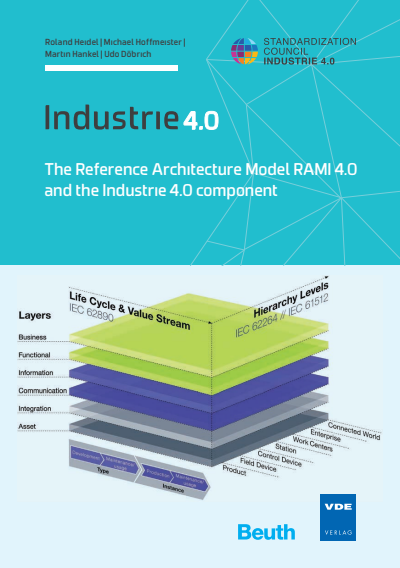
Cover of book: Industrie 4.0
, to see if you have full access to this publication.
Edited Book No access

Industrie 4.0

The Reference Architecture Model RAMI 4.0 and the Industrie 4.0 component
Authors/Editors:
Publisher:
 2019


Bibliographic data

Edition
1/2019
Copyright Year
2019
ISBN-Print
978-3-410-28919-7
ISBN-Online
978-3-410-28920-3
Publisher
DIN Media, Berlin
Series
DIN Media Innovation
Language
English
Pages
160
Product Type
Edited Book

Table of contents

ChapterPages
    1. Table of contents No access
  1. About the authors No access Pages 1 - 4
  2. Foreword No access Pages 5 - 6
  3. 1 Introduction No access Pages 7 - 7
  4. 2 Positioning Industrie 4.0 No access Pages 8 - 10
    1. 3.1 Characteristics of a reference architecture model No access
    2. 3.2 General requirements within Industrie 4.0 No access
    3. 3.3 The current state of technology No access
    4. 3.4 Scenario: The versatile factory No access
      1. 4.1.1 Terms and definitions No access
      2. 4.1.2 Properties No access
      1. 4.2.1 Specification of properties for Industrie 4.0 No access
      2. 4.2.2 Property values No access
      3. 4.2.3 The structured use of properties No access
      4. 4.2.4 Lists of properties for different processes and process phases No access
    1. 5.1 Basic considerations No access
    2. 5.2 Presentation and communication ability No access
    1. 6.1 Background No access
    2. 6.2 The Life cycle & Value Stream axis No access
    3. 6.3 The Hierarchy axis (allocation) No access
      1. 6.4.1 The Asset Layer and the Integration Layer No access
      2. 6.4.2 The Communication Layer No access
      3. 6.4.3 The Information Layer No access
      4. 6.4.4 The Functional Layer No access
      5. 6.4.5 The Business Layer No access
    4. 6.5 Example of a servo-hydraulic axis using the architectural layers of RAMI 4.0 No access
    1. 7.1 Value streams: Different perspectives No access
    2. 7.2 Data and information: Different perspectives No access
    1. 8.1 Object worlds No access
    2. 8.2 Fundamentals of the reflection process No access
      1. 8.3.1 International Registration Data Identifier (IRDI) No access
      2. 8.3.2 Uniform Resource Identifier (URI) No access
    1. 9.1 Motivation for a reference model No access
    2. 9.2 The fundamental concept of the I4.0 component No access
    3. 9.3 Scope of the I4.0 component No access
      1. 9.4.1 Case 1: The administration shell is provided by the asset itself No access
      2. 9.4.2 Case 2: The administration shell is provided by a central repository No access
      1. 9.5.1 Activating operation (case 1) No access
      2. 9.5.2 Asset-oriented access (case 2) No access
      3. 9.5.3 Dynamic cooperation (case 3) No access
    4. 9.6 Which information elements should the administration shell include? No access
    5. 9.7 The format of standardized properties No access
    6. 9.8 Implementation of data elements as properties No access
    7. 9.9 Standardized functions No access
    8. 9.10 Submodels group the information and functions of an I4.0 component No access
    9. 9.11 Identifiers for the different elements of the I4.0 component No access
    10. 9.12 The general structure of the (asset) administration shell No access
    11. 9.13 Example of a submodel No access
    12. 9.14 Designing the I4.0 component No access
    13. 9.15 The design process for a system comprising I4.0 components No access
    1. 10.1 Cooperation No access
    2. 10.2 Relationships No access
    3. 10.3 Asset compounds No access
      1. 10.4.1 Screw connection No access
      2. 10.4.2 Machines as part of a factory No access
      3. 10.4.3 Pipe with valve No access
    4. 10.5 Asset compounds: Aggregation and details No access
    5. 10.6 Diagram of cooperation No access
    6. 10.7 A uniform language (grammar) for cooperation No access
    1. 11.1 Service-orientation No access
    2. 11.2 Interaction models for I4.0 components No access
    1. 12.1 Identifiers and identities No access
    2. 12.2 Security (process) as an asset No access
    1. 13.1 The need for standardization No access
    2. 13.2 Standardizing properties No access
    1. 14.1 General No access
    2. 14.2 Outlook No access
  5. Bibliography No access Pages 138 - 140
  6. Bibliography of standards and technical rules No access Pages 141 - 148
  7. Index No access Pages 149 - 150

Similar publications

from the series "DIN Media Innovation"
Cover of book: BIM für Facility Manager
Edited Book No access
Annelie Casper, Ilka May, Stefanie Radek, Tanja Gutena, Fabian Naethbohm, Michael Maaß, Samuel Klaus, Sven Axt, Štefan Jaud, Thomas Utermann, DIN e. V.
BIM für Facility Manager
Cover of book: Zukunftsfähiges Bauen
Edited Book No access
Alexandra Dietze, Carmen Herrmann, Daniela Merkenich, Daniya Dölling, Stefanie Stefanie Weidner, Elena Boerman, Nefeli Mavroeidi, Martina Bauer, Susan Draeger, Sonja Thaler, Vanessa Propach, You Seok Kirschenmann, Baptiste Lach, Bernd Köhler, Dominik Stein, Sebastian Clark Koth, Simon Simon Steffen, Jan Hesse, João Mata, Matthias Domke, Max Dölling, Max Mannschreck, Michael Dax, Moritz Brombacher, Patrick Mahler, Philipp Wölfer, Dirk Hebel, E.h. Werner Sobek, Thomas Auer, Thomas Fenner, Timo Schmidt, Lucio Blandini, Steffen Feirabend, Roland Bechmann, Sebastian Hölzlein, DIN e. V.
Zukunftsfähiges Bauen
Cover of book: The BIM Manager
Edited Book No access
Mark Baldwin, DIN e. V., Mensch und Maschine Deutschland GmbH
The BIM Manager
Cover of book: Der BIM-Manager
Edited Book No access
Mark Baldwin, DIN e. V., Mensch und Maschine Deutschland GmbH
Der BIM-Manager
Cover of book: Erfolg durch Kooperation mit Start-ups
Edited Book No access
Christine Proksch, Matthias Helfrich, DIN e. V.
Erfolg durch Kooperation mit Start-ups