, to see if you have full access to this publication.
Edited Book No access
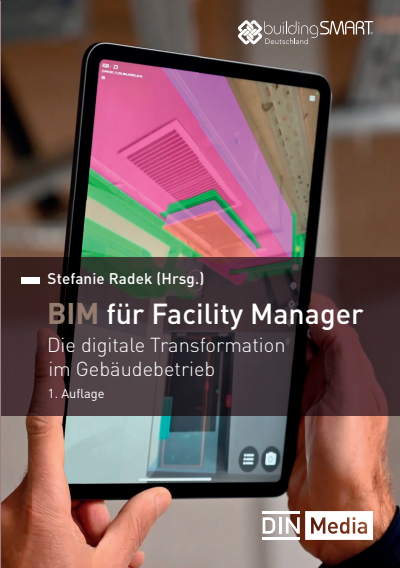
BIM für Facility Manager
Die digitale Transformation im Gebäudebetrieb- Authors/Editors:
- | | | | | | | | | |
- Series:
- DIN Media Innovation
- Publisher:
- 2026
Keywords
Search publication
Bibliographic data
- Edition
- 1/2026
- Copyright Year
- 2026
- ISBN-Print
- 978-3-410-38221-8
- ISBN-Online
- 978-3-410-38233-1
- Publisher
- DIN Media, Berlin
- Series
- DIN Media Innovation
- Language
- German
- Pages
- 425
- Product Type
- Edited Book
Table of contents
ChapterPages
- Autorenporträts No access
- Vorwort No access
- Danksagung No access
- Inhaltsverzeichnis No access
- Motivation No access Pages 1 - 8
- 1.1.1 Der Immobilienlebenszyklus No access
- 1.1.2 Gebäudebestand No access
- 1.1.3 Wie arbeitet der Gebäudebetrieb No access
- 1.2.1 BIM im Lebenszyklus No access
- 1.2.2 Die BIM-Arbeitsweise No access
- 1.2.3 Die Verbreitung von BIM No access
- 1.2.4 Die Informationen sind das zentrale Element No access
- 1.2.5 BIM-Software No access
- 1.2.6 Kooperation und Qualitätssicherung No access
- 1.2.7 BIM einfach machen No access
- 1.3.1 Was braucht wer? No access
- 1.3.2 Was wird benötigt? No access
- 2.1 Ziele No access
- 2.2 Optimierung No access
- 2.3.1 Standards, Objekttypen und Merkmale No access
- 2.3.2 Identifikatoren No access
- 2.3.3 Geometrie No access
- 2.3.4 Digitaler Zwilling No access
- 2.3.5 Datenbanken No access
- 2.3.6 Datenbankmanagementsysteme No access
- 2.3.7 Softwarearchitektur No access
- 2.3.8 IT-Systemlandschaft No access
- 2.3.9 IT-Sicherheit No access
- 2.3.10 Von LOIN, LOD und 3D-, 4D-, 5D-… BIM No access
- 2.4.1 Der digitale Zwilling im Betrieb No access
- 2.4.2 Übergabe der Informationen an den Betrieb No access
- 2.4.3 Die Mitwirkung des Betriebs im Bauprojekt No access
- 2.4.4 Die Methode „Eine Quelle für alle“ – eine „Single Source of Truth“ No access
- 2.4.5 Herausforderungen mit BIM No access
- 2.4.6 Bewirtschaftung No access
- 2.4.7 Prozesse eines BIM-Projekts No access
- 2.5.1 BIM fordert einen kulturellen Wandel No access
- 2.5.2 BIM fordert Kompetenz No access
- 3.1.1 BIM in der Planungsphase No access
- 3.1.2 Warum BIM im Betrieb No access
- 3.1.3 Nachhaltigkeit No access
- 3.1.4 BIM und Lean No access
- 4.1.1 BIM im Betrieb No access
- 4.1.2 Ein BIM-Bauprojekt ausschreiben No access
- 4.1.3 Anwendungsfälle No access
- 4.1.4 Der Betrieb im Bauprojekt No access
- 4.1.5 Die Verwendung im Betrieb No access
- 4.1.6 Die Übergabe in den Betrieb (Handover) No access
- 4.1.7 Bestandsdokumentation im Betrieb No access
- 4.1.8 Führung und Pflege der IT-Werkzeuge No access
- 4.1.9 Change-Management – Lean Transformation No access
- 4.2.1 Alphanumerische Informationen No access
- 4.2.2 Geometrische Informationen No access
- 4.2.3 Unstrukturierte Informationen No access
- 4.3.1 CAD (Computer-aided Design) No access
- 4.3.2 GIS (Geoinformationssysteme) No access
- 4.3.3 OpenBIM-Standards No access
- 4.3.4 AAS (Asset Administration Shell) No access
- 4.3.5 Methoden zur digitalen Aufnahme von Gebäuden, Bauteilen, Außenflächen No access
- 4.3.6 Kennzeichnungssysteme für Objekte No access
- 4.3.7 Methoden der Visualisierung No access
- 4.3.8 Model-Checker No access
- 4.3.9 Prozessmodellierung No access
- 4.3.10 Datenbanken No access
- 4.3.11 Data Warehouse No access
- 4.3.12 KI (künstliche Intelligenz) No access
- 4.3.13 Digitaler Produktpass No access
- 5.1.1 Entscheidungen treffen No access
- 5.2 Die Multiplikatoren (im Change-Management oder in der Transformation) No access
- 5.3 Die Vorgesetzten No access
- Quellen- und Literaturverzeichnis No access Pages 388 - 392
- Stichwortverzeichnis No access Pages 393 - 393
- Bildverzeichnis No access Pages 394 - 398
- Tabellenverzeichnis No access Pages 399 - 399