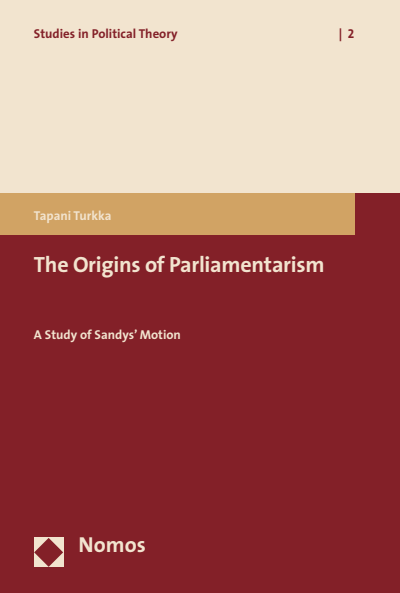
The Origins of Parliamentarism
A Study of Sandys' Motion- Authors:
- Series:
- Studies in Political Theory, Volume 2
- Publisher:
- 2007
Summary
In this study Tapani Turkka offers a discussion of the origins of parliamentarism in the context of early 18th century Britain. This is accomplished in the perspective of Dr. Turkka's new interpretation of John Locke's political thought in the Second Treatise. In this interpretation the exercise of state power is not by nature political but must be separately constituted as such. According to Turkka, Locke finds this possible to his contemporaries and succeeding generations of men. The origins of parliamentarism is seen to mean this very process of constitution of the use of state power as political. It is argued that this took place without a precedent during Sir Robert Walpole's long ascendancy (1721-1742) and due to his innovative policies.
Samuel Sandys' motion (1741) to remove Walpole from his office as Prime Minister embodies in a compact form the problems involved in the use of state power constituted as political in the context of early 18th century Britain emanating from the revolution of 1688. As such it allows a concentrated study of the origins of parliamentarism. This work will be of great interest and importance for scholars in political science and history.
Search publication
Bibliographic data
- Edition
- 1/2007
- Copyright Year
- 2007
- ISBN-Print
- 978-3-8329-2615-1
- ISBN-Online
- 978-3-8452-0181-8
- Publisher
- Nomos, Baden-Baden
- Series
- Studies in Political Theory
- Volume
- 2
- Language
- English
- Pages
- 236
- Product Type
- Monograph
Table of contents
- Titelei/Inhaltsverzeichnis No access Pages 2 - 6Authors:
- Acknowledgements No access Pages 7 - 8Authors:
- Time-point, era and the longue durée; parliamentarism No access Pages 9 - 14Authors:
- “A kind of parliamentarism” No access Pages 14 - 21Authors:
- Objectives of the study No access Pages 21 - 27Authors:
- Study material and procedure No access Pages 27 - 33Authors:
- The motion No access Pages 34 - 37Authors:
- The grounds for the motion No access Pages 37 - 41Authors:
- Walpole’s reply No access Pages 41 - 44Authors:
- Formation of the modern concept of revolution No access Pages 45 - 48Authors:
- Necessity for a discriminative analysis No access Pages 48 - 51Authors:
- Return to the acknowledgedly right state of affairs No access Pages 51 - 57Authors:
- Long-term structural change No access Pages 57 - 63Authors:
- A condition on Locke’s doctrine No access Pages 64 - 72Authors:
- The state of nature is the state all men are naturally in No access Pages 72 - 74Authors:
- Every man in the state of nature disposes of power No access Pages 74 - 77Authors:
- A “strange doctrine” No access Pages 77 - 79Authors:
- Inconveniences in the state of nature as grounds for membership in a society No access Pages 79 - 81Authors:
- Membership in society No access Pages 81 - 84Authors:
- The significance of entry into membership in a society No access Pages 84 - 86Authors:
- Political power – what is it? No access Pages 86 - 88Authors:
- The formation of political power No access Pages 88 - 93Authors:
- The exercise of political power No access Pages 93 - 96Authors:
- Meaning at point in time No access Pages 96 - 101Authors:
- Significance in period No access Pages 101 - 107Authors:
- Significance in the longue durée No access Pages 107 - 111Authors:
- The possibility of realisation of the doctrine No access Pages 111 - 115Authors:
- What is involved? No access Pages 116 - 119Authors:
- The locus of constitution No access Pages 119 - 124Authors:
- The problem of viability No access Pages 124 - 130Authors:
- The constitution of political power No access Pages 130 - 138Authors:
- Walpole’s programme No access Pages 139 - 140Authors:
- Freedom No access Pages 140 - 145Authors:
- Constraint No access Pages 145 - 155Authors:
- The Margin No access Pages 155 - 158Authors:
- Political responsibility in the exercise of power No access Pages 159 - 160Authors:
- The legitimacy of the exercise of political power No access Pages 160 - 164Authors:
- The possibility of realisation of legitimacy No access Pages 164 - 168Authors:
- Re-definition of legitimacy No access Pages 168 - 175Authors:
- Patterns of power No access Pages 175 - 177Authors:
- The nature of the power pattern No access Pages 177 - 180Authors:
- The opposition perspective No access Pages 180 - 186Authors:
- The government perspective No access Pages 186 - 194Authors:
- The opposition programme No access Pages 194 - 202Authors:
- Implementation of the opposition programme and the motion to remove Walpole from office No access Pages 202 - 206Authors:
- Government supporters and the motion to remove Walpole from office No access Pages 206 - 210Authors:
- The pattern of power and the motion to remove Walpole from office No access Pages 210 - 215Authors:
- Conclusion No access Pages 216 - 221Authors:
- Bibliography No access Pages 222 - 236Authors: