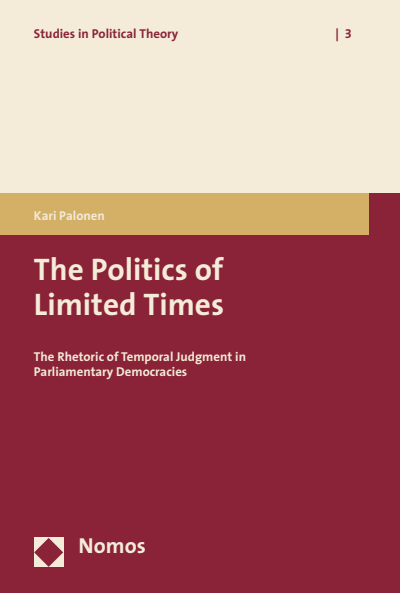
The Politics of Limited Times
The Rhetoric of Temporal Judgment in Parliamentary Democracies- Authors:
- Series:
- Studies in Political Theory, Volume 3
- Publisher:
- 2008
Summary
Politik ist von Natur aus ein Spiel mit der Zeit. Das Buch bietet eine interessante Lektüre mit einer gelungenen Kombination aus idealtypischen, rhetorischen und historischen Ansätzen. Der Autor setzt hiermit seine Studien der Politischen Ideengeschichte mit einer rhetorischen Analyse der Institutionen und Verfahren mit dem Spiel der Zeit fort.
Die Parlamentarisierung und Demokratisierung der Politik bedingen einen kürzeren zeitlichen Horizont der Politik als in monarchischen oder bürokratischen Regierungsformen. Die zeitlichen Ebenen regulärer und wiederkehrender Gelegenheiten für Veränderungen lassen sich im Einzelnen in Lebensdauer, Dynamik, Zeitspannen und Kalendarium aufteilen. Weitere Kapitel, die sich mit der Demokratisierung des Wahlrechts, dem Wechsel in der Regierung, parlamentarischen Verfahren, rhetorischen Praktiken und der Zeit von Politikern beschäftigen, zeigen Zusammenspiel und Widerspruch dieser Ebenen. Die abschließenden Kapitel verbinden die zeitlichen Ebenen mit dem Spiel mit der knappen Zeit und schließen mit einer Befürwortung des kurzen zeitlichen Horizonts einer Wahlperiode als den wichtigsten Vorteil von parlamentarischen Demokratien.
Mit dem Sprichwort: "Staatsmänner denken an die nächsten Generationen, Politiker an die nächsten Wahlen", ermutigt das Buch seine Leser, zu denken wie ein Politiker.
Search publication
Bibliographic data
- Edition
- 1/2008
- Copyright Year
- 2008
- ISBN-Print
- 978-3-8329-3804-8
- ISBN-Online
- 978-3-8452-1126-8
- Publisher
- Nomos, Baden-Baden
- Series
- Studies in Political Theory
- Volume
- 3
- Language
- English
- Pages
- 264
- Product Type
- Monograph
Table of contents
- Titelei/Inhaltsverzeichnis No access Pages 2 - 10Authors:
- Acknowledgements No access Pages 11 - 12Authors:
- Toward a temporal reading of politics No access Pages 13 - 17Authors:
- The scarce times of parliamentary democracies No access Pages 17 - 22Authors:
- The revaluation of timeliness No access Pages 22 - 25Authors:
- The layers of political time: lifetime, momentum, time-span and calendar No access Pages 25 - 32Authors:
- Learning to play with limited times No access Pages 32 - 35Authors:
- The contingency of suffrage No access Pages 36 - 40Authors:
- A reform within the English tradition No access Pages 40 - 42Authors:
- William Gladstone: A reversal of the conditions for suffrage No access Pages 42 - 44Authors:
- Benjamin Disraeli against the rule of numbers No access Pages 44 - 46Authors:
- Robert Lowe: Democracy as a threat to progress No access Pages 46 - 49Authors:
- John Bright: Suffrage and political freedom No access Pages 49 - 51Authors:
- John Stuart Mill: Political education through franchise No access Pages 51 - 52Authors:
- Parliament reform, political times and temporal scarcity No access Pages 52 - 57Authors:
- A new item on the reform agenda No access Pages 57 - 58Authors:
- Women, franchise and politics No access Pages 58 - 62Authors:
- Harriet Taylor: The break with custom No access Pages 62 - 65Authors:
- Lydia E. Becker and the redistribution of power No access Pages 65 - 68Authors:
- Equal vote and the temporalisation of politics No access Pages 68 - 70Authors:
- Universal suffrage as a contract: Léon Gambetta No access Pages 70 - 76Authors:
- The four “Kratien” No access Pages 76 - 84Authors:
- Occasional and professional politicians in democracy No access Pages 84 - 88Authors:
- Democracy, conceptual change and political times No access Pages 88 - 92Authors:
- Suffrage, time and scarcity No access Pages 92 - 94Authors:
- Rotation as a quasi-natural time No access Pages 95 - 98Authors:
- The imperative mandate No access Pages 98 - 102Authors:
- The endless discussion No access Pages 102 - 104Authors:
- The politicisation of elections No access Pages 104 - 108Authors:
- The politics of electoral terms No access Pages 108 - 113Authors:
- The extraordinary time of elections No access Pages 113 - 115Authors:
- From constitutional to parliamentary government No access Pages 115 - 117Authors:
- The defence of alternation: Eugène Pierre No access Pages 117 - 121Authors:
- The formation and dismissal of governments No access Pages 121 - 129Authors:
- Majority vs. coalition governments No access Pages 129 - 132Authors:
- Elections as an extension of the parliamentary paradigm No access Pages 132 - 135Authors:
- The rhythms of political change No access Pages 135 - 137Authors:
- The rhetorical politics of parliamentarism No access Pages 138 - 146Authors:
- Deliberation in the ancient assemblies No access Pages 146 - 148Authors:
- The formation and modification of parliamentary procedure No access Pages 148 - 152Authors:
- The legitimisation of the parliamentary procedure No access Pages 152 - 156Authors:
- The procedure and the play with times No access Pages 156 - 158Authors:
- Parliamentary eloquence in Britain No access Pages 158 - 169Authors:
- William E. Gladstone on eloquence and the eloquence of Gladstone No access Pages 169 - 173Authors:
- Walter Bagehot on eloquence as an obstacle to policy No access Pages 173 - 179Authors:
- French parliamentary eloquence No access Pages 179 - 183Authors:
- Louis-Marie de Cormenin on parliamentary eloquence and improvisation No access Pages 183 - 187Authors:
- Alexis de Tocqueville on the linguistic change in democracies No access Pages 187 - 189Authors:
- Louis Barthou on the plenary speaker No access Pages 189 - 193Authors:
- Ernst Müller-Meiningen on parliamentary speaking No access Pages 193 - 196Authors:
- The end of parliamentary eloquence? No access Pages 196 - 199Authors:
- Parliamentarism, rhetoric and time No access Pages 199 - 204Authors:
- Times of the parliamentarian No access Pages 205 - 213Authors:
- Times of the minister No access Pages 213 - 217Authors:
- Times of the candidate No access Pages 217 - 221Authors:
- Times of the citizen-voter No access Pages 221 - 225Authors:
- Plural times of politics No access Pages 225 - 227Authors:
- The politics of lifetime No access Pages 228 - 232Authors:
- The politics of the momentum No access Pages 232 - 235Authors:
- The politics of the time-span No access Pages 235 - 238Authors:
- The politics of the calendar No access Pages 238 - 242Authors:
- The difficult politics of limited times No access Pages 242 - 244Authors:
- The Temporal Subtext of Parliamentary Politics No access Pages 245 - 248Authors:
- Online References No access Pages 249 - 250Authors:
- Printed References No access Pages 250 - 264Authors: