, to see if you have full access to this publication.
Monograph No access
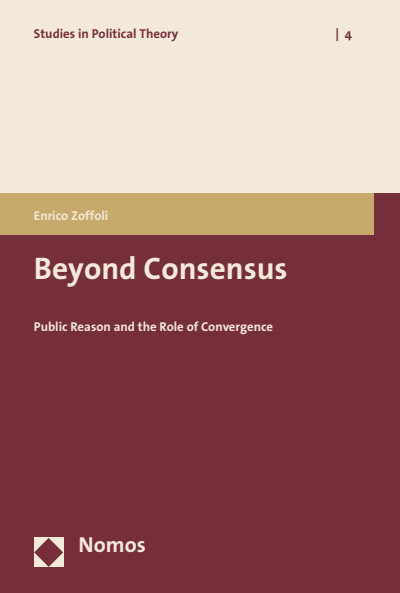
Beyond Consensus
Public Reason and the Role of Convergence- Authors:
- Series:
- Studies in Political Theory, Volume 4
- Publisher:
- 2013
Summary
Wie kann man ein System des gesellschaftlichen Zusammenlebens erreichen, in dem alle Bürger als frei und gleichberechtigt respektiert werden? Der Autor gibt eine innovative Antwort auf diese Kernfrage der modernen politischen Philosophie und denkt neu über öffentliche Vernunft, die Funktion der moralischen Epistemologie und über öffentliche Legitimierung nach.
Search publication
Bibliographic data
- Edition
- 1/2013
- Copyright Year
- 2013
- ISBN-Print
- 978-3-8487-0506-1
- ISBN-Online
- 978-3-8452-4796-0
- Publisher
- Nomos, Baden-Baden
- Series
- Studies in Political Theory
- Volume
- 4
- Language
- English
- Pages
- 249
- Product Type
- Monograph
Table of contents
ChapterPages
- Titelei/Inhaltsverzeichnis No access Pages 2 - 10Authors:
- a Varieties of liberalism No access Pages 11 - 13Authors:
- b Justificatory liberalism No access Pages 13 - 20Authors:
- a Consensus and convergence No access Pages 20 - 24Authors:
- b Overview of the argument No access Pages 24 - 28Authors:
- c Content and method No access Pages 28 - 32Authors:
- Overview of the argument No access Pages 33 - 34Authors:
- The Principle of Political Liberty No access Pages 34 - 38Authors:
- Some misgivings about the presumption in favor of liberty No access Pages 38 - 42Authors:
- The site of public reason No access Pages 42 - 44Authors:
- Rejecting the Derivative Justification Thesis No access Pages 44 - 46Authors:
- The principle of public justification No access Pages 46 - 48Authors:
- The concept of public justification and its conceptions No access Pages 48 - 49Authors:
- Strong and weak consensus No access Pages 49 - 53Authors:
- Private and public reasons No access Pages 53 - 54Authors:
- Three levels of publicness No access Pages 54 - 56Authors:
- The role of religious reasons No access Pages 56 - 61Authors:
- Rawls on the overlapping consensus No access Pages 61 - 63Authors:
- Deepening the problem No access Pages 63 - 66Authors:
- Two kinds of defeaters No access Pages 66 - 69Authors:
- Conclusive justification No access Pages 69 - 71Authors:
- The Conclusiveness Thesis No access Pages 71 - 73Authors:
- A first presumption in favor of convergence No access Pages 73 - 74Authors:
- The Freestandingness Thesis No access Pages 74 - 76Authors:
- Procedures of abstraction No access Pages 76 - 79Authors:
- Undermined freestanding reasons are not shareable No access Pages 79 - 81Authors:
- Rebutted freestanding reasons are not shareable No access Pages 81 - 84Authors:
- Suspended freestanding reasons are not shareable No access Pages 84 - 85Authors:
- Weak Shareability Requirement? No access Pages 85 - 88Authors:
- A twofold presumption in favor of convergence No access Pages 88 - 90Authors:
- A challenge for consensus No access Pages 90 - 91Authors:
- Strength-based arguments for consensus No access Pages 91 - 93Authors:
- Appropriateness-based arguments for consensus No access Pages 93 - 95Authors:
- Limits of appropriateness-based arguments for consensus No access Pages 95 - 96Authors:
- Summary No access Pages 96 - 98Authors:
- Overview of the argument No access Pages 99 - 100Authors:
- Public reasons as objective reasons No access Pages 100 - 103Authors:
- Four strength-based arguments for consensus No access Pages 103 - 106Authors:
- The basic argument No access Pages 106 - 110Authors:
- Strong externalism No access Pages 110 - 112Authors:
- Moderate externalism No access Pages 112 - 114Authors:
- Internalism No access Pages 114 - 117Authors:
- Open vs. closed justification No access Pages 117 - 117Authors:
- Open justification and internal coherence No access Pages 117 - 120Authors:
- Rejecting the top-down argument for consensus No access Pages 120 - 122Authors:
- The basic (radical) argument No access Pages 122 - 125Authors:
- Some important remarks No access Pages 125 - 127Authors:
- Post-metaphysical objectivity No access Pages 127 - 129Authors:
- Ethical discourses and open justification No access Pages 129 - 133Authors:
- Are private reasons necessarily defeated? No access Pages 133 - 134Authors:
- Validity claims No access Pages 134 - 137Authors:
- The asymmetry between rightness claims and truth claims No access Pages 137 - 140Authors:
- A discourse-theoretical approach to universalization No access Pages 140 - 143Authors:
- Discourse theory and epistemic pluralism No access Pages 143 - 144Authors:
- Rejecting some major arguments for consensus No access Pages 144 - 146Authors:
- A more moderate defense of consensus? No access Pages 146 - 149Authors:
- The (alleged) priority of freestanding reasons No access Pages 149 - 151Authors:
- What defeats what? No access Pages 151 - 154Authors:
- Back to post-metaphysical rationality No access Pages 154 - 156Authors:
- The scope of private defeaters No access Pages 156 - 158Authors:
- Summary No access Pages 158 - 160Authors:
- Overview of the argument No access Pages 161 - 162Authors:
- The argument from sincerity No access Pages 162 - 166Authors:
- Intelligibility and relevance No access Pages 166 - 169Authors:
- Why the sincerity requirement undermines convergence No access Pages 169 - 173Authors:
- Why the sincerity requirement does not justify consensus No access Pages 173 - 176Authors:
- The role of moral epistemology No access Pages 176 - 179Authors:
- The Commonsense View of Shareability No access Pages 179 - 182Authors:
- The Meta-Convergence View of Shareability No access Pages 182 - 184Authors:
- The Political View of Shareability No access Pages 184 - 186Authors:
- The value of full publicity No access Pages 186 - 190Authors:
- The role of the public sphere No access Pages 190 - 191Authors:
- Full publicity as a justificatory device No access Pages 191 - 194Authors:
- The argument from normative stability No access Pages 194 - 198Authors:
- The argument from reasonable compliance No access Pages 198 - 202Authors:
- Framing the issue No access Pages 202 - 205Authors:
- The Strong Burden Thesis and the Weak Burden Thesis No access Pages 205 - 207Authors:
- Freestanding rationales and general interests No access Pages 207 - 210Authors:
- Why the argument from symmetry seems appealing No access Pages 210 - 212Authors:
- Why the argument from symmetry is misguided No access Pages 212 - 215Authors:
- The Non-Coercive Rejection Thesis No access Pages 215 - 216Authors:
- Contested property rights No access Pages 216 - 218Authors:
- When liberty is not an available default No access Pages 218 - 221Authors:
- The narrow symmetry objection No access Pages 221 - 223Authors:
- The Symmetrical Convergence View of Public Reason No access Pages 223 - 225Authors:
- Against public reason’s Shareability Requirement No access Pages 225 - 226Authors:
- A further problem No access Pages 226 - 231Authors:
- Summary No access Pages 231 - 232Authors:
- Conclusion No access Pages 233 - 240Authors:
- Bibliography No access Pages 241 - 249Authors: