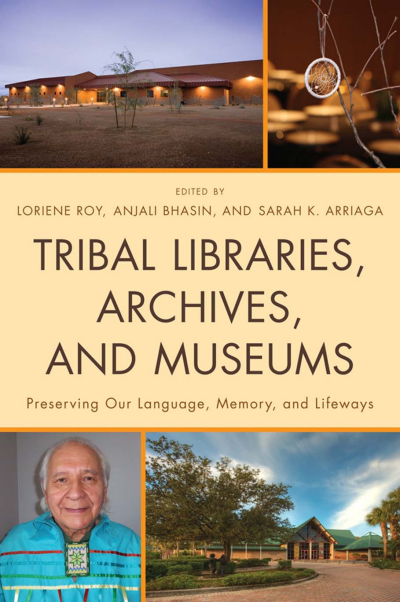
Tribal Libraries, Archives, and Museums
Preserving Our Language, Memory, and Lifeways- Editors:
- | |
- Publisher:
- 2011
Summary
Hundreds of tribal libraries, archives, and other information centers offer the services patrons would expect from any library: circulation of materials, collection of singular items (such as oral histories), and public services (such as summer reading programs). What is unique in these settings is the commitment to tribal protocols and expressions of tribal lifeways—from their footprints on the land to their architecture and interior design, institutional names, signage, and special services, such as native language promotion.
This book offers a collection of articles devoted to tribal libraries and archives and provides an opportunity for tribal librarians to share their stories, challenges, achievements, and aspirations with the larger professional community. Part one introduces the tribal community library, providing context and case studies for libraries in California, Alaska, Oklahoma, Hawai'i, and in other countries. The role of tribal libraries and archives in native language recovery and revitalization is also addressed in this section. Part two features service functions of tribal information centers, addressing the library facility, selection, organization, instruction, and programming/outreach. Part three includes a discussion of the types of records that tribes might collect, legal issues, and snapshot descriptions of noteworthy archival collections. The final part covers strategic planning, advice on working in the unique environments of tribal communities, advocacy and marketing, continuing education plans for library staff, and time management tips that are useful for anyone working in a small library setting.
Search publication
Bibliographic data
- Edition
- 1/2011
- Copyright Year
- 2011
- ISBN-Print
- 978-0-8108-8194-5
- ISBN-Online
- 978-0-8108-8195-2
- Publisher
- Rowman & Littlefield, Lanham
- Language
- English
- Pages
- 248
- Product Type
- Edited Book
Table of contents
- Contents No access
- Preface No access
- Introduction: The Role of Libraries in Lifelong Learning No access
- 1 A Place at the Table: California’s Tribal Libraries Take Steps Toward Inclusion No access
- 2 Alaska Native Village Libraries: Picking Up the Pieces No access
- 3 Community Collaborations with the Tribal Library No access
- 4 Beyond Books and Portals: Proactive Indigenous Librarianship No access
- 5 Mohave Language Projects and the Role of the CRIT Library No access
- 6 Out of the Archives: Fostering Collaborative Environments for Language Revitalization No access
- 7 International Efforts in Supporting and Advancing Library Services for Indigenous Populations No access
- 8 American Indian Library Association No access
- 9 Tribal College and University Library Association (TCULA) No access
- 10 Indigenous Architecture for Tribal Cultural Centers No access
- 11 Tribal Libraries as the Future of Librarianship: Independent Collection Development as a Tool for Social Justice No access
- 12 Organizing Information Resources: A Path for Access in Tribal Settings No access
- 13 Empowering Indigenous Students in the Learning Library No access
- 14 Weaving Partnerships with the American Indian Peoples in Your Community to Develop Cultural Programming No access
- 15 Recommendations and Implications for Services to and with Indigenous Elders No access
- 16 Where Are the Records? No access
- 17 Tribal Archives in Preserving Our Language, Memory, and Lifeways No access
- 18 The Record Road: Growing Perspectives on Tribal Archives No access
- 19 Your Tribal Library and Strategic Planning: Vision, Mission, Service Responses, Goals, Objectives, and Output Measures No access
- 20 Gaining Local Tribal Support for Library Development: Twenty-one Steps for Success No access
- 21 Advocacy and Marketing for the Tribal Library No access
- 22 Developing a Staff Development Plan for a Tribal Librarian No access
- 23 Time Management for the Tribal Librarian No access
- 24 Accreditation Through the Lens of a Tribal Museum No access
- 25 TLAM: Creating Student-Driven Indigenous LIS at the University of Wisconsin–Madison No access
- Index No access Pages 227 - 236
- About the Contributors No access Pages 237 - 248