, to see if you have full access to this publication.
Monograph No access
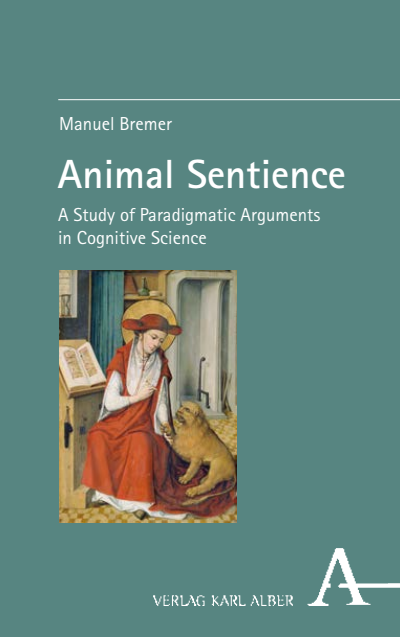
Animal Sentience
A Study of Paradigmatic Arguments in Cognitive Science
Authors:
Publisher:
2026
Summary
Humans are unique among living beings in having language, culture – and consciousness, all in the proper narrow sense of the words. Extending the sense of “language” (to cover animal signaling), “culture” (to cover animal tool use) and “consciousness” (to cover animal mentality) hinders a scientific understanding of animal minds, so far as animal species have minds. The book deals with the distinction between consciousness and sentience. The focus is on paradigmatic arguments in cognitive science concerning their distinction or continuity. Philosophy of Cognitive Science tries to define such paradigmatic arguments and to evaluate their cogency in their respective uses.
Search publication
Bibliographic data
Edition
1/2026
Copyright Year
2026
ISBN-Print
978-3-495-98760-5
ISBN-Online
978-3-495-98761-2
Publisher
Karl Alber, Baden-Baden
Language
English
Pages
155
Product Type
Monograph
Table of contents
ChapterPages
Preface No access Pages 1 - 20
§1 Paradigm Case Arguments No access Pages 21 - 22
§2 Reflective Equilibrium (I) No access Pages 23 - 24
§3 Not Simply Top-Down No access Pages 25 - 30
§4 The Neurophysiological Paradigm No access Pages 31 - 32
§5 The Behavioural Paradigm No access Pages 33 - 34
§6 The Appeal to a Certainty Intuition as Paradigm No access Pages 35 - 38
§7 The Evolutionary Paradigm (I) No access Pages 39 - 39
§8 Dualism and Sentience No access Pages 40 - 41
§9 The Non-Conscious Capacity Paradigm No access Pages 42 - 43
§10 The Pain Paradigm No access Pages 44 - 46
§11 The Evolutionary Paradigm (II) No access Pages 47 - 49
§12 Animal Attitudes (I) No access Pages 50 - 52
§13 Pain as Functionalist Paradigm No access Pages 53 - 54
§14 Primates as Special Case No access Pages 55 - 57
§15 The Simplicity Paradigm No access Pages 58 - 59
§16 The Fitness Paradigm No access Pages 60 - 61
§17 Animal Concepts (I) No access Pages 62 - 64
§18 Animal Attitudes (II) No access Pages 65 - 66
§19 The Language Paradigm (I) No access Pages 67 - 69
§20 The ‘Theory of Mind’ Paradigm No access Pages 70 - 73
§21 The Simulation Paradigm No access Pages 74 - 75
§22 Reflective Equilibrium (II) No access Pages 76 - 77
§23 The Anthropomorphic Fallacy No access Pages 78 - 80
§24 Heterophenomenology No access Pages 81 - 82
§25 A New Anthropomorphism No access Pages 83 - 87
§26 Sentience and Animal Welfare No access Pages 88 - 96
§27 Subjectless Awareness? No access Pages 97 - 101
§28 The Language Paradigm (II) No access Pages 102 - 102
§29 Animal LOT (I) No access Pages 103 - 104
§30 Shared LOT Types? No access Pages 105 - 111
§31 Animal LOT (II) No access Pages 112 - 112
§32 The Gricean Paradox No access Pages 113 - 114
§33 The Language Paradigm (III) No access Pages 115 - 115
§34 Human Cognitive Architecture No access Pages 116 - 121
§35 The Versatility Paradigm No access Pages 122 - 122
§36 Versatility in Behaviour No access Pages 123 - 124
§37 Animal LOT (III) No access Pages 125 - 126
§38 The Priority of Behavioural complexity No access Pages 127 - 128
§39 Varieties of Sentience No access Pages 129 - 129
§40 Human Dual LOT Coding No access Pages 130 - 132
§41 Animal Attitudes (III) No access Pages 133 - 134
§42 Goal/Registration-Explanations No access Pages 135 - 136
§43 Animal Concepts (II) No access Pages 137 - 139
§44 Conditions of Sentience No access Pages 140 - 142