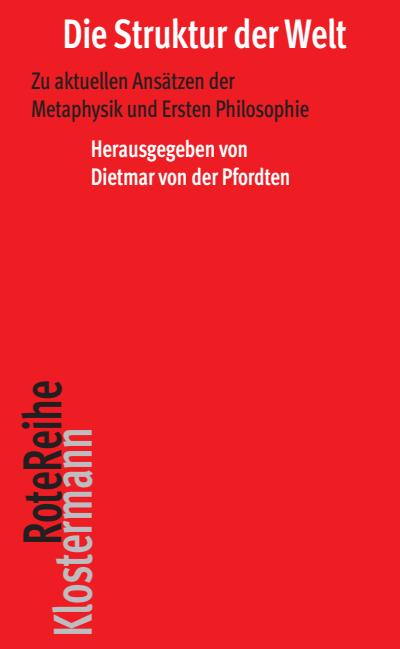
Die Struktur der Welt
Zu aktuellen Ansätzen der Metaphysik und der Ersten Philosophie- Editors:
- Series:
- Klostermann Rote Reihe, Volume 175
- Publisher:
- 2026
Summary
What is the structure of the world as a whole? Philosophy has been asking this question since its inception in antiquity. Given the increasing emancipation of the individual disciplines from philosophy since the beginning of the modern era, philosophy’s former claim to the encyclopaedic compilation of all knowledge about the world can no longer be upheld. For our philosophical thinking today, however, another, essential aspect of philosophy’s fundamental question remains crucial: the question of the foundation, categorisation and framing – in short, the ‘structure’ of the world as a whole. This other aspect of the fundamental question of philosophy has not been rendered superfluous with the independence of the ‘individual sciences’, because these, by virtue of their conceptual self-description and how they are described by others, can never seek the structure of the world as a whole. The contributions gathered in this volume reflect the renaissance of philosophical inquiry into First Philosophy or Metaphysics that has taken place in recent decades. They engage with further developments of worldviews already held in antiquity, explore thought, mind and consciousness, and present comprehensive foundations, systematisations and categorisations of the structure of the world as a whole.
Keywords
Search publication
Bibliographic data
- Edition
- 1/2026
- Copyright Year
- 2026
- ISBN-Print
- 978-3-465-04767-4
- ISBN-Online
- 978-3-465-14767-1
- Publisher
- Klostermann, Frankfurt am Main
- Series
- Klostermann Rote Reihe
- Volume
- 175
- Language
- German
- Pages
- 267
- Product Type
- Edited Book
Table of contents
- Vorwort No access
- Einleitung No access Pages 9 - 16Authors:
- Authors:
- Zusammenfassung No access
- Einleitung No access
- 1. Das Projekt der Metaphysik und die Frage nach der Struktur der Welt No access
- 2. Neoaristotelische Theorien der Substanzen No access
- 3. Aristotelische und neoaristotelische Bestimmung des Substanzbegriffs No access
- 4. Die Population der Substanzen No access
- 5. Die kategoriale Struktur der Welt No access
- 6. Die einseitige ontologische Abhängigkeit von den Substanzen No access
- 7. Die hylemorphe Struktur der Substanzen No access
- 8. Das neoaristotelische Bild von der Struktur der Welt No access
- Authors:
- Zusammenfassung No access
- 1. Atomismus im Kontext der neuzeitlichen Naturwissenschaft No access
- 2. Was Atomismus besagt: ein Vorschlag zur genauen Formulierung No access
- 3. Die Grenzen des Atomismus No access
- Authors:
- Zusammenfassung No access
- 1. Einleitung No access
- 3. Der Mythos der Substanz No access
- 4. Whiteheads Prozess-Metaphysik No access
- 5. Das Programm der General Process Theory No access
- 6. Motivationen für eine Prozessontologie No access
- Authors:
- Zusammenfassung No access
- I. Das Spektrum des philosophischen Idealismus No access
- II. Begründung der Subjektivitätsthese No access
- III. Die ursprüngliche epistemische Selbstindividuation der Subjekte No access
- IV. Der Ort von Bewusstsein in der Welt No access
- Authors:
- Zusammenfassung No access
- I. Die Struktur der Wirklichkeit und die Form unserer Gedanken No access
- II. Die Idee eines Ansatzes zum Fortschritt No access
- III. Abriss eines Arguments No access
- IV. Begrifflicher Idealismus No access
- Authors:
- Zusammenfassung No access
- 1. Einleitung No access
- 2. Was ist Bewusstsein? No access
- 3. Physikalistischer Reduktionismus No access
- 4. Dualistischer Emergentismus No access
- 4. Zur These DE1: die Einzigartigkeit erlebender Wesen No access
- 5. Zur These DE2: die Einzigartigkeit erlebnismäßiger Eigenschaften No access
- 6. Zur These DE3: die Neuartigkeit von Bewusstsein No access
- 7. Zur These DE4: der Einfluss aktiver Wesen auf die Welt No access
- 8. Schlussbemerkung No access
- Authors:
- Zusammenfassung No access
- I. Die Welt als Hierarchie: von der Supervenienzthese zur Fundierungstheorie No access
- II. Thesen 1 bis 3 über Fundierung: Transparenz, Spezifizität, begriffliche Perspektiven No access
- III. These 4 über Fundierung: Erklärungspraktiken No access
- IV. Objektiver Konzeptualismus über Fundierung No access
- V. Anwendungen: die Fundierung von Generalisierungen und Negationen No access
- VI. Ein-Reich-Metaphysik vs. Zwei-Reiche-Metaphysik No access
- Authors: |
- Zusammenfassung No access
- I. Welche „Welt“? No access
- II. Was meint „Konstruktion“? No access
- 1. Die Welt als Konstruktion des Geistes (Idealismus) No access
- 1.1. Vom kantischen Idealismus der einen Erscheinungswelt zum biologischen Konstruktivismus der vielen Umwelten No access
- 2. Die Welt als Konstruktion des Gehirns (Neurokonstruktivismus) No access
- 2.1. Ein phänomenologischer Realismus als Kritik des Neurokonstruktivismus? No access
- 3. Die Welt als Konstruktion der Gesellschaft (Sozialkonstruktivismus) No access
- 4. Die Welt als nichts als Konstruktion (Radikaler Konstruktivismus) No access
- IV. Fazit: Ein chiastischer Konstruktivismus von Realität UND Wirklichkeit? No access
- Authors:
- Zusammenfassung No access
- 1. Die Struktur der Welt als Ganzes als Erkenntnisgegenstand des Philosophierens No access
- 2. Präzisierung dieses Erkenntnisgegenstandes des Philosophierens No access
- 3. Welche Methode ist diesem Erkenntnisgegenstand angemessen? No access
- 4. Eine etwas bevorzugte Methode der Philosophie No access
- 5. Warum Analyse des allgemeinsten Teils unseres Begriffssystems? No access
- 6. Die Kategorien/allerallgemeinsten Begriffe No access
- 7. Die Deskriptivität der Ersten Philosophie No access
- 8. Der Begriff des Begriffs No access
- 1. Platons fünf größte Gattungen: No access
- 2. Aristoteles‘ zehn Kategorien: No access
- 3. Der sog. „Baum des Porphyrios“: No access
- 4. Kants Kategorientafel: No access
- 5. Hegels Antwort: Sein No access
- 6. Charles Sanders Peirces Kategorien: No access
- 7. Roderick Chisholms Tafel der Kategorien: No access
- a) Ding/Etwas/Substanz No access
- b) Eigenschaft No access
- c) Relation/Verhältnis/Beziehung No access
- d) nichts (Leeren, Lücken, Löcher usw.) in einem pluralen Sinn No access
- e) Sein No access
- f) Das Nichts im Singular No access
- g) Welt No access
- 2. Die Kategorien der übergeordneten Ebene 2 No access
- 3. Was ist der allerallgemeinste, systematisierende Begriff, also die allgemeinste Kategorie (conceptum summum) auf der Ebene 1 unseres Begriffssystems? No access
- 4. Systematische Beschreibung unseres Begriffssystems: Ebenen 1 + 2 + 3 mit Visualisierung der Struktur No access
- Über die Autorinnen und Autoren No access Pages 263 - 266