, to see if you have full access to this publication.
Monograph No access
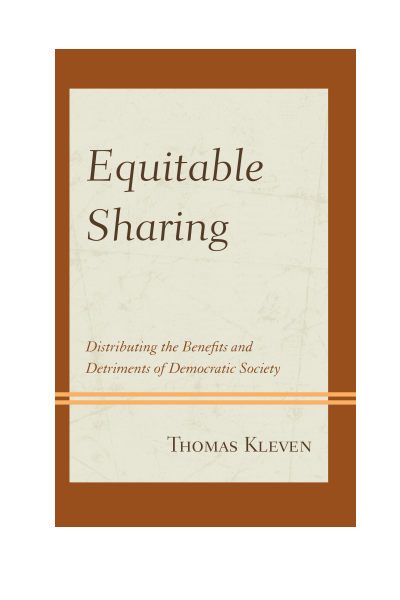
Equitable Sharing
Distributing the Benefits and Detriments of Democratic Society
Authors:
Publisher:
2013
Summary
Equitable Sharing: Distributing the Benefits and Detriments of Democratic Society argues that a principle of equitable sharing—one that requires the benefits and detriments of social life to be fairly distributed among all members of society—is fundamental to the concept of democracy and is implicit in the founding documents of the democratic society the United State purports to be. To illustrate the centrality of equitable sharing to democracy, this book examines the political philosophies of John Locke, John Stuart Mill, and John Rawls. Locke’s libertarianism, Mill’s utilitarianism, and Rawls’ egalitarianism represent major strains of Western democratic theory, and all contain a principle of equitable sharing in some form. To illustrate the centrality of equitable sharing to U.S. society, the book examines the Declaration of Independence and the Constitution. While these documents do not set forth a particular version of equitable sharing, they contain elements of all of Locke’s, Mill’s and Rawls’ philosophies and evidence a commitment to equitable sharing as fundamental to the democratic society they contemplate.
The task of U.S. society throughout its existence has been to engage in an on-going dialogue that gives life to the commitment to equitable sharing set forth in its founding documents. As the elected representatives of the people and the repository of the powers through which to implement much of what equitable sharing requires, the primary responsibility for implementation rests with the legislative branch. This book argues that the Supreme Court, interacting with the public and the legislature, also has a meaningful role to play in the dialogue over the requirements of equitable sharing and can play this role in a manner consistent with democratic principles. This point is illustrated through a discussion of several contemporary issues: same sex marriage, racial integration in public schools, health care, and the regulation of the electoral process.
Keywords
Search publication
Bibliographic data
Edition
1/2013
Copyright Year
2013
ISBN-Print
978-0-7391-8436-3
ISBN-Online
978-0-7391-8437-0
Publisher
Lexington, Lanham
Language
English
Pages
237
Product Type
Monograph
Table of contents
ChapterPages
Contents No access
Introduction No access Pages 1 - 6
Chapter One: Equitable Sharing and Democratic Theory No access Pages 7 - 30
Chapter Two: Equitable Sharing and the American Ideal No access Pages 31 - 66
Chapter Three: Equitable Sharing in Practice No access Pages 67 - 94
Chapter Four: Equitable Sharing and the Supreme Court No access Pages 95 - 130
Chapter Five: Equitable Sharing and Same Sex Marriage No access Pages 131 - 142
Chapter Six: Equitable Sharing and School Integration No access Pages 143 - 158
Chapter Seven: Equitable Sharing and the Electoral Process No access Pages 159 - 174
Chapter Eight: Equitable Sharing and States’ Rights No access Pages 175 - 206
Conclusion No access Pages 207 - 210
Selected Bibliography No access Pages 211 - 226
Table of Cases No access Pages 227 - 230
Index No access Pages 231 - 236
About the Author No access Pages 237 - 237
Similar publications
from the topics "Recht allgemein, Übergreifende Werke und Sammlungen"