, to see if you have full access to this publication.
Monograph No access
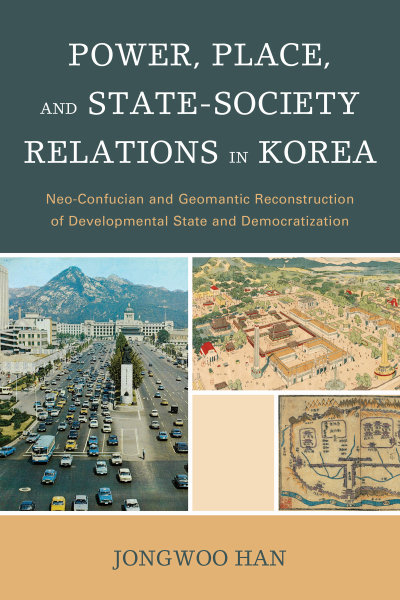
Power, Place, and State-Society Relations in Korea
Neo-Confucian and Geomantic Reconstruction of Developmental State and Democratization
Authors:
Publisher:
2013
Summary
No book has addressed the simultaneous phenomena of Korea’s rapid economic development and its vibrant democratization in a single coherent paradigm. The late developmentalist approach emphasizes the strong role of Korea’s state and bureaucratic efficiency but does not explain how political development was concurrent with the economic miracles in the Han River; modernization and dependence theories also fail to explain the aspect of simultaneity in this phenomenon. What these three theories commonly miss is the unique relationship between state and society in Korea’s long history of political culture. In this book, Jongwoo Han takes a holistic approach to understanding these phenomena by examining the state’s role in the unprecedented economic development and society’s capabilities to resist the state’s centralized power.
Han re-articulates state-society relations through Onuf’s social constructivist approach based on three rules of a political community: hegemony, hierarchy, and heteronomy. This book expands upon this effort to re-construct the state and society relations in two ways. First, it produces case studies of the capital city of Hanyang (Joseon Dynasty from 1392 to 1910), Kyeongseong (Japanese colonial control from 1910 to 1945), and Seoul (1945-current). The capital city is analyzed as a container for the major ideologies and ways of thinking that have shaped three important political eras. Second, i adopts two indigenous thoughts, Neo-Confucianism and geomancy, as sources of the main political and cultural ideologies that shape Korea’s state and society relations. These sources have never been treated as units of political analysis. This book finds that both Neo-Confucianism and geomancy, over two periods of Hanyang and Kyeongseong, are two main contributing factors of the emergence of the developmental state and vibrant democracy in Korea in the Seoul era.
Keywords
Search publication
Bibliographic data
Edition
1/2013
Copyright Year
2013
ISBN-Print
978-0-7391-7554-5
ISBN-Online
978-0-7391-7555-2
Publisher
Lexington, Lanham
Language
English
Pages
414
Product Type
Monograph
Table of contents
ChapterPages
Contents No access
List of Tables, Diagrams, Maps, and Figures No access
Acknowledgements No access
Chapter One: Introduction No access Pages 1 - 48
Chapter Two: Indigenous Model for State Hegemony: Neo-Confucianism, Power, and Place No access Pages 49 - 128
Chapter Three: The Hanyang Prototype of Hegemony, Hierarchy, and Heteronomy No access Pages 129 - 196