, to see if you have full access to this publication.
Monograph No access
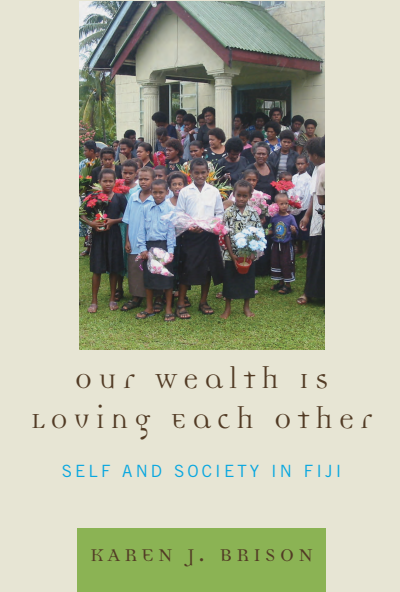
Our Wealth Is Loving Each Other
Self and Society in Fiji
Authors:
Publisher:
2007
Summary
Our Wealth Is Loving Each Other explores the fluid and context-bound nature of cultural and personal identity among indigenous Fijians. While national identity in Fiji is often defined in opposition to the West through reference to a romanticized pre-modern tradition, individual Fijians are often more concerned with defining their identity vis-à-vis other villagers and other groups within Fiji. When people craft self accounts to justify their position within the indigenous Fijian community they question and redefine both tradition and modernity. Modernity on the margins is an experience of anxiety provoking contradictions between competing ideologies, and between international ideologies and local experiences. Indigenous Fijians have been exposed to international ideologies and government programs extolling the virtues of "pre-modern" communities that place communal good and time honored tradition over individual gain. But other waves of policy and rhetoric have stressed individual achievement and the need to "shake" individuals out of community bonds to foster economic development. Individuals feel contradictory pressures to be autonomous, achieving individuals and to subordinate self to community and tradition. Brison examines traditional kava ceremonies, evangelical church rhetoric, and individual life history narratives, to show how individuals draw on a repertoire of narratives from local and international culture to define their identity and sense of self. Our Wealth is Loving Each Other is appropriate for upper level students and anyone with an interest in Fiji or anthropology.
Keywords
Search publication
Bibliographic data
Edition
1/2007
Copyright Year
2007
ISBN-Print
978-0-7391-1488-9
ISBN-Online
978-0-7391-3126-8
Publisher
Lexington, Lanham
Language
English
Pages
152
Product Type
Monograph
Table of contents
ChapterPages
Contents No access
Preface No access
1 Introduction: Self and Society in Fiji No access Pages 1 - 14
2 Defining the Community Through Ceremony No access Pages 15 - 40
3 Constructing Self and Community Through Religious Discourse No access Pages 41 - 66
4 Re-Imagining Sociocentrism No access Pages 67 - 94
5 Imagining Modernity in Rakiraki No access Pages 95 - 108
6 Crafting a Community No access Pages 109 - 118
7 Imagining Identity Among Rakiraki Children No access Pages 119 - 134
Conclusion: Identity in a "Postcultural" World No access Pages 135 - 140