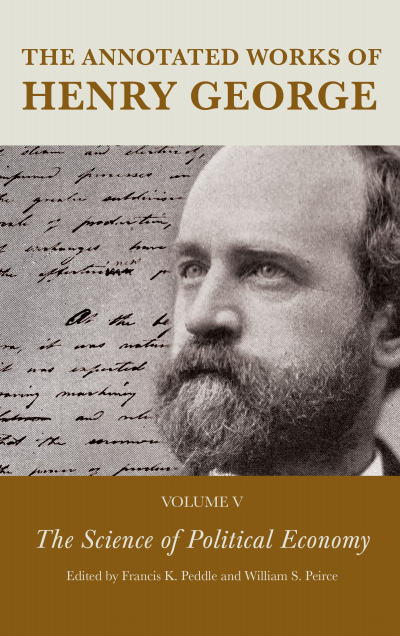
The Annotated Works of Henry George
The Science of Political Economy- Editors:
- |
- Publisher:
- 2022
Summary
Henry George (1839–1897) rose to fame as a social reformer and economist amid the industrial and intellectual turbulence of the late nineteenth century. His best-selling Progress and Poverty (1879) captures the ravages of privileged monopolies and the woes of industrialization in a language of eloquent indignation. His reform agenda resonates as powerfully today as it did in the Gilded Age, and his impassioned prose and compelling thought inspired such diverse figures as Leo Tolstoy, John Dewey, Sun Yat-Sen, Winston Churchill, and Albert Einstein. This six-volume edition of The Annotated Works of Henry George assembles all his major works for the first time with new introductions, critical annotations, extensive bibliographical material, and comprehensive indexing to provide a wealth of resources for scholars and reformers.
Volume V of this series presents the unabridged and posthumously published text of The Science Political Economy (1898). George’s original text is comprehensively supplemented by annotations which explain his many references to other political economists and writers both well known and obscure. A new index augments accessibility to the text, the critical annotations, and their key terms. The introductory essay by Professor Francis K. Peddle, “Political Economy and the Satisfactions of Wealth,” provides the historical, economic, and primarily philosophical context for George’s debates with the prominent political economists and thinkers of his time.
Henry George, in history books and documentaries, is generally portrayed as a prominent reformer in the Gilded Age, one who ushered in with others the social and economic advances of the Progressive Era in the period from the 1890s to the 1920s. The Science of Political Economy reveals George to be one of the most original and systematic architects of political economy, and its developing self-image as a science, in the nineteenth century, along with David Ricardo, John Stuart Mill, and Alfred Marshall.
Henry George wrote The Science of Political Economy in order to correct the many confusions and myths about the nature and definition of wealth, value, and money, as well as the essential assumptions behind efficient production and the moral basis of the distribution of wealth. He defined political economy as the science that treats of the nature of wealth, and of the laws of production and distribution. It is not, for him, a science of human psychology or the twists and turns of political life. George’s constructive critiques of previous political economists led to fresh insights about the meaning and the limitations of political economy, about the intriguing relation between wealth and value, and about how the proper distribution of wealth in society ought to be understood as a function of the cooperative character of civilization. Volume V of The Annotated Works of Henry George presents the culmination of his life’s work and thought.
Keywords
Search publication
Bibliographic data
- Edition
- 1/2022
- Copyright Year
- 2022
- ISBN-Print
- 978-1-68393-338-0
- ISBN-Online
- 978-1-68393-339-7
- Publisher
- Lexington, Lanham
- Language
- English
- Pages
- 568
- Product Type
- Edited Book
Table of contents
- Contents No access
- Preface No access
- Introduction No access Pages 1 - 57
- Prefatory Note to the Original Edition / 1898 No access Pages 58 - 59
- Preface to the Original Edition / 1894 No access Pages 60 - 61
- General Contents. No access Pages 62 - 81
- General Introduction. No access Pages 82 - 88
- Contents of Book I. No access
- Introduction to Book I. No access
- I. The Three Factors of the World. No access
- II. Man, His Place and Powers. No access
- III. How Man’s Powers Are Extended. No access
- IV. Civilization—What It Means. No access
- V. The Origin and Genesis of Civilization. No access
- VI. Of Knowledge and the Growth of Knowledge. No access
- VII. Of Sequence, Consequence and Laws of Nature. No access
- VIII. Of the Knowledge Properly Called Science. No access
- IX. The Economy Called Political Economy. No access
- X. The Elements of Political Economy. No access
- XI. Of Desires and Satisfactions. No access
- XII. The Fundamental Law of Political Economy. No access
- XIII. Methods of Political Economy. No access
- XIV. Political Economy as Science and as Art. No access
- Contents of Book II. No access
- Introduction to Book II. No access
- I. Confusions as to the Meaning of Wealth. No access
- II. Causes of Confusion as to the Meaning of Wealth. No access
- III. What Adam Smith Meant by Wealth. No access
- IV. The French Physiocrats. No access
- V. Adam Smith and the Physiocrats. No access
- VI. Smith’s Influence on Political Economy. No access
- VII. Ineffectual Gropings toward a Determination of Wealth. No access
- VIII. Breakdown of Scholastic Political Economy. No access
- IX. Wealth and Value. No access
- X. Value in Use and Value Exchange. No access
- XI. Economic Value—Its Real Meaning and Final Measure. No access
- XII. Value in Exchange Really Related to Labor. No access
- XIII. The Denominator of Value. No access
- XIV. The Two Sources of Value. No access
- XV. The Meaning of Wealth in Political Economy. No access
- XVI. The Genesis of Wealth. No access
- XVII. The Wealth that Is Called Capital. No access
- XVIII. Why Political Economy Considers Only Wealth. No access
- XIX. Moral Confusions as To Wealth. No access
- XX. Of the Permanence of Wealth. No access
- XXI. The Relation of Money to Wealth. No access
- Contents of Book III. No access
- I. The Meaning of Production. No access
- II. The Three Modes of Production. No access
- III. Population and Subsistence. No access
- IV. The Alleged Law of Diminishing Returns in Agriculture. No access
- V. Of Space and Time. No access
- VI. Confusion of the Spacial Law with Agriculture. No access
- VII. The Relation of Space in Production. No access
- VIII. The Relation of Time in Production. No access
- IX. Coöperation—Its Two Ways. No access
- X. Coöperation—Its Two Kinds. No access
- XI. The Office of Exchange in Production. No access
- XII. Office of Competition in Production. No access
- XIII. Of Demand and Supply in Production. No access
- XIV. Order of the Three Factors of Production. No access
- XV. The First Factor of Production—Land. No access
- XVI. The Second Factor of Production—Labor. No access
- XVII. The Third Factor of Production—Capital. No access
- Contents of Book IV. No access
- Introduction to Book IV. No access
- I. The Meaning of Distribution. No access
- II. The Nature of Distribution. No access
- III. The Common Perception of Natural Law in Distribution. No access
- IV. The Real Difference Between Laws of Production and of Distribution. No access
- V. Of Property. No access
- VI. Cause of Confusion as to Property. No access
- Contents of Book V. No access
- Introduction to Book V. No access
- I. Confusions as to Money. No access
- II. The Common Understanding of Money. No access
- III. Medium of Exchange and Measure of Value. No access
- IV. The Office of Credit in Exchanges. No access
- V. The Genesis of Money. No access
- VI. Two Kinds of Money. No access
- Appendix No access Pages 536 - 550
- Index No access Pages 551 - 566
- About the Contributors No access Pages 567 - 568