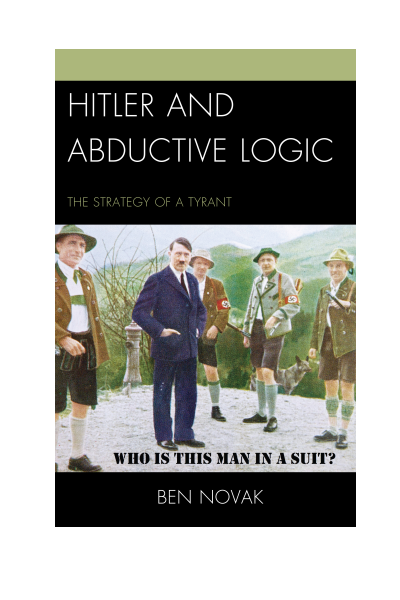
Hitler and Abductive Logic
The Strategy of a Tyrant- Authors:
- Publisher:
- 2014
Summary
Adolf Hitler is the greatest mystery of the 20th century, and the mystery surrounding him consists of two unanswered questions that have baffled biographers and historians. First, how did he ever rise to power? Second, who was he really?
Hitler had the power to mesmerize crowds as the most dynamic orator of the modern age. Yet, his power was not in his ideas, which he collected from the gutter sheets of Vienna, nor was it in his personality; his biographers describe him as an "unperson" and his character as a "void" and a "black hole." What, then, was the source of his power? Was he a medium or a magician with paranormal powers, as many contemporaries thought? Or did he have a secret or method that has not yet been revealed?
Ben Novak spent fourteen years searching for the secret of Hitler's political success and his power as a speaker. Hitler's most astute contemporary observer, Konrad Heiden, who wrote the first objective books on Hitler warning that this man was "the greatest massdisturber in world history," suggested that Hitler's secret lay in his use of "eine eigentiimliche art von Logik,"or a "peculiar form of logic." Beginning with this clue, Novak finds that there is a new form of logic in accordance with Heiden's description and examples that can explain Hitler's phenomenal political success. This new form of logic, called "abduction," was discovered by an American philosopher, Charles Sanders Peirce (1839-1914), who is rapidly becoming America's most well-known philosopher and logician.
Abduction is a third form of logic, in addition to deduction and induction. Unlike the other forms of logic, abduction is based on instinct and has a power over emotions. Novak argues that Hitler was the first politician to apply the logic of abduction to politics. This book provides the first coherent account of Hitler's youth that ties together all the known facts, clearly showing the genesis of the strangest and most terrible man of the twentieth century while identifying the power he discovered that allowed him to break out into the world in such a terrifying way.
Keywords
Search publication
Bibliographic data
- Edition
- 1/2014
- Copyright Year
- 2014
- ISBN-Print
- 978-0-7391-9224-5
- ISBN-Online
- 978-0-7391-9225-2
- Publisher
- Lexington, Lanham
- Language
- English
- Pages
- 247
- Product Type
- Monograph
Table of contents
- Contents No access
- Insufficient Facts No access
- Opportunist No access
- Demagogue No access
- Pawn No access
- Intellectual Currents No access
- Economic, Political, and Social Conditions No access
- Mediumistic Powers No access
- Psychological Interpretations No access
- Other Interpretations No access
- The Historical Problem No access
- Conclusions Drawn from Review of the Literature No access
- The Question So Far Not Investigated No access
- METHOD No access
- Notes No access
- THE WORM IN THE APPLE OF SCIENCE No access
- THE DISCOVERY OF A THIRD FORM OF LOGIC No access
- THE NATURE OF ABDUCTION No access
- THE FORMAL STRUCTURE OF ABDUCTION No access
- THE SIGNIFICANCE OF THE FORMAL STRUCTURE OF ABDUCTION TO THE RISE OF ADOLF HITLER: HOW HE EMPLOYED ABDUCTIVE LOGIC No access
- Notes No access
- Certainty and Uncertainty No access
- The Initial Immunity of Abduction to Refutation No access
- Mendaciousness No access
- Ampliativity No access
- Instinct No access
- The Divinatory Power of Abduction No access
- The Power of Abductive Logic over the Mind No access
- CONCLUSION No access
- Notes No access
- THE DISCOVERY OF ABDUCTION IN LITERATURE No access
- The Uniqueness of the Detective Story No access
- Ratiocinative Man No access
- The Character of the First Detective Hero: C. Auguste Dupin No access
- The Character of the Most Popular Hero: Sherlock Holmes No access
- THE POWER OF ABDUCTIVE LOGIC IN DETECTIVE STORIES No access
- Summary No access
- Voltaire’s “The Tale of Zadig” No access
- Thomas Henry Huxley on “The Method of Zadig” No access
- Karl May No access
- Winnetou: A Textbook on Abductive Logic No access
- The Plot of Winnetou No access
- The Logic of the Novel No access
- SUMMARY No access
- Notes No access
- THE UNDISPUTED FACTS OF HITLER’S TRANSFORMATION IN 1900, AT AGE ELEVEN No access
- THE BAFFLEMENT OF SCHOLARS AT THE TWO MYSTERIES ARISING FROM HITLER’S TRANSFORMATION No access
- THE NEED FOR A NEW APPROACH AND A NEW LOGIC TO UNRAVEL THE MYSTERY OF HITLER’S YOUTH No access
- CRITIQUE OF THE ESTABLISHED METHOD OF HISTORICAL INVESTIGATION No access
- Peirce’s Conditions For The Application Of The New Logical Method No access
- Presentation Of Peirce’s Logic No access
- First Rule: Explain All the Facts No access
- Second Rule: Assume the Principal Testimonies Are True No access
- Third Rule: Be Careful of Probabilities No access
- Fourth Rule: Trace Out the Logical Consequences of the Hypothesis No access
- Fifth Rule: Enlarging the Field No access
- Sixth Rule: Economy No access
- Testing the Hypothesis Selected No access
- First Clue: The Unusual Nature of Hitler’s Dispute with His Father at That Age No access
- Second Clue: An Already Formed Attitude toward Work No access
- Third Clue: The Existence of an Antecedent Idea No access
- Fourth Clue: The Decision about Which School to Attend No access
- A First Hypothesis No access
- Second Hypothesis: The Source of the Young Hitler’s Identification of His Own Fate with the German People No access
- Examining the Second Principal Testimony: Hitler’s Headmaster, Dr. Eduard Huemer No access
- Summary of Hypotheses No access
- Notes No access
- HITLER WAS A BORN GENIUS No access
- HITLER’S ANECDOTE No access
- HITLER BEGINS THINKING ABOUT A FUTURE CAREER (1897) No access
- HITLER DISCOVERS A BOOK ON WAR (1898) No access
- GREATNESS REPRIEVED: THE BOER WAR BREAKS OUT (1899) No access
- THE GREATNESS OF WAR REFLECTS ON HITLER’S FATHER No access
- SCHOOL AS REINFORCEMENT (1897–1900) No access
- DISTINGUISHING THE NATURE AND LOGIC OF HITLER’S EARLY GENIUS No access
- HITLER’S FIRST IDEALS No access
- THE GREAT MAN DOES NOT WORK No access
- HITLER’S CONFLICT WITH HIS FATHER (SPRING 1900) No access
- HITLER’S FATHER MISJUDGES HIM No access
- HITLER’S FATHER WANTS HIS SON TO BE A CIVIL SERVANT No access
- FURIOUS ARGUMENTS No access
- ADOLF ENTERS REALSCHULE (SEPTEMBER 1900) No access
- How Hitler Resolves the First Dilemma: What to do about his Classmates? No access
- Hitler Resolves the Second Dilemma: What to Do about the Argument with His Father No access
- A New Factor Enters the Picture: Hitler Discovers Karl May No access
- Karl May’s Lifelong Influence on Hitler No access
- Karl May’s Influence on What to Do about School No access
- Karl May Comes to Linz No access
- How Hitler’s Decision to Become an Artist Fits in with His Previous Ideas No access
- THE SON’S REBELLION No access
- Notes No access
- ADOLF’S IDEA OF GREATNESS No access
- THE LOGIC OF GREATNESS No access
- THE MEANING OF HISTORY No access
- THE BACKWARD NATURE OF HITLER’S THOUGHT No access
- THE INFLUENCE OF KARL MAY No access
- IN THAT HOUR IT BEGAN No access
- NOTE ON THE CREDIBILITY OF KUBIZEK’S MEMOIRS No access
- Notes No access
- Background of Hitler’s Decision to Charge Admission No access
- Consequences of Charging Admission to Meetings No access
- SECOND EXAMPLE: HITLER’S IDEA OF THE FUNCTION OF A PARTY PROGRAM No access
- Background No access
- Hitler Organizes the Membership No access
- FOURTH EXAMPLE: HITLER FORBIDS ANY PHOTOGRAPHS OF HIMSELF No access
- CONCLUSION No access
- Notes No access
- BIBLIOGRAPHY OF REFERENCES CITED No access Pages 235 - 242
- Index No access Pages 243 - 246
- About the Author No access Pages 247 - 247