, to see if you have full access to this publication.
Edited Book No access
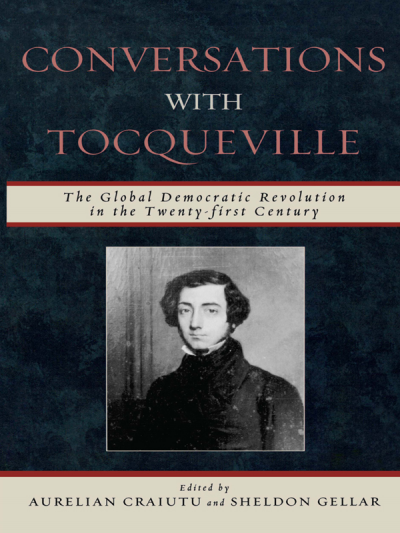
Conversations with Tocqueville
The Global Democratic Revolution in the Twenty-first Century
Editors:
|
Publisher:
2009
Summary
The questions and issues raised by Tocqueville in his monumental studies of France and America are just as crucial for understanding the evolution of democracy in the West and the development of democracy in the non-western world. They clearly show the breadth of Tocqueville's contributions to the development of modern social sciences. Among the questions addressed by Tocqueville were: How does the weight of the past affect the evolution of political institutions and political behavior? What impact do differences in physical environment have on the organization of society? What are the relationships between social equality, freedom, and democracy? To what extent does centralization destroy the capacity for local initiative and self-governance? What conditions are needed to nurture the flourishing of self-governing communities? What safeguards are needed to preserve freedom and to prevent incipient democracies from becoming dictatorships? Why has democracy had such a problem taking hold in many parts of the non-western world? How should one study democracy in non-western settings? Tocquevillian analytics can help us provide answers. Addressed to a wider audience than Tocqueville scholars, the book argues that Tocquevillian analytics can be used to understand developments in non-western as well as western societies and be updated to address such issues as globalization, ethnicity, New World-Old World comparisons, and East-West dynamics. The first part of the book examines the basic components of Tocquevillian analytics, outlining its stepwise, interdisciplinary approach to understanding societies and nations. The second part applies the Tocquevillian conceptual framework to the contemporary world and contains individual chapters on various regions of the worldDNorth America, Russia, Western Europe, Asia, Africa, and Latin America. Unlike previous collective works on Tocqueville,Conversations with Tocqueville does not offer a survey of the authors' views, but instead focuses on presenting a cohesive theoretical framework of analysis that can then be applied and adjusted to fit a multitude of settings.
Search publication
Bibliographic data
Edition
1/2009
Copyright Year
2009
ISBN-Print
978-0-7391-2301-0
ISBN-Online
978-1-4616-3324-2
Publisher
Lexington, Lanham
Language
English
Pages
337
Product Type
Edited Book
Table of contents
ChapterPages
Contents No access
Preface No access
Acknowledgments No access
1 Tocqueville and Us Aurelian Craiutu and Sheldon Gellar No access Pages 1 - 18
2 Citizen-Sovereigns: The Implications of Hamilton's Query and Tocqueville's Conjecture about the Democratic Revolution Vincent Ostrom No access Pages 19 - 30
3 Tocquevillian Analytics and the Global Democratic Revolution Sheldon Gellar No access
4 What Kind of Social Scientist Was Tocqueville? Aurelian Craiutu No access
5 Racial Equality and Social Equality: Understanding Tocqueville's Democratic Revolution and the American Civil Rights Movement, 1954–1970 Barbara Allen No access
6 Democracy? In Guatemala? Charles A. Reilly No access
7 Grafting the Head of Liberty? Latin America's Move to the Left Gustavo Gordillo de Anda and Krister Andersson No access
8 The Peril of Democratic Despotism in West European Egalitarian Democracy Frederic Fransen No access
9 Democracy in Russia: A Tocquevillian Perspective Peter Rutland No access
10 Tocqueville in Africa: Analyzing African Local Governance James S. Wunsch No access
11 Roots of Democracy in Burma Tun Myint No access
12 The Road to Democracy in China: A Tocquevillian Analysis Jianxun Wang No access
13 Tocqueville and Japan Reiji Matsumoto No access